Trumpian Kitsch: McNaughton's 'Maga Symphony' Painting Sparks Debate on Orchestras and Power
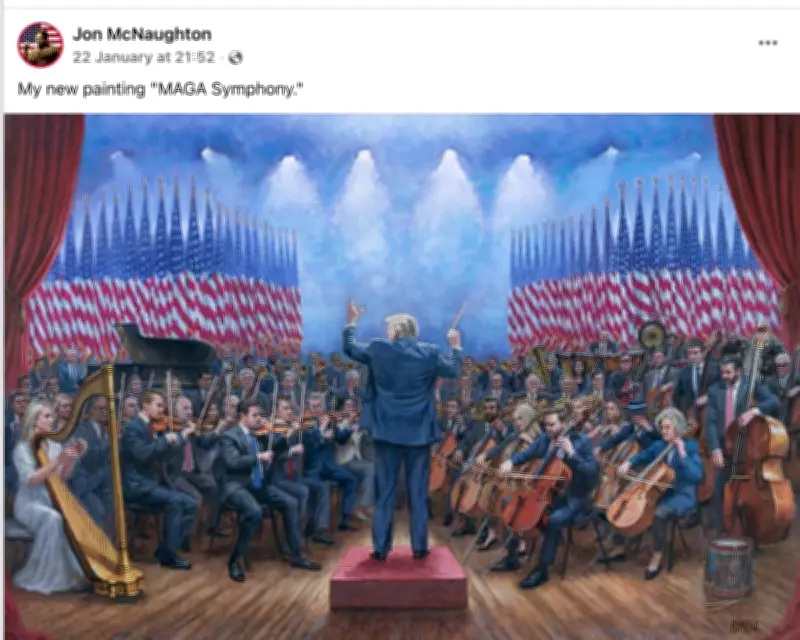
In a striking blend of art and politics, Jon McNaughton has unveiled his latest painting, Maga Symphony, shared via a Facebook post that has quickly captured attention. The artwork presents a fever dream of musical unity, with Donald Trump portrayed as the conductor of an orchestra composed of prominent political and cultural figures, aiming to "Make the Orchestra Great Again." This piece not only delves into Trumpian aesthetics but also fundamentally misunderstands the dynamics of orchestras and conductors, raising questions about artistic representation and societal ideals.
The Composition of a Political Orchestra
McNaughton's painting features a detailed lineup of musicians, each assigned to an instrument that symbolizes their role in this political narrative. Marco Rubio leads the violins, while JD Vance takes up the cello, with Melania Trump relegated to the second desk. The double basses are manned by Trump's sons and Roger Stone, forming the ideological foundation of the orchestra's sound. A curiously configured woodwind and brass section includes four flutes and no oboes, and notably, no violas—perhaps hinting at their perceived political affiliations. Tom Homan appears on horn, and Tucker Carlson cheerleads on the cymbals, with Elon Musk adding an unconventional twist on electric guitar, described as the joker in this orchestral pack.
As McNaughton describes the image, "you can feel it—the music is coming together—rising and stirring something deep inside … When Americans pull together and trust a shared vision, they create something strong, lasting, and bigger than any one person." This statement underscores the cultural trope the painting promotes: the all-powerful conductor inspiring total command and obedience, a concept historically linked to dictators like Hitler, Stalin, and Mussolini.

Orchestras as Symbols of Autocracy and Society
The idea of orchestras representing an ideal society has long fascinated those in power, as noted by Elias Canetti in Crowds and Power, where he writes, "There is no more obvious expression of power than the performance of a conductor … He has the power of life and death over the voices of the instruments." McNaughton's work takes this further by omitting music stands, suggesting the musicians perform through Trumpian telepathy, turning the scene into a political seance rather than a symphony.
This notion isn't confined to political art; it resonates in broader contexts, such as apologists for Venezuela's El Sistema or UK orchestral leaders who argue that if society functioned like an orchestra, with individuals sacrificing for the collective good, our lives would improve. However, this perspective is deeply problematic, as it overlooks the inherent tensions and chaos that define real orchestral performances.
The Reality of Orchestral Dynamics
Contrary to the image of perfect harmony, orchestras thrive on the balance between individual will and collective contribution. The best ensembles are not well-oiled machines but models of controlled chaos, where human emotions, desires, and virtuosities interact in a state of flux and creative negotiation. In such settings, the conductor isn't a despotic ruler but an inspirer who fosters a dynamic culture, encouraging musicians to listen and respond to each other in real-time.
McNaughton's painting, while comic, reinstates outdated populist shorthands for autocracy, ignoring the nuanced realities of musical collaboration. As the Association of British Orchestras convenes its annual conference in London this week, it may inspire a more genuine collective vision for the future, or perhaps, in a twist of irony, an orchestra might consider Trump as a music director—stranger things have happened in the world of arts and politics.
This discussion highlights how art can reflect and distort societal ideals, prompting reflection on the role of music in shaping cultural narratives. As events unfold, the interplay between politics and the arts continues to reveal new dimensions, challenging our perceptions of unity and power.