Scottish Opera's 'The Great Wave' Brings Hokusai's Epic Life to the Stage
Scottish Opera has ventured into largely uncharted territory with its new production, The Great Wave, which takes as its subject matter one of the world's most recognisable artworks. The iconic woodblock print, often seen on fridge magnets and phone cases, serves as the inspiration for an opera that delves into the wild and fascinating life of its creator, Katsushika Hokusai.
An Artist's Resilient Journey
Hokusai, born in 1760 in Edo (modern-day Tokyo), lived an extraordinarily eventful life, surviving a lightning strike, a stroke, and a devastating studio fire. His prolific output included approximately 30,000 works, from paintings and sketches to the famous Thirty-Six Views of Mount Fuji series, which features Under the Wave off Kanagawa – the print commonly known as The Great Wave. This image, with its cascading foam and menacing undertow, centres on Mount Fuji, revered as a deity in Hokusai's time.
A Non-Linear Narrative Approach
The opera, composed by Dai Fujikura with a libretto by Harry Ross, eschews a chronological structure, beginning instead with Hokusai's funeral. Ross explains that this non-linear approach aligns with an eastern worldview, contrasting with western teleological perspectives. The narrative thread weaving through the five acts is Hokusai's profound relationship with his daughter, Ōi, also a significant artist. Ōi, who divorced her husband due to his lack of artistic success, returned to her father's studio, a decision that fascinated the creators for its rarity in that era.

Cross-Cultural Collaboration and Musical Innovation
Fujikura, who grew up in Japan with western musical training, incorporated the shakuhachi, a traditional Japanese flute, to transport listeners into another realm. The instrument's breathy sound features in the opening and closing scenes, interpreted by director Satoshi Miyagi as the voice of Hokusai resonating in his daughter's mind. The opera also includes a scene with German botanist Dr Philipp Franz von Siebold, a countertenor role reflecting the strangeness of western faces in sakoku-era Japan, where the country was largely closed to foreigners.
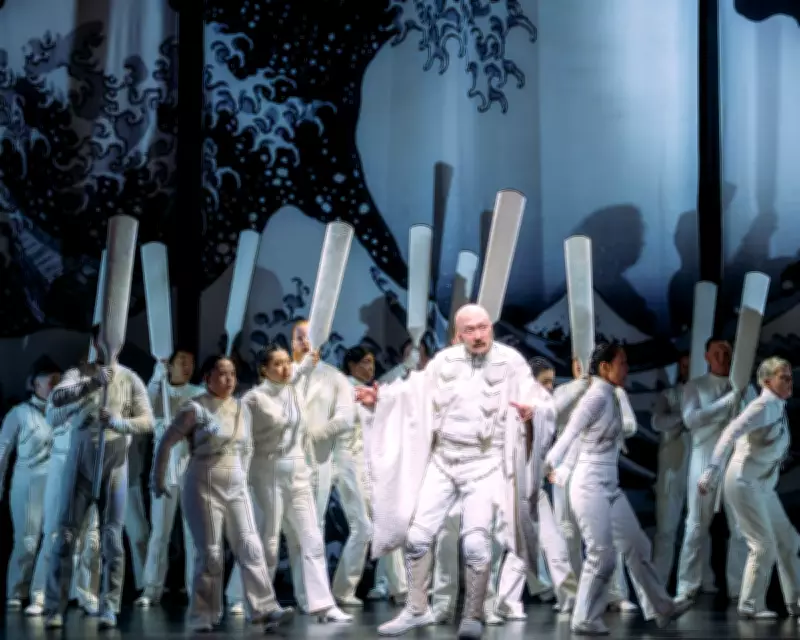
Fujikura used a blend of timbres, including natural harmonic trills and vibraphone, to musically represent the Prussian Blue pigment that enabled Hokusai's vibrant colours. The production, supported by Japanese government agencies, involves a team of Japanese designers and choreographers, with plans to transfer to Tokyo and Kyoto in 2027. Scenographer Junpei Kiz introduced the wave image in monochrome before revealing its full colour spectrum, addressing the challenge of depicting such an iconic piece.
Universal Themes and Contemporary Resonance
Ross and Fujikura emphasise the universal message of Hokusai's story, highlighting his resourcefulness and constant reinvention – qualities they see as highly relevant for today's artists. Ross notes, "He's quite contemporary – we have this notion of the Romantic artist who's always struggling, but in the 21st century we're more like Hokusai – we must change to stay the same." Fujikura adds, "He shows such strong energy, just to be an artist, a better artist. Nonstop creativity – that's something I absolutely love about this person."
The Great Wave will be performed at Theatre Royal Glasgow on 12 and 14 February, and at Festival Theatre Edinburgh on 19 and 21 February, offering audiences a unique fusion of visual art, music, and cross-cultural storytelling.