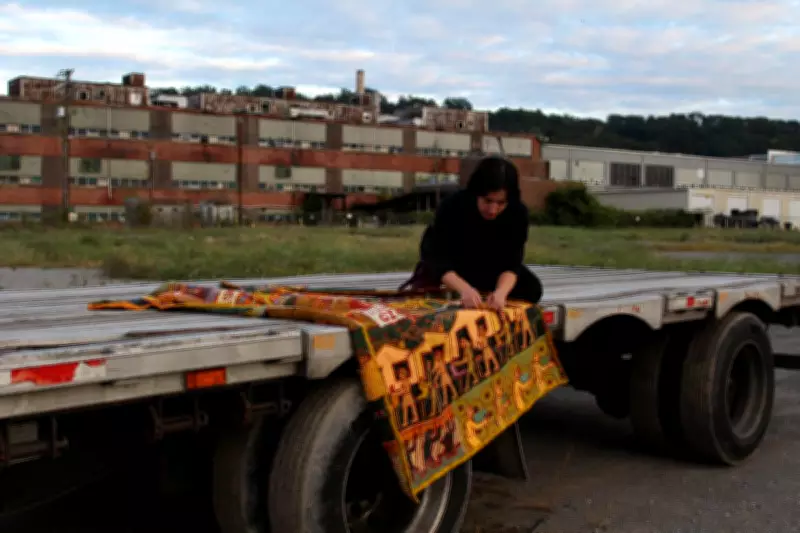
Tabitha Arnold's Tapestries Chronicle the Heartbeat of the US Labor Movement
When Tabitha Arnold unveiled her exhibition, Gospel of the Working Class, in New York City last autumn, the crowd defied typical gallery expectations. Instead of affluent art patrons, the space brimmed with young attendees adorned with Zohran Mamdani pins, Democratic Socialists of America hats, and SEIU T-shirts. This audience felt perfectly at home amidst Arnold's monumental handmade tapestries, which vividly portray working-class struggles from historical and contemporary perspectives.
Art as a Mirror for Organizers and Workers
Arnold, a socialist and labor organizer based in Chattanooga, Tennessee, dedicates her craft to reflecting and inspiring those within the labor movement. In a cultural landscape often dominated by tales of extreme wealth, her work spotlights the 99%, earning her prestigious accolades like the 2025 Southern Prize for visual art and a 2023 MacDowell fellowship. "I think of my work as being for labor organizers," Arnold explained. "I see it as a source of encouragement, reflecting and validating what they're doing back to them."
Her journey into labor politics began during her art studies in Philadelphia in the late 2010s, while working as a barista. Discovering wage disparities through a transparency spreadsheet sparked her involvement in a union drive, though pandemic layoffs halted the effort. This experience profoundly shaped her artistic vision, teaching her the often tedious, thankless nature of organizing work, which she seeks to capture in her tapestries.

Historical Context and Textile Traditions
Julia Bryan-Wilson, a professor of art history and archaeology at Columbia University, emphasizes art's "vital role" in social movements. She cites examples like Russian constructivism and Chilean guerrilla graffiti, noting how artists have historically used their mediums to communicate with marginalized groups. Arnold draws inspiration from muralist Diego Rivera and the Palestinian poster movement, aligning her work with a legacy of pro-labor imagery.
Bryan-Wilson also highlights the deep connection between textiles and radical politics, tracing back to the Industrial Revolution. "Textiles are uniquely suited to make comments about labor because textiles were at the heart of the Industrial Revolution and all of the many issues that arose with exploited bodies in systems of mass manufacturing," she stated. This tradition includes artists like Faith Ringgold and Hannah Ryggen, whose works address social justice themes through fabric.
A Tapestry That Resonates with Workers
Arnold's piece, These Hands, commemorates the Tennessee Volkswagen organizing efforts with the United Auto Workers. Featuring autoworkers on assembly lines intertwined with religious imagery from her Bible Belt roots, the tapestry took 224 hours to create. Initially nervous about presenting it at a union hall rally, Arnold was overwhelmed by positive feedback from workers. Caleb Michalski, a Volkswagen employee, expressed appreciation, saying, "I like how it artistically demonstrates how working people are the drivers of the economy. Things exist because we make them. [Elites] make billions of dollars because of our blood, our sweat, our tears."
Less than a month after the unveiling, Volkswagen Tennessee workers voted to join the UAW, marking a historic unionization in the South. Recently, they secured a tentative agreement with Volkswagen, including 20% wage increases and improved job security. Michalski, now on the bargaining committee, envisions Arnold's tapestry displayed prominently in a future union hall, offering ongoing inspiration.
The Enduring Impact of Art in Labor Movements
Arnold's work underscores the power of art to validate and uplift working-class experiences. As Michalski noted, "People feel seen and understood when they see themselves in an art piece. Otherwise, what they see subconsciously is that they're invisible and no one gives a damn about them." Through her tapestries, Arnold continues to weave narratives of struggle and solidarity, ensuring that the stories of laborers are not only told but celebrated for generations to come.