Names such as John, James, Elizabeth, and Mary once reigned supreme in classrooms and playgrounds across the United Kingdom. However, scientific research now indicates that these traditional favourites are facing a significant decline in popularity.
A Global Shift Towards Uniqueness
A groundbreaking new study demonstrates that parents are increasingly turning away from conventional names, instead seeking out the most distinctive and unusual options for their children. This trend is not confined to British shores; researchers have discovered that parents around the world are embracing a similar pattern of favouring unique names over traditional ones.
Scientific Insights into Naming Trends
Previous investigations have hinted at a growing inclination among parents to deliberately select names perceived as uncommon. However, these studies often focused on individual countries through narrow scientific perspectives. In contrast, Professor Yuji Ogihara from Aoyama Gakuin University conducted a comprehensive analysis by comparing historical naming data from multiple nations.

His research uncovered that unique names have become more prevalent in countries including Germany, the United States, France, Japan, China, and Indonesia. The manifestation of this quest for uniqueness varies by country, influenced by local naming conventions. For instance, Professor Ogihara notes that in Japan, greater emphasis is placed on how a name is read, whereas in China, the written form of the name holds more significance.
Despite these cultural nuances, the overarching trend remains consistent: fewer individuals share common popular names, while an increasing number receive unique or rare names. Professor Ogihara explained to the Daily Mail, 'One of the main reasons is that people seek more uniqueness and distinction from others.' He anticipates this trend will persist for the foreseeable future.
The Decline of Traditional Names in the UK
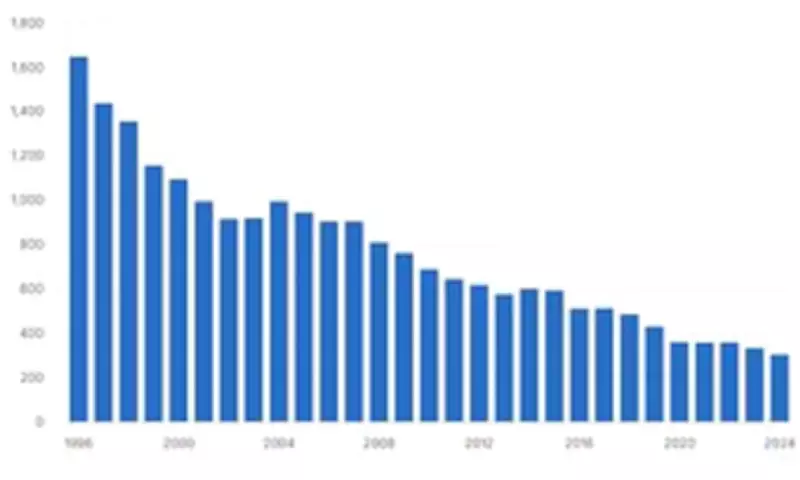
In the United Kingdom, one of the most noticeable outcomes of this shift is the gradual disappearance of names that were once extremely common. For example, the name Jack consistently topped the popularity charts for baby boys every year from 1996 to 2008. However, according to Office for National Statistics data from 2024, Jack has plummeted to 22nd place, with only 1,711 babies given the name. This represents a staggering decline of over 70 percent compared to a decade ago, marking the most significant fall among more than 6,000 boy names.
Similarly, the name Harry has experienced a sharp decrease, with 3,600 fewer babies named Harry, a 67 percent drop from the previous decade, now ranking 20th and continuing on a downward trajectory. The pattern extends to girls' names as well; for instance, the number of babies named Emily has fallen from 3,991 to 1,170, and those named Jessica have declined from 2,995 to just 483.
Rising Stars and Unique Variations
Concurrently, certain names are ascending the popularity charts. Arlo, an Old English term meaning 'fortified hill,' has seen a remarkable surge from 397 instances in 2014 to 2,220 in 2024, reflecting a total change of 1,823, or a 459 percent increase. This rise is accompanied by a notable uptick in the popularity of culturally and religiously specific names, such as Mohammed, Nabeel, and Iqra.
Nevertheless, research indicates that the UK's cultural diversity is not the primary driver behind this trend. A 2018 study by University of Oxford researchers found that changes in ethnic diversity alone could not account for the explosion in unique names. In the ONS dataset, approximately 65 percent of names were registered to fewer than 10 babies in a given year, while four percent of names appear only once in a 20-year period.
Short-Lived Trends and Creative Spellings
The study reveals that parents often follow fleeting baby naming trends, opting for a unique-sounding name until it becomes common enough to fall out of fashion. Frequently, this involves adding distinctive endings or alternative spellings to previously popular or 'old-fashioned' names. For example, researchers observed spikes in variations like Abagael in 1999, Abygayle in 2000, Abaigael in 2004, and Abbygael in 2013.

In 2016, names with alternative endings, such as Hollee, Holley, Holli, Hollie, and Holly, constituted 9.1 percent of all unique names. This creative approach to naming underscores the ongoing desire for individuality among parents.
Top Baby Names in England and Wales
The most popular baby names in England and Wales for 2024 highlight the current preferences. For girls, the top ten include Olivia with 2,761, Amelia with 2,448, Lily with 2,185, Isla with 2,056, Ivy with 1,956, Florence with 1,936, Freya with 1,929, Poppy with 1,888, Ava with 1,774, and Elsie with 1,727. For boys, the leading names are Muhammad with 5,721, Noah with 4,139, Oliver with 3,492, Arthur with 3,368, Leo with 3,324, George with 3,257, Luca with 2,814, Theodore with 2,761, Oscar with 2,747, and Archie with 2,575.
This evolving landscape of baby names reflects a broader cultural shift towards personal expression and uniqueness, as traditional monikers give way to more distinctive choices across the globe.