Axel Burrough: Architect of Iconic Cultural Spaces Passes at 79
Axel Burrough, the visionary architect behind Manchester's Royal Exchange theatre and the transformative restoration of St Luke's church for the London Symphony Orchestra, has died at the age of 79. His career was defined by a unique ability to fuse historic preservation with bold, modern interventions, leaving an indelible mark on Britain's cultural landscape.
The Royal Exchange: A Space-Age Marvel in Manchester
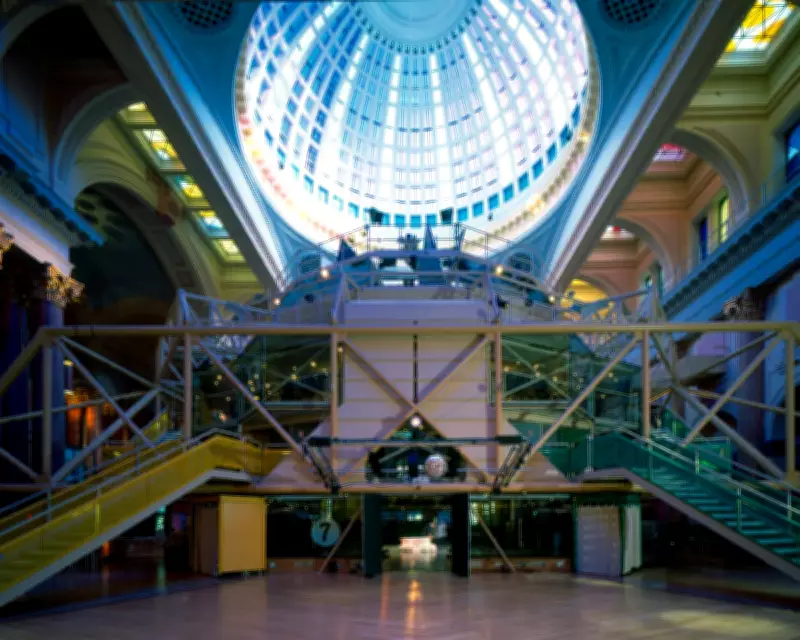
In 1976, the Royal Exchange theatre in Manchester opened its doors, a heptagonal theatre-in-the-round that represented a literal interpretation of the "space age" design trends inspired by the 1969 moon landing. Co-designed by Axel Burrough alongside David Levitt and Malcolm Brown at Levitt Bernstein Architects, this ultra-modern structure of tubular steel and glass was housed within the neo-classical confines of the historic Royal Exchange building. When the Exchange ceased trading in 1968, its grade two listed status posed challenges, but Burrough's team ingeniously created a "building-within-a-building," offering a striking contrast between old and new.
In an era before computerised design, Burrough relied on a Sinclair scientific calculator to work out the theatre's complex geometry, reportedly going through three devices during the project. Seating 750 people, all within 10 metres of the stage centre, the theatre was inaugurated by Laurence Olivier. Despite damage from the 1996 IRA bomb attack in Manchester, it remains a beloved landmark, recently voted the city's favourite building.

St Luke's Church: A Radical Restoration for the LSO
As a director at Levitt Bernstein, Burrough led the remodelling of St Luke's church in Old Street, London, transforming the 18th-century structure into a performance and rehearsal space for the London Symphony Orchestra. Originally designed by Nicholas Hawksmoor, the church had suffered from subsidence, with a dry summer in 1959 causing columns to hang from the roof. By 1996, it was roofless, with a collapsing crypt and vegetation growing through the walls, listed by English Heritage as one of England's most at-risk buildings.
Burrough saw opportunity in decay, stating, "It is a happy paradox that 40 years of dereliction and decay increased the potential for the radical reordering now on site." The restoration featured four massive steel columns supporting a new roof, independent of the original walls, creating a modern intervention that allowed the building's layered history to read like a palimpsest. When the LSO first performed there in January 2003, Burrough described it as "an emotional moment – the culmination of seven years' hard work."
A Career Defined by Creative Reuse and Collaboration
Born in Frenchay, near Bristol, in 1946, Burrough studied architecture at Cambridge University, joining Levitt Bernstein in 1968. He honed his skills on arts projects like the South Hill Park theatre in Bracknell and the Pier Arts Centre in Orkney. His expertise in theatre design led to commissions such as the refurbishment of the Theatre Royal in Bury St Edmunds, a Regency playhouse by William Wilkins.
Between 1996 and 2002, he served as a trustee of the Theatres Trust, the first architect on its board, and later on the board of the Almeida Theatre in Islington. His later work, boosted by National Lottery funding, included the King's Lynn Corn Exchange, the Victoria Gallery & Museum in Liverpool, and the Bristol Beacon concert hall, completed in 2023 with a new 2,200-capacity auditorium within 1867 walls.
Burrough consistently focused on reworking existing structures, from converting a burnt-out Victorian school into Birmingham's Ikon Gallery to turning an art deco cinema into the Regent theatre in Stoke-on-Trent. Collaboration was key, whether with acoustician Carl Giegold on St Luke's or artist Rana Begum on the Bristol Beacon's upholstery. He is survived by his wife, Jeni Walwin, three daughters, and two grandchildren.