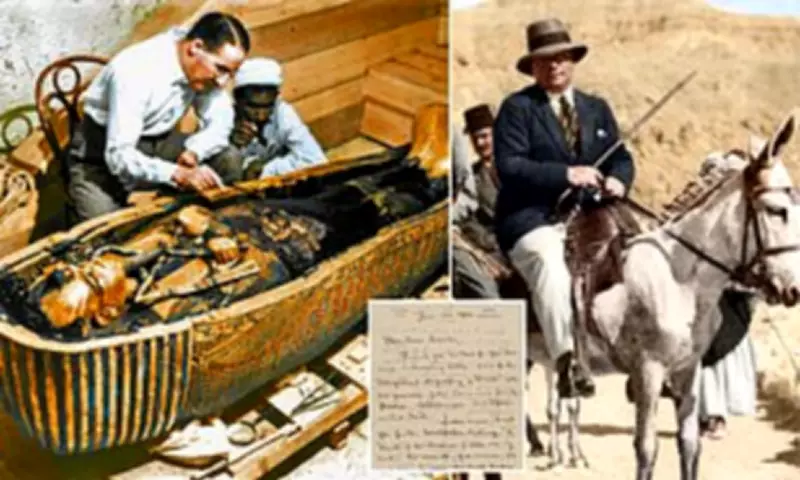
Archaeologist's Withering Letter Uncovered Nearly a Century Later
A scathing letter written by British archaeologist Howard Carter, celebrating the death of the Daily Mail journalist who invented the mythical 'Curse of Tutankhamun', has been uncovered nearly a century after it was penned. The remarkable document reveals Carter's deep resentment toward journalist Arthur Weigall, whose sensational theory about a pharaoh's curse gained worldwide prominence following the unexpected death of Lord Carnarvon.
The Origins of the Famous Curse
The British archaeologist, who discovered the pharaoh's tomb in Egypt's Valley of the Kings in 1922, states unequivocally in the letter that the curse 'had no basis and was a menace to archaeology'. Carter describes Weigall's passing as a 'real blessing', despite acknowledging the journalist was a clever writer. The three-page handwritten letter, with letterhead stating 'Curna, Luxor, Egypt', recently sold at auction for £12,530 ($16,643) at RR Auction in Boston, exceeding expectations.
Arthur Weigall was a distinguished Egyptologist working for the Daily Mail in Luxor in February 1923 when Tutankhamun's tomb was opened. He wrote extensively about the historic moment, but had grown angry with Carter and Carnarvon after they struck an exclusive deal with The Times newspaper. For £5,000 and 75% of syndication profits, The Times gained sole access to the discovery, leaving other journalists including Weigall excluded.

A Fateful Prediction Comes True
The tension reached its peak when Weigall watched Carter's financial backer Lord Carnarvon enter the tomb in high spirits. He reportedly told a fellow journalist: 'If he goes down in that spirit, I give him six weeks to live.' Remarkably, Carnarvon died exactly six weeks later from complications arising from a mosquito bite. Weigall then promoted his theory that anyone disturbing a pharaoh's mummy faced bad luck, illness, or death - a story that captured global attention among superstitious readers.
In his newly revealed January 1934 letter to a woman named Helen Lonides, Carter writes: 'I fear I must admit that I have not the same sentiments with regard to Weigall. In fact his death is a real blessing. For although he was a clever writer, he was cunning. His inventions had no basis and thus a menace to archaeology.' Carter specifically identifies the Tutankhamun curse as Weigall's invention and notes the journalist 'was never at the opening of the discovery', arriving several minutes after other correspondents.
Professional Rivalry and Resentment
The professional rivalry between Carter and Weigall had deeper roots. Weigall had taken over Carter's position as Chief Inspector of Antiquities for Upper Egypt in 1905 after Carter was forced to resign following the 'Saqqara Affair', where he ejected drunken French tourists fighting with Egyptian guards. Weigall held that post until 1914 before returning to London and eventually becoming a film critic for the Daily Mail.
Weigall's grandson, London schoolteacher Peter Weigall, explained in a 2012 documentary: 'Arthur was a professional archaeologist and he deeply disapproved of Carter and Carnarvon, who he regarded as amateurs. Arthur was horrified when he saw Carter and Carnarvon running around the tomb laughing.' He added that his grandfather believed 'the tomb belonged to the world – and especially to Egypt' and was annoyed that Carter and Carnarvon had shut Egyptians out of the discovery process.
The Historical Context of the Discovery
Carter first uncovered the 3,300-year-old tomb in November 1922, one of history's greatest archaeological finds. Until just weeks before the discovery, foreign excavators in Egypt could keep roughly half their finds. However, regulations changed before Carter's discovery, meaning the Egyptian government could keep all historically significant items, with foreign teams permitted only lesser or duplicate pieces.

A recent Channel 4 documentary in January accused Carter of stealing from the tomb, revealing unpublished letters that appeared to confirm long-held allegations. Carter spent a decade supervising the removal of the tomb's contents, including 4,500 treasures such as chariots, household items, jewelled ornaments, and Tutankhamun's iconic golden mask, now displayed at the Grand Egyptian Museum in Giza.
Weigall's Fascinating Account
On February 17, 1923, one day after the burial chamber had been formally opened, Weigall wrote a detailed article in the Daily Mail headlined 'Pharaoh's Golden Coffin'. He described the moment: 'Tap-tap went the hammer, and down came the first of the stones which blocked the doorway, and as it did so I felt as though there must be some message to give to the Pharaoh, some word of comfort to fortify him at this great moment of his resurrection.'
Weigall later added: 'The amazed discoverers now turned to gaze at a huge statue of a goddess in the form of a lioness which is described as a superb work of art, and from this their eyes passed to a little chamber on the right leading from this burial room. This was seen to be full of glorious objects - superb chariots of gold, a marvellous box of ivory and ebony and many chests, vases, and statuettes. It was a sight which took the breath away.'
Legacy of the Controversy
Tutankhamun died aged 18 or 19 between 1323 and 1324 BC, with studies suggesting malaria combined with a bone disorder as his cause of death. He was mummified and buried in three nested coffins within four gilded shrines. The curse theory gained additional credence when Carnarvon's postmortem revealed the pharaoh had a lesion on his left cheek in the exact spot where the mosquito had bitten Carnarvon.
An RR Auction spokesperson commented: 'Lord Carnarvon had granted The Times exclusive access in exchange for £5000 plus 75 per cent of profits generated from the King Tut story. Although this helped to finance the work, it created resentment both from other newspaper reporters-most notably Weigall, and from the Egyptian authorities, whose own press was also excluded.'
The newly uncovered letter provides remarkable insight into one of archaeology's most famous controversies, revealing the personal animosity behind the creation of a myth that has endured for a century. Carter's blunt assessment of Weigall as 'a menace to archaeology' stands in stark contrast to the journalist's detailed, poetic accounts of one of history's greatest archaeological discoveries.