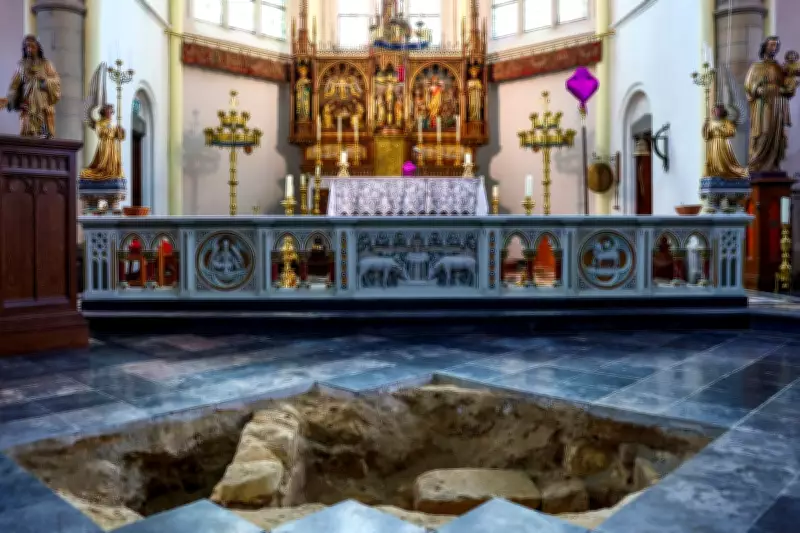
Potential Discovery of Legendary Musketeer's Remains in Dutch Church
Archaeologists and officials have announced a potentially groundbreaking historical discovery in the Dutch city of Maastricht. They believe that the skeleton of Charles de Batz de Castelmore d'Artagnan, the real-life 17th-century French nobleman and musketeer who inspired Alexandre Dumas' classic 1844 novel The Three Musketeers, may have been unearthed beneath the floor of St Peter and Paul Church.
Unearthing History After Structural Incident
The remarkable find occurred last month when part of the church floor unexpectedly subsided, revealing a grave containing human remains hidden underneath the tiles. This accidental discovery immediately prompted a meticulous scientific investigation to identify the skeleton, with DNA testing playing a crucial role in the authentication process.
The historical figure of d'Artagnan was a spy and musketeer serving under France's King Louis XIV, famously known as the Sun King. Historical records indicate that he met his end during the Siege of Maastricht in 1673, killed by a musket ball to the throat. The church's proximity to the site where the French army camped during the siege had long marked it as a plausible final resting place for the soldier, as transporting his body back to Paris in the summer heat would have been logistically challenging.

Scientific Investigation and Compelling Clues
Scientists have now carefully retrieved DNA from a jawbone of the skeleton to conduct comparative analysis with known descendants of d'Artagnan. Archaeologist Wim Dijkman emphasised the significance of the investigation, stating, "This has truly become a top-level investigation, in which we want to be absolutely certain — or as certain as possible — whether it is the famous musketeer, who was killed here near Maastricht."
Additional compelling evidence was found at the burial site, strengthening the case for the skeleton's identity. Deacon Jos Valke reported that other clues included a French coin dated to 1660 and part of a lead bullet. "He lay buried under the altar in consecrated ground," Valke explained. "There was a French coin from that time in the grave. And the bullet that killed him was lying at chest level, exactly as described in the history books. The indications are very strong."
From Historical Figure to Literary Legend
The fictional portrayal of d'Artagnan in Dumas' novel depicts him as a hot-headed teenager who befriends the original three musketeers and ultimately becomes the fourth member of their legendary group. This character has been brought to life in numerous screen adaptations over the decades, with actors such as Douglas Fairbanks and Michael York famously portraying the swashbuckling hero.
The ongoing investigation represents a fascinating convergence of historical archaeology, literary history, and modern scientific techniques. If confirmed, this discovery would provide a tangible connection to one of literature's most enduring characters and the real historical figure who inspired his creation, offering new insights into 17th-century European history and the life of a man who served at the right hand of one of France's most powerful monarchs.