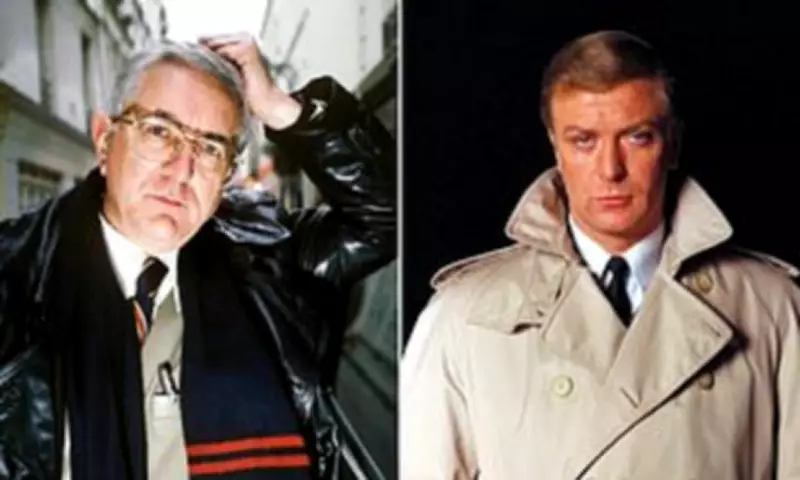
The Passing of a Literary Revolutionary
Len Deighton, the bestselling author whose thrillers fundamentally reinvented the spy novel genre, has died at the age of 97. The writer, who maintained a complex relationship with his own literary success throughout his career, leaves behind a legacy that transformed popular fiction while simultaneously questioning its conventions.
A Reluctant Literary Star
Deighton famously expressed ambivalence about his profession, once confiding: 'The best thing about writing books is being at a party and telling some pretty girl that you write books. The worst thing is sitting at a typewriter and actually writing the book.' This characteristic blend of anti-establishment mischief and self-deprecation defined his public persona, even as his career soared to remarkable heights.
During the mid-1960s, following the successful film adaptation of his groundbreaking espionage tale The Ipcress File, Deighton briefly achieved greater fame than the movie's star, Michael Caine. 'Of course,' he later noted with typical wryness, 'he overtook me like a skyrocket, but there was a brief period when I was more famous.'

The Multi-Talented Maverick
Deighton's talents extended far beyond thriller writing. Playboy magazine appointed him as its travel correspondent, while a Sunday newspaper featured him as its star food writer. His foray into film production resulted in Oh! What A Lovely War, which became the most controversial musical of its decade.
Despite being celebrated for meticulous research that satisfied readers' demands for factual detail, Deighton never allowed background to overshadow action. One Daily Mail reviewer memorably declared: 'His plots grip like Princess Anne's jodhpurs!'
Creating the Anti-Bond
Deighton's most enduring creation remains his aggressively proletarian anti-hero – nameless in the books but called Harry Palmer in the hit films. This character, who wore NHS spectacles identical to Deighton's own, represented a deliberate contrast to the urbane sophistication of James Bond. Palmer's contempt for university-educated MI6 types and his working-class authenticity made him a symbol of 1960s egalitarianism.
This distinctive approach may explain why a 2022 ITV revival of Harry Palmer, starring Joe Cole, left contemporary audiences somewhat baffled. The adaptation struggled to reconcile Deighton's gritty realism with modern expectations of espionage glamour.
A Career of Contradictions
Despite becoming Britain's most bankable thriller writer, Deighton saw his fame wane dramatically in the late 1990s. His final novel, Charity – concluding a nine-book series about jaded secret agent Bernard Samson – appeared in 1996. Afterward, he simply stopped writing, unable to find a publisher for his last project, a history of the aero engine.
Deighton consistently rejected honors, including a rumoured knighthood offer, and refused to participate in literary festivals. He told one organizer: 'The only thing I would like less than going to your festival and reading from my latest book is to be at your festival and to hear other writers reading from their latest books.'
Self-Criticism and Literary Recognition
Even with multi-million sellers to his name, Deighton remained scathing about his abilities. At the end of the 1960s, he declared himself 'the most illiterate writer ever... I'm not a writer. Anything that is good in my books tends to be descriptions that an art student would provide.'
Critic and thriller writer Julian Symons offered a contrasting perspective, stating: 'The constant crackle of his dialogue makes Deighton a kind of poet of the spy story.' Yet Deighton never shook the feeling that he had stumbled into a literary world populated by mediocrities who considered themselves superior due to public school educations.
Formative Experiences
Born Leonard Cyril in 1929, Deighton claimed his mother Dorothy gave birth in a workhouse because the maternity hospital had no available bed. His parents lived in a Marylebone mews, where Dorothy worked as a cook and her husband Leonard served as a chauffeur.

Wartime London left indelible marks on the young Deighton. He recounted discovering twenty bodies in an air raid shelter after a night of bombing, with a warden telling him: 'Come out of there, son.' This horror, combined with childhood fears of German invasion, fueled the nightmare vision of his 1978 novel SS-GB, which imagined England under Nazi rule.
Another formative memory involved Special Branch officers arresting his neighbor, 38-year-old Russian emigre Anna Wolkoff, who was secretly a Nazi spy targeting US ambassador Joseph Kennedy. 'It was a huge, exciting event for a boy,' Deighton recalled. 'Things stick in the subconscious and germinate.'
From RAF to Literary Fame
After wartime service as an RAF photographer, Deighton studied art at St Martin's College and the Royal College of Art. He worked briefly as a BOAC cabin steward before becoming a graphic designer and illustrator at an advertising agency.
There, surrounded by Eton graduates who called each other 'Piggy and Wiggy,' he felt profoundly out of place. This experience inspired him, while on holiday in France in 1960, to begin writing a novel about a working-class secret agent. 'The Ipcress File is about spies on the surface,' he explained, 'but it's also really about a grammar-school boy among public-school boys.'
Instant Success and Lasting Impact
After two publisher rejections, The Ipcress File became an instant bestseller in 1962, partly thanks to the premiere of the first James Bond film, Dr No, a week earlier. The initial print run of 4,000 copies sold out on the first day, aided by Deighton's distinctive white, embossed cover design, which he partially subsidized.
Simultaneously, his innovative Cookstrips – cartoon-style panels cramming recipes and cooking tips – began appearing in a Sunday newspaper. These reflected his habit of scribbling notes while cooking, a passion shared by his character Harry Palmer.
Personal Life and Later Years
Deighton's first marriage to designer Shirley Deighton deteriorated to the point that she refused to attend The Ipcress File movie premiere in 1965, citing career commitments. They married in 1960, lived apart for years, and divorced in 1976.
In 1980, he married his second wife, Ysabele de Ranitz, who survives him along with their two children. By then, Deighton had become a tax exile, living primarily in Portugal and complaining that Labour's 95 percent top income tax rate had driven him from Britain.
Diverse Passions and Final Reflections
A lifelong fascination with war history produced two books about RAF operations, Fighter and Bomber – the latter inspiring Motorhead vocalist Lemmy to create an album with the same title. Though Deighton preferred classical music to rock, he appreciated the explosive power of creative work.
'When you make a book,' he reflected, 'it's like making a hand grenade. It's a dull process... but when you throw it, the person at the other end gets the effect.' This metaphor perfectly captures the complex legacy of an author who transformed spy fiction while remaining profoundly ambivalent about his own literary achievements.