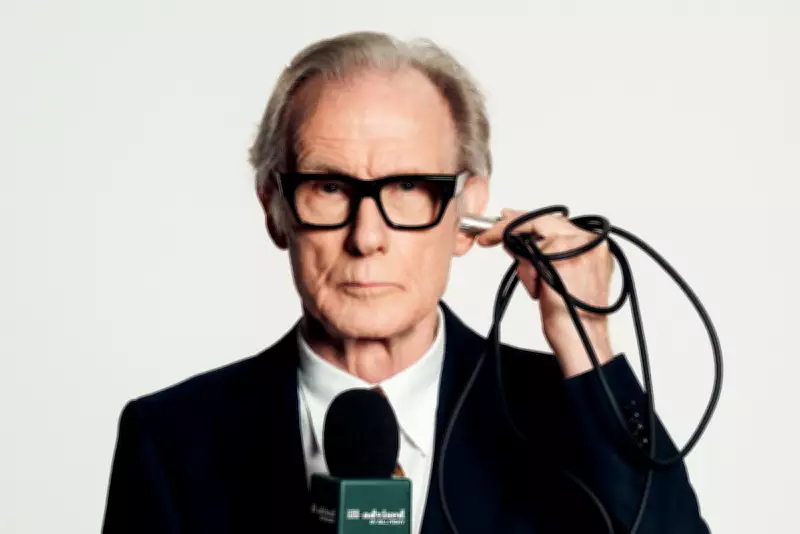
This morning, I swallowed two raw eggs with orange juice, says Bill Nighy, shooting me a wry sideways glance. I am not proud of it. It is a bright Tuesday in May, and the actor, all limbs and languid charm, is describing his morning. I luxuriated a bit, but not much, and got up at 8.15, he begins. I turned the music on, and today it was my blues playlist, 'Let Me Follow You Down'. He beats out the five words with his fingers. Next: to his local cafe for those raw eggs. This always makes the very nice lady who works there... well, she has to turn away. After that, I had a couple of savoury pastries and a banana. And I read about Obama, and I came to see you.
All of this is delivered in Nighy's unmistakable purr; he does not say words so much as let them drift out of him with a shrug. It is often how he delivers his lines, too. You have seen it in more than 80 films, when he played Love Actually's scene-stealingly crass rocker Billy Mack, or in his understated, Oscar-nominated turn as a terminally ill bureaucrat in Living, or his role as a warm, wise, time-travelling dad in About Time. But it turns out the greatest role he has ever played is... himself. Bill Nighy is playing Bill Nighy to perfection right now, just as he does on his podcast ill-advised, a gentle audio gem where he gives advice to listeners who send in questions by voice note.
I became obsessed with the podcast when it launched last autumn, Nighy's chat about escaping crap parties and how to play air guitar becoming the soundtrack to my days. When I asked his people if he would be up for meeting to discuss it, it had to be in person, naturally: he recently announced on his podcast that he has retired from Zoom (it is impossible to actually imagine him – this suave flaneur in exquisite tailoring, spotted in cafes all around London reading Joan Didion – squished into a grid of squares on a screen). Zoom just makes me so unhappy, he says. Zoom is over, as far as I am concerned. Everyone looks terrible, including me. Everyone looks like they are in a hostage situation. And everyone jumps in at the wrong moment. I had been tempted to ask for this interview to take place at his flat, not far from here, in Pimlico. No, that would be weird. That would be weird and wrong, he says, relishing the g.

Instead, we meet for coffee in The Goring – staff at the front desk explain that Nighy always sits in the exact same spot – where he drinks a double espresso with sweetener (he says he is off sugar). He has the uncanny effect of somehow being a familiar, cosy international treasure, and also strikingly young-hearted and, well, cool. Talking to him is a surreal, disarming experience, like tuning in to a personalised episode of the podcast.
The Podcast That Almost Wasn't
Ostensibly, ill-advised is an agony uncle show. In reality, it is an invitation for the clumsy and awkward among us to squander time with Nighy. He is asked all manner of things, and his morsels of guidance – invented on the spot – always come with the disclaimer that he will try, sort of, to not actually make things worse. It has just finished its second season, and this month saw the launch of Nighy's subscriber channel, The Back Room, where, among other treats, listeners will have access to Nighy reading Between the Acts by Virginia Woolf over the podcast's summer break.
But the podcast almost never happened at all. It was conceived after a press junket in 2024, when Vogue filmed Nighy responding to questions posed by the public. It was so well received that his long-time publicist and friend, Ciara Parkes, persuaded him to make a whole show out of it. I was really uneasy about doing it, says Nighy, impeccably turned out in black spectacles, a navy wool sweater and pressed grey slacks. I pulled out three times at the very last minute, just to make everyone's lives more difficult. Nighy is 76, and thinks this is why he is often mistaken for someone who knows what to do about things – although he was recently berated for being too slow to cross the road. I was shouted at by a young van driver, he says, more tickled by the encounter than traumatised. And you can imagine what he said. I am not going to say it. It is unrepeatable. But I thought, 'I see, that is where I stand now.'

One reason he was reluctant to do the podcast was a fear that he would be punished. It is not clear what he means by this exactly – made fun of? Cancelled? Either way, that did not happen. More people talk to me about the podcast now than anything else, he says. Though I always wait for which film they are going to refer to. He likes that the podcast's mission statement is to be as inconsequential as is humanly possible. It just amuses me, he says.
Eccentricities and Wisdom
Episodes are full of an endearingly British type of esoterica. With the help of his listeners, Nighy is accruing a list of words that should be banned from the English language. Botty b, aka bottomless brunch, is on there. Hearing Nighy say this phrase in his leisurely drawl, and dismiss it as elaborately awful, is just as pleasing as you would imagine. Moist and picky bits are forbidden, too. Nighy's podcast is meant to comfort and entertain. It is certainly not the space for real, scary problems. One listener dilemma: if one is squeezing between restaurant tables, should one present one's crotch or one's bottom to the strangers at the next table? It is always genitalia first, came Nighy's answer, delivered gravely. Weeks later, a canny listener called him out for not following his own advice. I was in my local cafe and I got busted, he says. The woman on the other table said, 'Well, that is not what you said on your podcast!' Because I had given her – he pauses for dramatic effect – my bum.
Nor is it the place for discussions about politics and culture wars. Such topics are deemed too serious. Although, in one recent episode, Nighy and a listener bemoaned how people always seem to say things were better before. When I raise the subject now, he is animated.
You would have had monks in the mid-16th century saying, 'It is all fallen apart since 1500, you know? In 1500, things were just great.' It is a perennial thing that human beings have a nostalgia for a time just before they were born. And therefore it is very easy to manipulate people in that way – all my life, people have been saying strange men will come across the border and they will have sex with your daughter and steal your job. It is not happening, it has never happened, but it is people's favourite.
He says we are especially easy to manipulate today because the thing that was supposed to bring us all closer together, the digital world, has been weaponised and used for the exact opposite. I do occasionally think I am glad I was born when I was, he says. Nighy arrived in 1949, the youngest of three. His mother was a psychiatric nurse; his father managed the garage that the family lived above. I am glad I was born before mobile phones. I was born at a time when they started to properly educate the children of the working class. I missed any kind of combat. I was not oppressed by technology until I was in my thirties. And I am wilfully and irresponsibly turning my mind off every time anyone says AI. Because I just cannot take it. He shakes his head. A few people will get very rich from it, and the rest of us will try to play catch-up and delay the moment our children are handed a mobile phone. Because you just know that they are never going to be the same after that.
The Man Behind the Voice
One of the things that ill-advised listeners have discovered about Nighy is how particular he is. And how eccentric. He never eats at home, ever. The only items in his fridge are sparkling water and milk. He does not drive. The best thing he ever did was quit smoking – he used to smoke for England, Ireland and Wales, he says, and could light a zipper on his beard. He loves to dance, especially naked, in his flat – but it is better if you have got shoes on, because then you can spin. Sartorial matters are very important. He has told listeners: I do not want to stand next to anyone wearing linen. He also has very strong views on anyone daring to go sockless in London. I think he is only half joking about a lot of it. Whether said in jest or not, these pieces of information are actually quite intimate. Where does Nighy draw the line?
I try to avoid the third cup of coffee, because that unlocks one's mouth, he says. No, but there is a line, and the line is generally to do with other people, because no one in my family or anyone I know has asked to be in a podcast. He occasionally mentions his daughter Mary – for example when recalling going ape on the dance floor at her 18th, more than two decades ago. But very little is known about his romantic life, which we do not discuss today. He was in a relationship with the actor Diana Quick for almost three decades until 2008, and she is Mary's mother. There were rumours a few years back that he had dated Anna Wintour, but these were always denied by his representatives.
The podcast is revealing, though; whether he is slightly performing or not, the show serves as a window into his psyche. Nighy may seem like a stone-cold chiller now – one of his catchphrases is stay loose – but his nickname used to be Nerve. And he still struggles enormously with a lack of self-belief. I will project anything from humiliation to doom, he says. I do not know how it compares to other people because I have never been anyone else, but my tendency to undermine myself has been, I think, quite extreme at times. After he finishes a job, his brain decides it was a disaster. He calls this his anti-talent. There is an enormous disparity between what I think is happening and what in fact is happening; I have had to get used to that.
He once opened a play on Broadway, and on opening night, saw his colleagues staring back with confusion at how terrible he was. Or so he thought. At the curtain call, the theatre exploded and they started throwing flowers at us. He is not so bad these days. I have done certain jobs where I think, 'That is OK, and if somebody has a problem with that, it will have to remain their problem, because I do not.' For me, that is a huge development. Given his laidback manner, it is a surprise to hear that Nighy has never been comfortable in his own skin. He used to shower in the dark so he would not have to look at himself. I have always wanted to be something or someone else in terms of my body, he says. But I should be grateful. My body has been very good to me, and it has not let me down yet. There is nothing seriously grotesque about me, but it is just a bit sad, you know, I have never enjoyed my body. It is why I do not have tattoos. I have never thought my body worthy of decoration. I would not want to draw attention to it, because there is nothing I like. He seems more relaxed about ageing, though – apart from the fact that people start to die, which, strictly speaking, is absolutely awful – and has no interest in getting cosmetic work done like his Hollywood peers. I get employed for looking like this, he says. I play somebody's grandfather most of the time, or somebody who is dying.
There is something about Nighy that feels timeless, and deeply analogue – like he should only communicate via landline or fax. He walks everywhere and reads voraciously; in front of him on the table are The New Yorker and The New York Review of Books. He has been reading about Barack Obama's plans around AI legislation. And about the manosphere. Machismo, he says, is just another word for cowardice. But he does have a smartphone – and he picks it up several times to note down things that come up during our conversation, or to dig out a quote he has jotted down from someone famous. He builds all his playlists on there. And he has personalised his ringtone to be Where Are We Now? by David Bowie. Familiar and cosy, yet young-hearted and cool, Nighy has an endless curiosity and appetite for life. He is playing the role of Bill Nighy just right.