Paulo Nimer Pjota was just 15 when he sold his first painting, but by then he had already been a graffiti artist for three years. 'I don't really know what life is like without painting,' the 37-year-old Brazilian artist says. 'It is in everything I do, the movies that I watch, the books that I read. They might not have anything to do with art, but I can find something in them that I might be able to use.'
Pjota's studio, once his bedsit before he married and had a son, sits in a quiet São Paulo neighbourhood. Shelves are lined with gourds, skulls, postcards, and trinkets; a pair of skateboards hang on the wall; a desk overflows with tubes of paint. Among this productive clutter lies a pile of sketches from his teenage years, discovered at his parents' house.
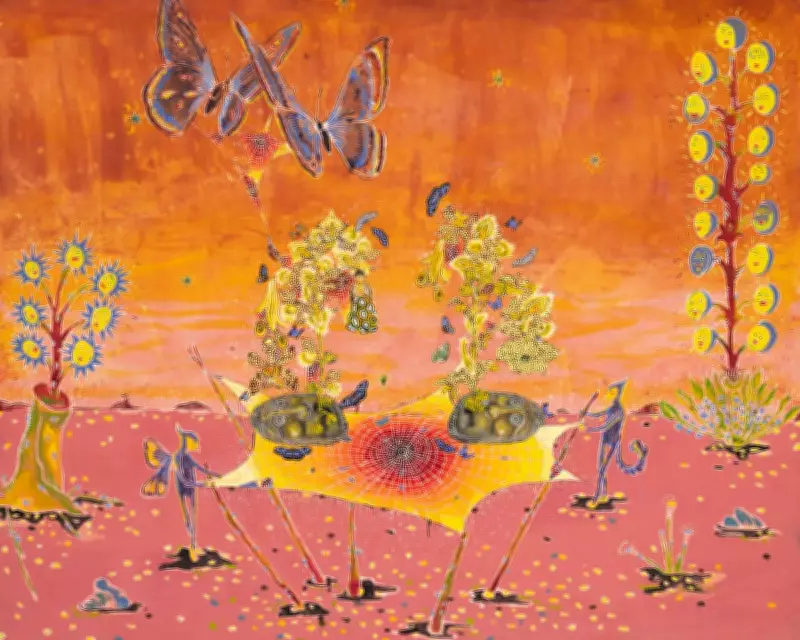
We speak over the phone as he travels to install his first UK institutional show at South London Gallery. Titled Encantados (Enchanted), the exhibition features 11 new paintings on canvas, hung against a vast and intricate wall drawing. The stretched works depict witchy and fantastical scenes, with surfaces imbued with a shimmering quality from layers of acrylic, oil, and tempera.

In one painting, pink butterflies burst from a woman's stomach; in another, a monkey picks over a fallen urn. Gods, fish, and huge blooming bouquets of flowers recur. Pjota, dressed in skatewear and covered in tattoos, likens his process to a hip-hop producer, sampling imagery and motifs from sources that include ancient civilisations, Brazilian folklore, art history, exercise books, and children's literature.
'Mythology has always been interesting to me,' he says. 'Stories I heard in my parents' house, in the media, these things form a big part of our life from a very young age. Becoming a father myself, I started reading a lot of fables to my son and I was looking back on the drawings I used to make when I was a kid. Crazy animals, anthropomorphised nature.'
In The Land Before Time for Jorge, two cacti appear—one crying, one laughing—like the masks of Greek tragedy, except their faces have characteristics of ancient Japanese warriors. Pjota says the background landscape comes from a 15th-century painting about the colonial invasion of the Americas, and a barely robed canoodling couple in the background is taken from a French tapestry. 'I made this painting for my son. The title references the film, which everyone in Brazil watched as children.'
The wall painting in London, featuring a menagerie of creatures playing musical instruments, recalls his youth amid the graffiti and hip-hop scene of São José do Rio Prêto, his hometown in the countryside of São Paulo state. Pjota started making art after attending the local hip-hop school, a social club offering breakdance, DJing, and graffiti classes in an otherwise conservative city with little cultural diversion.
'I started a crew with two friends, and then started another crew with the teachers of the school. I was this 13-year-old boy spraying with these 25-year-old guys. This is how I met all these star graffiti artists: Os Gêmeos, Ise, Nunca. It was super fun, super raw, the beginning of Brazilian graffiti.' That first sale came from a community project at the local office of PT, the Workers' Party. 'Hip-hop and street culture, it's about revolution and community.'
He was attracted to using brushes as much as spray cans and developed his own style, painting both on city walls and on canvas at home. 'I messed around with different graffiti styles: throw-ups, wildstyle, but soon I started to develop my own thing, very different from what else was going on.'

Aged 17, he moved to São Paulo to attend art college, but his friends remained the older guys he met on the streets. 'The graffiti scene was harder here. There were more police, who were a lot more brutal, and I wasn't a kid any more.' His first exhibition at São Paulo gallery Mendes Wood DM in 2012 featured far larger paintings than he makes now, with motifs such as crabs, crystals, and anatomical drawings, equally diverse but rendered floating and discrete on an otherwise monochrome surface—as they might coexist on a graffitied wall. Other works were made on sheets of scrap metal or old found textiles. He says there is a stronger sense of narrative in his latest work. 'The symbols intersect in a more subtle way,' he says. The juxtapositions are no longer the purpose of the work. 'They are a tool for constructing a new mythical and fantastical universe.'
Paulo Nimer Pjota: Encantados is at South London Gallery from 1 May to 23 August.