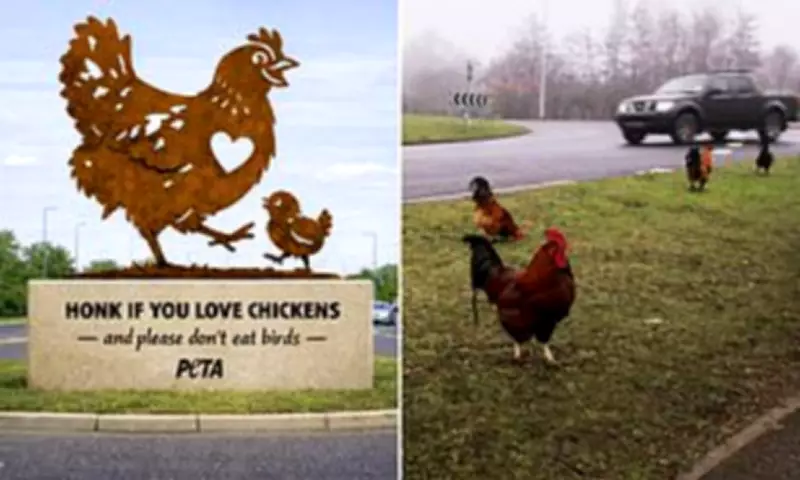
Villagers near a roundabout renowned for its wild chickens have criticised an attempt by an animal rights group to have a giant statue of a hen and its chick erected there with wording urging motorists to honk their horns to show support for the birds.
The Eggstraordinary Proposal
The feature would adorn the so-called 'Chicken Roundabout' in Ditchingham, Norfolk, where up to 300 fowl have lived at times. People for the Ethical Treatment of Animals (PETA) have written to Norfolk County Council offering to pay for it if it agrees to rename the junction 'Save the Chickens Roundabout'. A sign underneath would read: 'Honk if you love chickens – and please don't eat birds.'
The organisation picked the spot as it says the county is 'known as the “mega-farm” capital of Europe, with more than 70 large-scale, intensive chicken operations'.

Local Opposition
But locals complained it would affect traffic safety, as the Highway Code states horns should only be used to 'warn other road users of your presence' or if 'another road user poses a danger'. They also pointed out it would lead to unnecessary noise in the area.
Kevin Rouse, who lives nearby, said: 'Why would anyone think that sounding your horn on a roundabout is a good idea for traffic or nearby residents?' Raf Turnhall added there's 'enough honking as there is'. Another villager, Hugh Trent, commented that the spot is 'a lovely little wildlife haven' which should be left alone.
History of the Chicken Roundabout
Ditchingham, which once boasted Phil Collins among its residents after he bought a nine-bedroom mansion there, was mentioned in the Domesday Book and has a population of around 5,000. The roundabout on the A143 had already been a haven for feral chickens for decades when it was officially opened in 1986, although their numbers have fluctuated significantly since.
Some birds are believed to have escaped from a nearby allotment and their numbers soared to around 300 under the care of Bungay resident Gordon Knowles, who brought feed to them in a wheelbarrow for almost 20 years. The county council announced its intention to move them due to safety concerns in 2000 but the plan didn't endure, amid protests from fans of the unusual tourist attraction.
Two years later, numbers had plummeted and there were suspicions they were being stolen and sold. By 2006, there were over 100 again as owners were suspected of leaving them there during an avian flu outbreak - but this dropped to as little as six after rat poison was left in the area.
With impeccable resilience, numbers were back up to more than 100 in 2009 until a suspected attack by foxes, according to the RSPCA, which saw around 70 disappear. The remaining birds were handed to an animal charity the following year. Mr Knowles' dedication to the birds was recognised in 2012 when a plaque was unveiled near the roundabout, with one councillor describing him as 'one of the last great eccentrics'. He died in 2020.
PETA's Stance
PETA vice president of corporate projects, Dawn Carr, said: 'The “Chicken Roundabout” and the wild chickens who once lived there may be cherished but most chickens in Norfolk never see daylight or feel fresh air, as they're confined to dirty sheds and slaughtered at a fraction of their natural lifespan. PETA is asking Norfolk County Council to embrace a compassionate roundabout rename and a statue that encourages everyone to leave chickens in peace.'
The organisation added chickens are 'social learners who watch and emulate one another' and 'form strong bonds'. It went on: 'Yet those raised and killed for their flesh are crammed by the tens of thousands into filthy, windowless sheds.' The slaughtering process at abattoirs is also inhumane, PETA said.
Highway Code Concerns
Rule 112 of the Highway Code states that the horn should be used 'only while your vehicle is moving and you need to warn other road users of your presence'. It should never be used 'aggressively' or 'while stationary on the road [or] driving in a built-up area between the hours of 11.30 pm and 7.00 am except when another road user poses a danger'. The county council was approached for a comment.