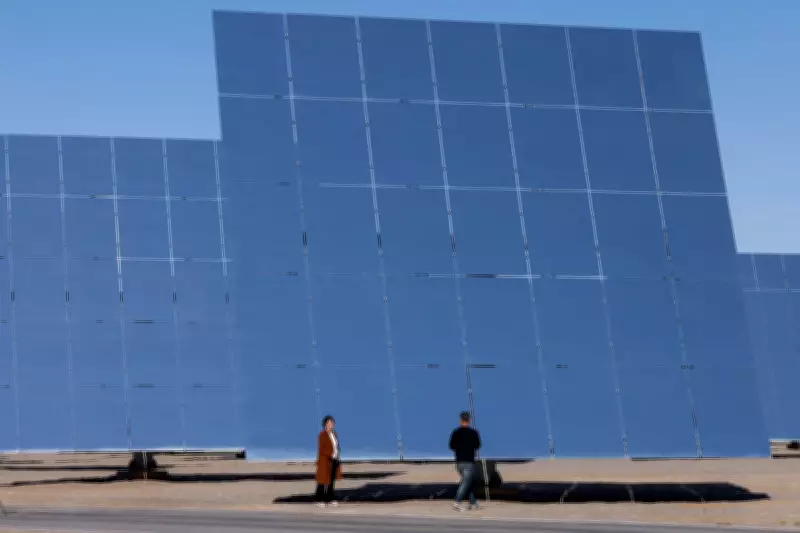
China is on course to reduce greenhouse gas emissions at a pace exceeding its public commitments, even as its economy continues to expand, according to a new report by an independent energy research firm. The New Energy Outlook 2026, published by BloombergNEF on Tuesday, projects that China's emissions will fall 17 percent from their 2023 peak by 2030, ahead of the schedule the Asian giant has pledged, despite achieving annual GDP growth of around 5 percent.
China's Emissions Trajectory
China currently emits twice as much carbon dioxide annually as any other nation, making its emissions trajectory one of the most critical variables in global climate projections. The country's official climate commitment, outlined in its nationally determined contribution under the Paris Agreement, is to peak carbon emissions before 2030 and achieve carbon neutrality, or net zero, before 2060. However, the new report suggests that emissions will not only peak but also decline sharply within this decade. By 2050, emissions are projected to fall 50 percent from their peak, though they may still remain significantly above the levels projected for the United States or Europe at that point.
China remains the single largest contributor to global emissions reductions under BloombergNEF's central modelling scenario.

Energy Transition Driven by Security Concerns
The broader outlook paints a picture of an energy transition driven as much by security concerns as by climate ambition. Three successive energy shocks this decade—the pandemic, the war in Ukraine, and the war in the Middle East—have prompted nations heavily reliant on fossil fuel imports to accelerate the deployment of clean technologies. Asian economies, including Vietnam, Japan, Indonesia, and India, spent 3 to 6 percent of their GDP on energy imports in 2025, providing strong economic incentives to switch to renewable energy.
A report in April showed that solar and wind power were already shielding the world from the worst impacts of the energy crisis triggered by the US-Israeli war on Iran.
Solar and Storage Growth
Solar is projected to become the world's single largest source of electricity by 2032, driven by falling prices and massive overcapacity. Battery storage is expected to increase 17-fold, from 223 gigawatts in 2025 to 3.8 terawatts by 2035.
"We're living in another moment of crisis, but unlike in past decades, today there are real options for countries to react," said David Hostert, chief economist at BloombergNEF, in the report. "We now have viable technologies that can be deployed at scale and fast, at an overall lower cost to the system than the fossil fuel technologies that used to be the primary choice."
Global Electricity Demand
Global electricity demand has more than doubled since 2000 and is projected to rise a further 29 percent by 2035 and 69 percent by 2050 under BloombergNEF's central scenario. Data centre capacity alone reached 84 gigawatts in 2025, consuming 500 terawatt-hours of power, representing 1.9 percent of global demand and a 20 percent increase year on year. That figure is projected to more than double to 1,114 terawatt-hours by 2050.
Revised Net Zero Scenario
The latest report also marks a significant revision to BloombergNEF's net zero scenario. Achieving a 1.5 degrees Celsius warming limit is now judged no longer feasible, the report states, citing persistently high emissions and continued investment in carbon-intensive assets. Under its maximum-effort pathway, peak warming reaches 1.81 degrees Celsius, up from 1.75 degrees Celsius in last year's edition.
Nuclear Expansion
Nuclear expansion is concentrated heavily in Asia, with China and India accounting for 80 percent of new capacity through 2035. Of the 75.5 gigawatts of nuclear capacity under construction worldwide, 38 gigawatts are in China and 6 gigawatts in India.
Regional Energy Transition Timelines
Energy transition timelines diverge widely by region. China is electrifying faster than any other major economy. Coal's share of its power generation is projected to fall from 32 percent in 2025 to about 7 percent by 2050 as renewables take over. In India, electricity overtakes oil and coal by 2041. Europe reaches that point by 2043, and the US by 2047.

"As EVs, data centres, population growth and industrial activity spur electricity demand, the world is in a race to meet rising energy demand with the most efficient, least-cost technologies," said Matthias Kimmel, head of energy economics at BloombergNEF. "NEO shows that solar becomes the world's largest generator overall by 2032 while storage jumps 17-fold to 3.8 terawatts by 2050, underscoring how clean technologies are increasingly critical to energy security, system flexibility and meeting the world's growing power needs."
Investment Needs
Global energy transition investment reached a record $2.3 trillion in 2025, the report said, though achieving net zero would require $235 trillion in total investment by 2050, 24 percent more than under BloombergNEF's central scenario.