The Doomsday Glacier's Looming Threat
The Thwaites Glacier in Antarctica, often dubbed the 'Doomsday Glacier,' represents one of the most critical threats to global coastlines. This colossal river of ice, roughly the size of the United Kingdom, contains enough frozen freshwater to raise global sea levels by approximately 2.1 feet (65 centimeters) if it were to collapse entirely. Scientists have identified that the primary driver of its alarming retreat is a persistent current of warm ocean water that infiltrates the gap between the glacier and the continental shelf, relentlessly melting the ice from beneath.
A Radical Engineering Solution
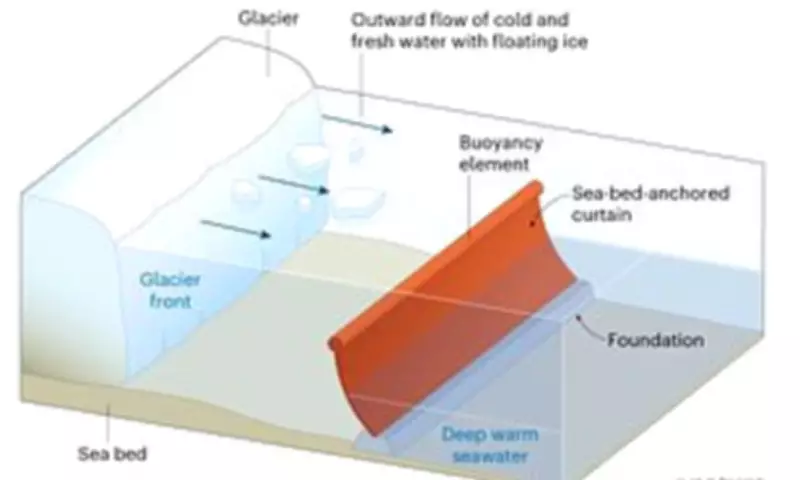
In response to this existential threat, an international consortium of scientists has proposed a groundbreaking, albeit unconventional, engineering marvel: the Seabed Curtain. This ambitious project envisions constructing a monumental barrier stretching 50 miles (80 kilometers) in length and standing 492 feet (150 meters) tall. It would be anchored to the seabed at a depth of 2,132 feet (650 meters) directly in front of the glacier's most vulnerable sections. The curtain's primary function would be to act as a colossal underwater windbreak, physically blocking the warm water currents from reaching and melting the ice.
Design and Development Phases
The Seabed Curtain is currently in its initial conceptual and design phase. The proposed structure would likely utilize a reinforced tensile fabric, suspended by buoyant elements and secured to the seafloor by a heavy foundation system. Researchers are debating whether a single, continuous curtain or a series of fragmented sections would be more effective, with the latter potentially reducing hydrodynamic drag. Early computational models from 2024 tentatively suggest such a barrier could reduce glacial melting rates by a factor of ten in specific areas, though these projections remain untested in the real world.

Testing and Astronomical Costs
To validate the concept, scientists plan to deploy a test section of the curtain—measuring 492 feet long and 132 feet tall—in the Ramfjorden fjord in mainland Norway. Concurrent ecological studies in Svalbard's Mijenfjorden will assess the potential environmental impacts of such a large-scale polar barrier. The projected cost for the full Antarctic installation is staggering, estimated to exceed $80 billion (£58.7 billion). Proponents, like project co-lead and former Norwegian deputy foreign minister Marianne Hagen, argue this investment is negligible compared to the trillions in global damage that a Thwaites collapse would inflict. 'If it's possible to take 65 centimetres of global sea level rise off the table for everybody, with one single targeted intervention in one location, I'm willing to explore it,' Hagen stated.
Scientific Urgency and Criticism
The urgency is underscored by recent findings; Thwaites Glacier is already contributing to four percent of current global sea-level rise, and some studies suggest it could undergo a complete collapse within decades. A total collapse might not only release its stored water but also destabilize the wider West Antarctic Ice Sheet, potentially leading to several meters of sea-level rise over centuries. However, the Seabed Curtain project faces significant criticism. Some scientists label it a dangerous distraction from the essential work of reducing greenhouse gas emissions, warning of 'intrinsic environmental damage' and questioning whether such an untested structure could be deployed at the necessary scale and speed to be effective.
The Stakes of Inaction
The Thwaites Glacier has been retreating rapidly since the 1970s, with its grounding line receding nearly 9 miles between 1992 and 2011. Its collapse would be a global catastrophe, inundating coastal communities and displacing millions. While the Seabed Curtain presents a bold, engineered response to a warming planet, it exists within a fierce debate between technological intervention and fundamental systemic change to address the root causes of climate change.