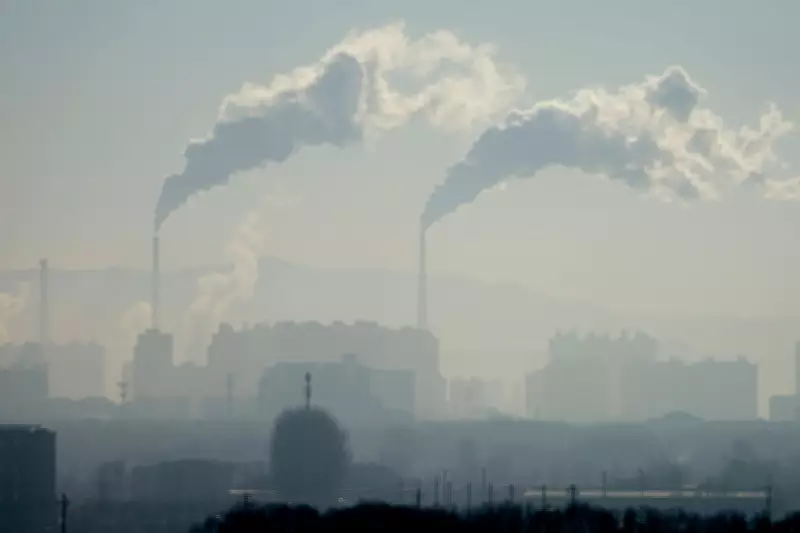
China's Coal Power Expansion Contradicts Renewable Energy Leadership
Even as China accelerates its deployment of solar and wind power at unprecedented rates, the nation has simultaneously embarked on a massive coal power plant construction programme that has alarmed climate analysts worldwide. This paradoxical energy strategy sees the world's largest carbon emitter bolstering fossil fuel infrastructure while championing clean energy technologies, creating a complex picture for global climate targets.
Staggering Scale of New Coal Capacity
According to a joint research report released by the Centre for Research on Energy and Clean Air and Global Energy Monitor, China commissioned more than 50 large coal units in 2025 alone. These individual boiler and turbine sets each boast generating capacity of 1 gigawatt or more, representing a dramatic increase from fewer than 20 such units annually over the previous decade.
The comprehensive analysis reveals China brought approximately 78 gigawatts of new coal power capacity online last year, marking a sharp uptick from previous years' figures. To contextualise this expansion, report co-author Christine Shearer of Global Energy Monitor noted that "China commissioned more coal power capacity in 2025 than India did over the entire past decade."

Renewable Energy Growth Amid Fossil Fuel Expansion
Simultaneously, China achieved remarkable progress in renewable energy deployment during the same period. Official statistics from the National Energy Administration indicate the country added 315 gigawatts of solar capacity and 119 gigawatts of wind capacity in 2025. These substantial additions actually nudged down coal's share in total power generation by approximately 1% last year, as growth in cleaner energy sources covered all increases in electricity demand.
This dual-track energy development raises fundamental questions about China's climate commitments and energy transition pathway. Despite leading the world in renewable energy installation, the parallel expansion of coal infrastructure suggests a more complicated energy security calculus than simple climate considerations.
Energy Security Drivers Behind Coal Revival
The resurgence in coal plant construction stems from multiple interconnected factors, with energy security emerging as a primary concern. Power shortages affecting parts of China during 2021 and 2022, which resulted in temporary factory production halts and rolling blackouts in some cities, prompted government action to bolster baseload power capacity.
Analyst Qi Qin from the Centre for Research on Energy and Clean Air explained that "the government's response was to signal that it wanted more coal plants, leading to a surge in applications and permits for their construction" during 2022-2023. This permitting surge directly drove the substantial capacity increase observed in 2025 as new units became operational.
Several additional factors contribute to China's continued coal investment:
- China's earlier development stage compared to Western economies necessitates greater energy availability for continued growth
- Rising middle-class aspirations among 1.4 billion citizens increase demand for electricity-intensive appliances
- Industrial manufacturing requirements and artificial intelligence development create substantial power demands
- Government prioritisation of energy reliability following drought-related hydropower shortages in 2022
Official Justification and Transition Risks
Chinese authorities position coal as providing essential stability to complement intermittent renewable sources like wind and solar, which depend on weather conditions and time of day. The National Development and Reform Commission emphasised in recent guidance that coal should "play an important underpinning and balancing role" for years to come, while advocating for cleaner and more efficient coal plant operations.
Industry representatives echo this perspective, with the China Coal Transportation and Distribution Association asserting last week that coal-fired power remains essential for power-system stability despite increasing renewable penetration.

However, analysts warn that excessive coal capacity creates significant transition risks. Qin cautioned that "political and financial pressure will keep the plants operating, leaving less room for other sources of power," potentially delaying the shift to cleaner energy sources. The research report specifically urged China to accelerate retirement of aging and inefficient coal plants and commit in its forthcoming five-year plan to ensuring power-sector emissions do not increase between 2025 and 2030.
Future Emissions Trajectory Uncertain
The ultimate climate impact of China's coal expansion remains uncertain and will depend on operational patterns. As Qin explained, "whether China's coal power expansion ultimately translates into higher emissions will depend on whether coal power's role is genuinely constrained to backup and supporting rather than baseload generation."
With construction started on 83 gigawatts of additional coal power capacity last year, substantial new units may come online in the current year, further complicating China's energy transition pathway. This development occurs against the backdrop of China's stated climate ambitions and leadership in renewable technology manufacturing, creating a contradictory energy policy landscape that will significantly influence global emissions trajectories.