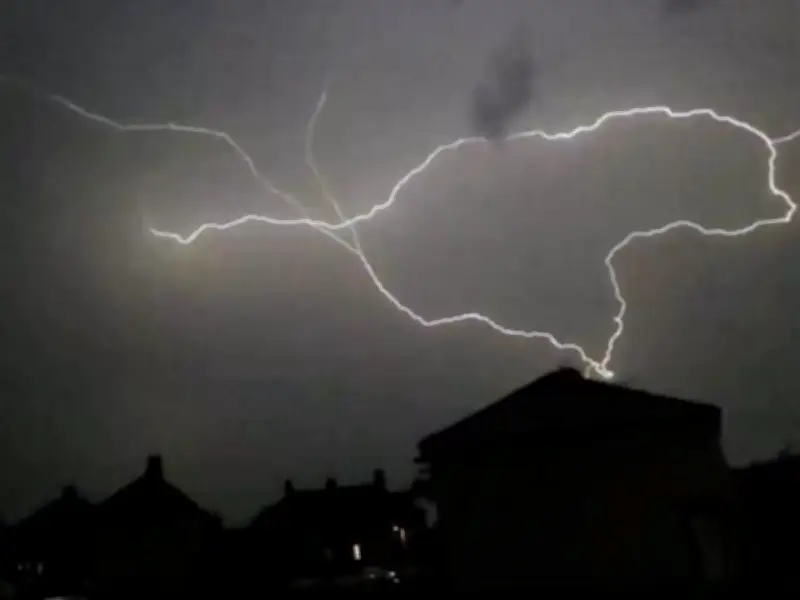
The Met Office has extended a yellow thunderstorm warning across much of Scotland until 3am on Saturday, June 27, after heavy rain cleared more slowly in the far north. The warning follows days of high temperatures and a heatwave, with forecasters warning of heavy downpours, frequent lightning, hail, and winds up to 60mph.
Overnight Storms Light Up Scottish Skies
Overnight thunderstorms already put on a spectacular display across parts of Scotland. Residents shared dramatic footage of lightning illuminating the skies above Edinburgh, Fife, and surrounding areas. While many places remain dry, areas that see thunderstorms could experience torrential rain and frequent lightning.
Why Thunderstorms Follow Hot Weather
Thunderstorms are most likely to develop when the atmosphere becomes unstable. According to the Met Office, this usually happens when very warm air near the ground sits beneath much cooler air higher up. During hot and humid weather, particularly after several days of strong sunshine, the perfect conditions are created for this to happen.

As the sun heats the ground, warm air near the surface becomes lighter and begins to rise. As it climbs higher into the atmosphere, it cools and moisture condenses into water droplets, forming towering cumulonimbus clouds. These clouds can grow rapidly to several miles high and produce torrential rain, hail, strong winds, and lightning.
How Lightning and Thunder Form
Inside the cloud, strong updrafts and downdrafts send water droplets, ice crystals, and hailstones crashing into each other. Those collisions build up electrical charges, with positive charge collecting near the top and negative charge gathering lower down. Eventually, the difference becomes so large that it is released as a lightning strike. The flash heats the air around it to around 30,000°C, about five times hotter than the surface of the sun, making the air expand very quickly.
The rapid expansion creates a shockwave that produces thunder. Although thunderstorms can build quickly, they are often localised, meaning one area may get torrential rain and frequent lightning while another nearby stays dry.
Potential Disruption and Flooding
Thunderstorms can bring much-needed rain after a hot spell, but they can also cause major disruption. The Met Office has warned of possible flooding to homes and businesses, difficult driving conditions, transport delays, and power cuts where the heaviest thunderstorms hit. Many Scots experienced the first round of storms early on June 26, with social media users describing "spectacular" lightning displays and "tremendous" thunder echoing across Edinburgh and other parts of the country.