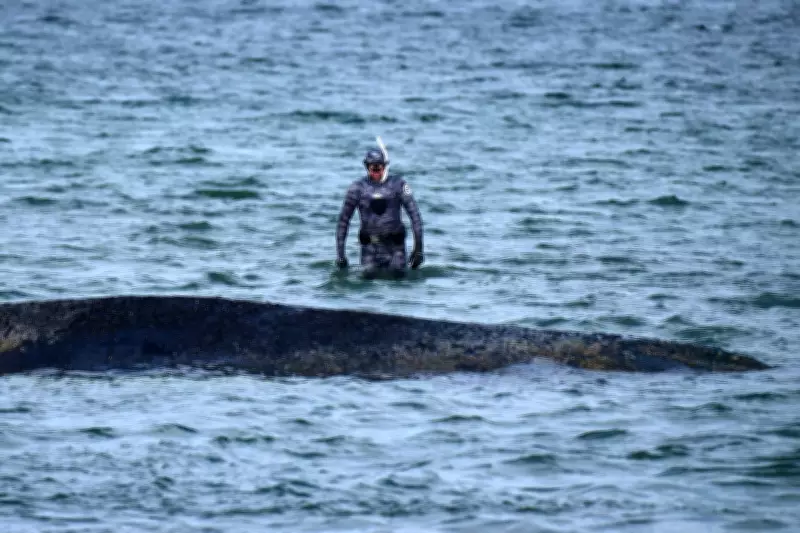
A humpback whale that was stranded for several days in the shallow waters of a popular German Baltic Sea resort has successfully swum free from a sandbank overnight, following a determined and last-ditch rescue operation. However, marine biologists are cautioning that the massive marine mammal is not yet out of danger and faces a challenging journey ahead.
Rescue Operation and Escape Channel
On Thursday, rescuers deployed an excavator to dig a carefully planned escape channel in front of the whale's head at Timmendorfer Strand, a well-known resort town. Marine biologist Robert Marc Lehmann, who was directly involved in the effort, guided the digging while approaching the animal. The team worked tirelessly until well after sunset, but had to pause for the night before the whale could fully escape.
Lehmann reported on Friday, via the German news agency dpa, that the whale subsequently swam through the newly dug channel overnight. This development marks a significant, though preliminary, success in the rescue mission.

Ongoing Perils and Long Journey
Despite this progress, experts emphasize that the whale's ordeal is far from over. Measuring between 12 and 15 meters (39 to 49 feet) in length, the whale is believed to be a young male, as males are more prone to migration than females. It is also suspected to be the same individual spotted multiple times in recent weeks in the port of Wismar, located east of Timmendorfer Strand.
Stephanie Gross of the Institute of Terrestrial and Aquatic Wildlife Research noted that early on Friday morning, the whale was observed making its way out of Lübeck Bay, where the resort is situated. It was accompanied by a coast guard ship and several boats, positioned about 300 meters (nearly 1,000 feet) off the coast.
The primary concern now is the whale's path to safety. Humpback whales are not native to the Baltic Sea, and this individual must navigate several hundred kilometers through German and Danish waters to reach the North Sea and, ultimately, the Atlantic Ocean—its true home. The Baltic Sea's lack of strong tides, which initially hindered rescue attempts by making it difficult to free the whale with boats creating waves, continues to pose a challenge for its navigation.
Initial Stranding and Rescue Efforts
The whale was first discovered stuck on an underwater sandbank at Timmendorfer Strand on Monday morning. Initial attempts to free it involved using coast guard and fire department boats to generate large waves, aiming to coax it back toward deeper water. These efforts proved unsuccessful, leading to the more intensive excavation strategy.
The exact reason for the whale's presence in the area and subsequent stranding remains unclear. As the rescue team celebrates this small victory, they remain vigilant, aware that the whale's survival hinges on its ability to complete the arduous journey ahead through unfamiliar and potentially hazardous waters.