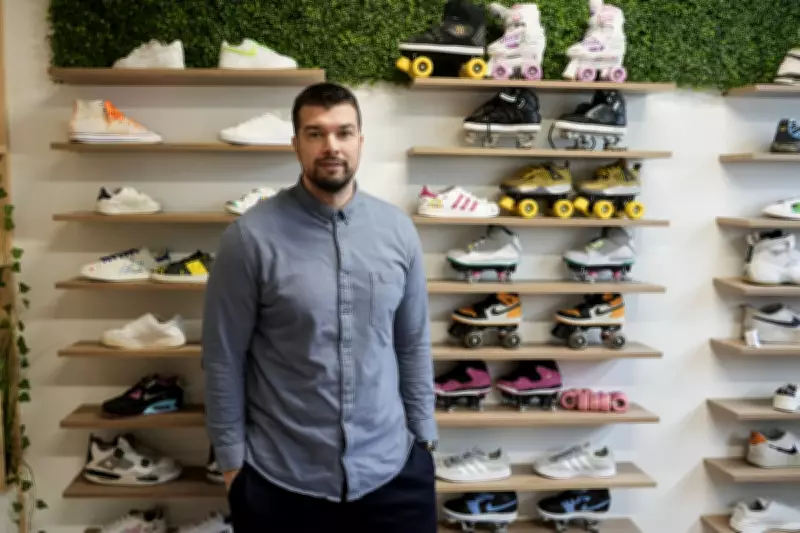
French Nonprofit Tackles Fast-Fashion Crisis Through Sneaker Salvage Initiative
In a workshop located east of Paris, a dedicated nonprofit organization is confronting the escalating issue of fast-fashion waste by focusing on a single item at a time: sneakers. Each week, hundreds of used sneakers arrive at this facility, where a team of workers meticulously inspects each pair to determine its fate—whether it can be resold, redistributed to those in need, or ultimately rejected due to irreparable damage.
Scaling Up Sneaker Salvage Operations
The organization, known as SneakCœurZ, has established itself as a pioneer in the sneaker sector by industrializing the processes of collection and reuse. According to Mohamed Boukhatem, the director general and co-founder, the nonprofit collected an impressive 30,000 pairs of used sneakers last year alone. Of these, 2,000 pairs were successfully resold, and the group has ambitious plans to significantly expand these numbers in the coming years.
"Today, there is no project of this scale in the sneaker sector," Boukhatem emphasized. "We are the only ones able to industrialize both the processes and the collection of sneakers for reuse." This initiative highlights a critical waste problem in France, a country renowned as a global fashion and luxury hub, particularly in its capital, Paris.

The Environmental Stakes of Textile Waste
The urgency of SneakCœurZ's mission is underscored by the severe environmental impact of the textile industry. The United Nations reports that the fashion and textiles sector is responsible for up to 8% of global greenhouse gas emissions, ranking it among the world's most polluting industries. Additionally, the European Parliament has noted that textiles were the third-largest source of water degradation and land use within the European Union in 2020.
In France, the scale of the problem is vast. Refashion, the government-approved eco-organization for clothing, household linen, and footwear, states that 259 million pairs of shoes were sold in the country in 2024. Alarmingly, only about one-third of used textiles and footwear are separately collected, with the remainder often left unused in cupboards or discarded with general household waste.
Inside the Workshop: The Salvage Process
At the Champs-sur-Marne workshop, workers for SneakCœurZ conduct thorough inspections of each incoming sneaker. Paul Defawes Abadie, the workshop manager, explains that the decision to refurbish a shoe hinges on its structural integrity. "The structural elements of the shoe are what determine whether we can refurbish it or not," he said.
Defawes Abadie detailed that minor issues, such as damaged Velcro straps, broken laces, or surface dirt, do not disqualify a sneaker from salvage. "A damaged Velcro strap isn't a deal breaker. A lace isn't a deal breaker. Dirt is never a deal breaker," he clarified. "What really matters is the wear of the structural materials, especially the outsole."
For pairs that meet the criteria, the refurbishment process involves:
- Cleaning from the sole upward
- Disinfecting the interior
- In some cases, whitening under UV light
Once restored, these sneakers are reintroduced into circulation. Beyond environmental benefits, the nonprofit has redistributed over 7,000 pairs to individuals in need and has contributed to the creation of 19 jobs, demonstrating a positive social impact alongside its ecological goals.
Future Goals and Legislative Context
Looking ahead, Boukhatem has set ambitious targets for SneakCœurZ. "Over the next three years, the goal is to triple or even quadruple these volumes and move to an industrial scale," he announced. This expansion aligns with broader national efforts to address fast-fashion waste through legislative measures.

France has implemented several policies to combat this issue, including the 2020 anti-waste law, which mandates that unsold nonfood goods be reused, donated, or recycled rather than destroyed. In November 2023, authorities introduced a state-backed repair bonus for clothing and shoes to encourage sustainability. Furthermore, lawmakers are currently advancing a bill aimed at reducing the textile industry's environmental footprint. This bill passed the National Assembly in March 2024 and the Senate in June 2025, with the government indicating in February that it aims to convene a joint parliamentary committee this spring to finalize the legislation.
Through its innovative approach, SneakCœurZ is not only providing a practical solution to sneaker waste but also contributing to a larger movement towards sustainable fashion practices in France and beyond.