Mardi Gras Transforms Tradition with Eco-Conscious Bead Revolution
As New Orleans plunges into the vibrant chaos of Carnival season, the iconic green, gold, and purple Mardi Gras beads are undergoing a remarkable environmental transformation. Once treasured as glass keepsakes eagerly snatched by parade-goers, these symbols of celebration had devolved into mountains of cheap plastic necklaces, mass-produced overseas and hurled from floats with abandon.
The Plastic Problem That Flooded New Orleans
While revelers traditionally adorn themselves with dozens of bead strands, countless others end up discarded across city streets. The environmental consequences became devastatingly clear several years ago when post-flooding cleanup revealed over 46 tons of plastic beads obstructing storm drains. This created a profound dilemma: the beads had become an ecological nightmare, yet imagining Mardi Gras without them seemed nearly impossible.
Kristi Trail, executive director of the Pontchartrain Conservancy, explained the dual threat: "First, plastic beads clog storm drains, exacerbating flooding. Then, those not caught in drains wash directly into Lake Pontchartrain, where they endanger marine life." Her organization is currently preparing to study microplastic contamination in the lake, highlighting growing concerns about long-term environmental damage.

The Krewe That Dared to Ban Plastic
In a bold sustainability move, the Krewe of Freret made history last year by becoming the first major parading organization to completely prohibit plastic beads from their parade. "Our riders loved this change because spectators no longer value cheap plastic beads," revealed Freret co-founder Greg Rhoades. "The plastic has become so ubiquitous that people actually dodge out of the way when they see it coming toward them."
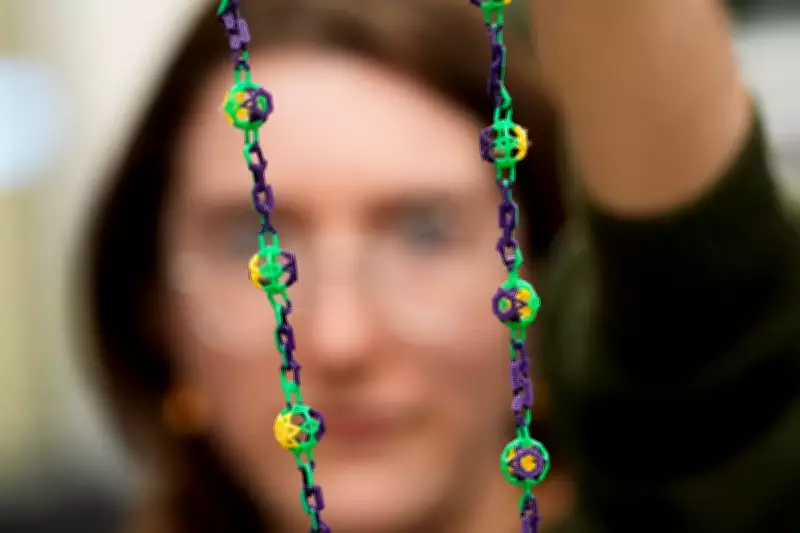
This year, beads have returned to Freret's parade—but with a crucial difference. They're among three krewes now distributing biodegradable "PlantMe Beads" developed through innovative research at Louisiana State University.
Louisiana State University's Green Innovation
Graduate student Alexis Strain, working in Professor Naohiro Kato's biology laboratory, has pioneered these sustainable alternatives. The PlantMe Beads are 3D-printed from polylactic acid (PLA), a commercially available starch-based material. Each large hollow sphere contains okra seeds, allowing the entire necklace to be planted. The okra attracts bacteria that accelerate decomposition, creating a truly circular product.
Professor Kato first conceived the biodegradable bead concept in 2013 after conversations with environmental advocates concerned about Carnival's ecological footprint. As a plant biologist, he recognized the potential of bioplastics derived from vegetation. The laboratory's initial breakthrough came in 2018 with beads made from microalgae-based bioplastic, though production costs proved prohibitive for widespread adoption.
Strain's experimentation with 3D printing technology ultimately birthed the PlantMe Bead. For the 2026 Carnival season, LSU students have produced 3,000 of these innovative necklaces, distributing them to three krewes in exchange for feedback about design and spectator reception.
The Sustainable Mardi Gras Movement Gains Momentum
The shift toward environmentally conscious celebrations has been building for years, encompassing a growing variety of thoughtful parade throws including food items, artisanal soaps, and practical sunglasses. While Trail acknowledges that comprehensive data about the movement's impact remains limited, the Pontchartrain Conservancy recently secured a grant to study this question systematically.
"Beads represent just one aspect of the challenge," Trail noted. "Mardi Gras generates approximately 2.5 million pounds of trash overall, so we need comprehensive solutions."

Looking Beyond Beads to Cultural Transformation
The LSU laboratory continues exploring sustainable Carnival innovations. Strain is testing alternative 3D printer materials that biodegrade rapidly without requiring planting. Professor Kato is discussing educational partnerships with local schools, envisioning students learning about bioplastics and plant biology while 3D-printing necklaces as community projects. He remains committed to making algae-based bioplastic commercially viable.
Yet Kato emphasizes that the ultimate goal transcends simply replacing one bead type with another. "We shouldn't aim to substitute plastic beads with less harmful versions," he asserted. "I hope Mardi Gras embraces the broader concept of waste reduction."
Rhoades confirms Freret is moving in this direction, noting that their most coveted throws now include baseball hats featuring the krewe's logo. "I see people wearing these hats throughout New Orleans year-round," he observed. "Other krewes have noticed this positive response. We believe we can inspire larger organizations to prioritize throws that people genuinely value, use regularly, and proudly share on social media."
This cultural shift represents perhaps the most significant transformation: from disposable plastic to meaningful keepsakes that extend Mardi Gras spirit throughout the year while protecting Louisiana's unique environment.