Shigeru Ban's Architectural Alchemy: Turning Waste into Wonder
"I don't like waste," declares Japanese architect Shigeru Ban, a statement that encapsulates his entire architectural philosophy. This visionary designer has spent decades transforming materials others discard—cardboard tubes, beer crates, styrofoam, and shipping containers—into structures of remarkable beauty and resilience. Through what can only be described as architectural alchemy, Ban refines rough edges and converts fragility into sturdiness, creating what he terms "scavenger architecture."
From Disaster Zones to High-End Boutiques
Ban's work defies conventional categorization, seamlessly blending eastern and western design traditions while straddling the line between luxury and necessity. His buildings range from emergency shelters for disaster victims to high-end fashion boutiques in Tokyo's glamorous Ginza district. Currently, he's working on a timber distillery in Scotland's Speyside region, whisky's holy land, featuring an elaborately arboreal structure reminiscent of fantasy landscapes.
Despite this diversity, Ban maintains a consistent perspective on architecture's fundamental nature. "In big cities like Los Angeles or Tokyo," he observes, "large buildings can just disappear, especially in the commercial sector—torn down to make way for new ones that will make more money for developers. Whereas a building made of paper can be permanent, as long as people cherish it."

Paper Architecture with Real-World Impact
Recently awarded the 2026 American Institute of Architects Gold Medal, Ban remains committed to his core mission: improving lives in disaster and conflict zones. He's currently building a hospital in Lviv, western Ukraine, using cross-laminated timber from local factories that can no longer export their products. "They're looking for an opportunity to deploy it within Ukraine," Ban explains.
For Ban, architecture represents flexible systems rather than fixed structures—mobile and responsive solutions to human needs. This perspective is particularly relevant in Japan, where natural disasters can reshape cities in seconds. The country's Meteorological Agency records earthquake activity as ubiquitous as rain in the UK, making resilient design essential.
The Paper Dome and Beyond
Following the devastating 1995 Kobe earthquake that killed over 5,000 people, Ban designed the Paper Dome to replace the destroyed Takatori Catholic Church. Constructed in just five weeks by volunteers using donated materials, this elliptical structure featured recycled cardboard tube columns inspired by Bernini's baroque church in Rome. What began as a temporary solution evolved into a community center hosting weddings, concerts, and film shows before being dismantled and shipped to earthquake-ravaged Taomi, Taiwan, where it still stands today.
Ban's disaster response architecture extends beyond symbolic structures. He created modular houses for Kobe's displaced Vietnamese community using cardboard tube walls supported on beer-crate foundations filled with sandbags. He also developed lightweight partitioning systems from cardboard tubes and fabric screens to provide privacy in evacuation centers—a basic human right he believes governments often overlook. This system is now officially employed throughout Japan and was even used for Ukrainian refugees fleeing Russia's invasion.
Cardboard Cathedrals and Community Building
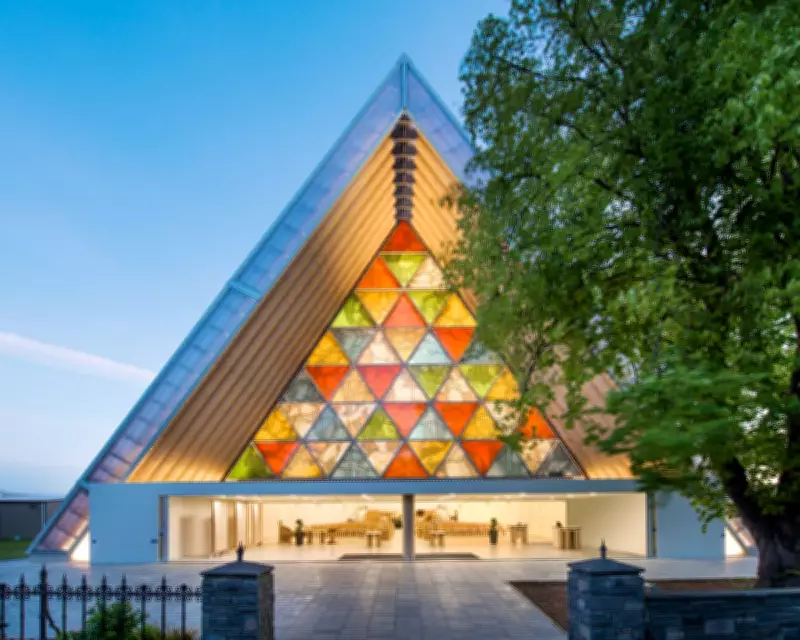
The now-famous Cardboard Cathedral in Christchurch, New Zealand, demonstrates Ban's material innovation on a grand scale. After the 2011 earthquake damaged the city's 19th-century cathedral, authorities contacted Ban requesting "a temporary church free of charge." The resulting structure features cardboard tubes 60cm in diameter, reinforced with laminated timber, forming a soaring A-frame with a tubular cardboard cross above the altar.

Ban's approach isn't limited to emergency response. He has designed an art museum with a basket-weave facade in Aspen, Colorado, and the Pompidou Centre in Metz, France, featuring a meringue-peaked roof reminiscent of Frank Gehry's extravagances. Yet his outlook remains distinctly un-starchitect. "Architects work mainly for people with wealth and power," he notes. "We're hired to create monuments to them. I want to use my experience not only for the privileged, but also for the person who has seen their home destroyed."
Sustainable Systems and Future Projects
Ban established the Voluntary Architects' Network, an NGO developing temporary housing using low-cost, recyclable local materials and labor. This initiative bridges the gap between immediate disaster relief and permanent reconstruction, with projects ranging from Pakistan to Altadena.
Currently, Ban is working on reconstructing houses on Japan's Noto Peninsula, destroyed by a New Year's Day 2024 earthquake that killed over 700 people. The project incorporates timber recycled from a massive ring-shaped installation designed for last year's Osaka Expo. "The original plan was to dismantle and burn what was billed as the world's largest timber structure," Ban explains. "But I thought that was such a waste. So I proposed some of the timber be used in post-earthquake reconstruction."
From cardboard tubes to salvaged roof tiles, Shigeru Ban continues proving that innovative design needn't come at the expense of sustainability or social responsibility. His work demonstrates that the most humble materials, when approached with creativity and compassion, can create spaces of enduring beauty and purpose.