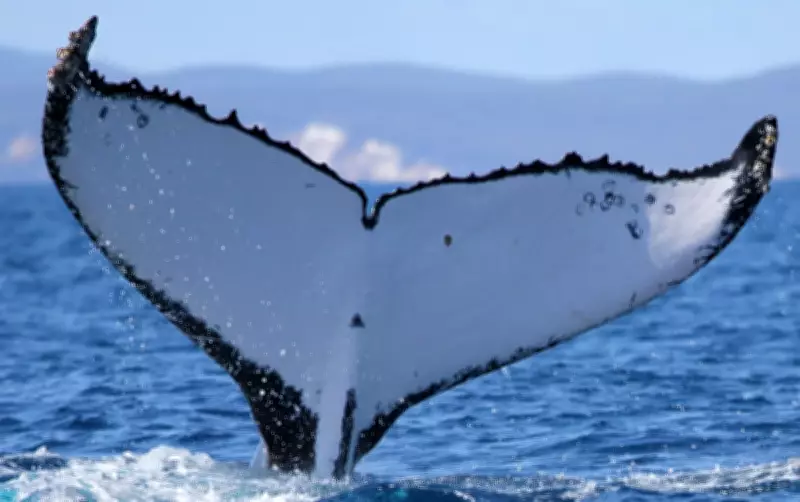
A humpback whale has been documented traveling an extraordinary 15,000 kilometers from Brazil to Australia, setting what researchers believe is the longest distance ever recorded between sightings of an individual humpback whale.
Discovery of the Record Journey
The whale was first photographed in 2003 at the Abrolhos Bank, Brazil's primary humpback whale nursery, located off the coast of the north-eastern state of Bahia. More than two decades later, in September 2025, it was spotted again in Hervey Bay off the Queensland coast. The straight-line distance between these two locations is approximately 15,100 kilometers.
Stephanie Stack, a PhD candidate at Griffith University and co-author of the new research published in Royal Society Open Science, described the finding as extraordinary. She noted that it is unprecedented to photograph a whale that has traveled such a vast distance.

Stack emphasized the remarkable nature of the 22-year gap between sightings, stating that the whale had not been seen for over two decades, which is itself a notable achievement.
Identification Through Fluke Photos
The whale was identified through a repository of photos on the platform Happywhale, where researchers and citizen scientists contribute whale sightings. Individual humpback whales can be identified by their flukes—the underside of their tails—which are unique to each animal, much like human fingerprints. Flukes are distinguished by their shape, patterns of black and white pigmentation, and distinctive features such as scars.
The Happywhale platform, co-founded by study co-author and Southern Cross University whale biologist Ted Cheeseman, employs an AI algorithm to identify matches, similar to facial recognition technology used for humans.
Additional Long-Distance Traveler
Another whale was photographed in Hervey Bay in 2007 and sighted again in the same area in 2013. Six years later, it was spotted off the coast of São Paulo, Brazil. The distance between these two breeding grounds is about 14,200 kilometers.
These two whales represent the first recorded exchange in both directions between the Brazilian and eastern Australian humpback whale populations. The researchers noted that the resighting intervals of six and 22 years suggest that such journeys are rare, possibly occurring only once in a lifetime, rather than being regular migratory shifts.
Statistical Rarity
The study analyzed 19,283 fluke photos collected between 1984 and 2025 from eastern Australia and Latin America. The two whales accounted for only 0.01% of all identified whales, highlighting the rarity of such long-distance movements.
Stack acknowledged the limitations of photo identification research, noting that researchers only have two data points: the starting point and the endpoint. The actual routes taken and the total distance traveled remain unknown, as the whales could have journeyed much farther than the straight-line distances indicate.
Implications for Conservation
The typical migration route for an Australian humpback whale involves traveling between feeding grounds in Antarctic waters and breeding grounds near the Great Barrier Reef, a round trip of about 10,000 kilometers. The discovery of these two whales crossing the open ocean underscores the need for international collaboration in marine conservation, as these migratory animals move across borders and between countries.
Stack also highlighted the potential impact of climate change on future migration patterns, pointing to dramatic changes in the Southern Ocean feeding grounds, where Antarctic krill populations are under threat. It is very likely that such environmental shifts will affect whale migration routes in the years to come.