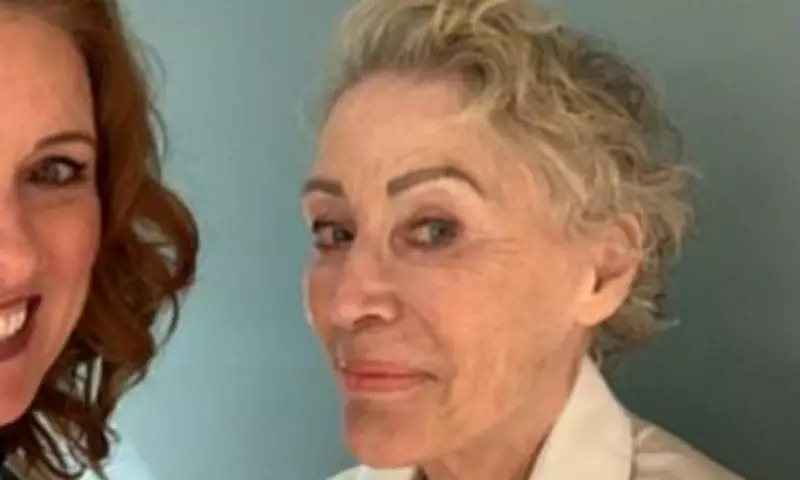
Angie Best debuted her new hairstyle in a candid Instagram post on Friday, as she said she's only got '15 hairs' left after undergoing chemotherapy for colon cancer. The ex-wife of late Manchester United legend George Best and mother of TV personality Calum Best stunned fans when she revealed she was battling colon cancer.
Mistletoe Therapy in Switzerland
Angie, 73, has since travelled to Switzerland for an unconventional cancer treatment known as mistletoe therapy, so called because it uses extracts from the European mistletoe plant, which can be used alongside traditional chemotherapy. The star has shared on Instagram that she's struggling with hair loss as a side-effect of her treatment, and paid a visit to the salon to have her pixie cut styled into a new look.
Hair loss is a common side effect for chemotherapy, and can begin 14 to 21 days after the first treatment. Angie shared a snap of her new hairstyle, along with the caption: 'Went to see the lovely @ginaconwaysalonandspa today and she worked wonders with what she had, 15 hairs.'

Progress and Humour
Last week, she shared a video revealing the amount of hair she'd lost, posting a video of a large clump in her hand, while saying she'd need to 'develop a sense of humour about going bald.' Angie's oncologist recently informed her that her treatment has been going well and has got rid of most of the cancer.
'I went to see my oncologist yesterday and he said, "Ange, you've done amazing. In four sessions we've got rid of 80 per cent of your cancer which is phenomenal." I was thrilled but he said, "you have to come back for another four sessions." If four got rid of 80 per cent, why do I need four more? I said, "let's do two" and he said, "OK."'
She added: 'I was hoping I'd walk in and he'd say, "Ange, it's all gone, you're cancer free." I had that in my head for a week. "Ange, your cancer free," but then I would look at my face and say, "holy s**t no you're not." ' Thanking her social media followers, she said: 'Your support means the world and I love you. Sorry for moaning, I'm just feeling a bit sorry for myself.'
Struggles with Weight
In February, Angie revealed she was struggling to put on weight because she has a healthy diet and those sorts of foods don't help with weight gain. 'I'm having my mistletoe treatment today. I have to say, this being sick, it's a very humbling experience,' she said. 'It makes you second guess everything. I'm trying to eat healthy because I've got to gain weight because I weigh 46 kilos and with the next two rounds of chemo, I need more weight. But the problem is, I'm trying to eat healthy so I've now got to go and eat, not quite so healthy. I'm sure I'll think of something.'
In a caption alongside the video, she wrote: 'Today I'm having Mistletoe therapy, it stimulates your immune system and mitigates side effects of Chemo and radiation like pain nausea and fatigue.' Angie's son Calum commented on the video and wrote: 'I love you'.
Mistletoe Treatment Explained
Mistletoe treatment is an alternative cancer treatment that has been used in Europe for decades, particularly in Germany, Switzerland and Austria. Some practitioners believe it can stimulate the immune system and improve quality of life for cancer patients, though its effectiveness remains debated in mainstream medicine. It is not a standard, approved cancer treatment on the NHS, as robust evidence of its effectiveness as a cure is considered inconclusive by major UK cancer bodies. It can be used alongside chemotherapy, which is what Angie is doing.
Son Calum's Emotional Revelation
Former Celebrity Big Brother star Calum, Angie's only son, revealed his mother's diagnosis in a devastating video posted to social media in January. In the clip, the clearly distressed star said: 'A few weeks ago, my beautiful, wonderful mum was diagnosed with cancer. For as long as I can remember, she has lived her life rooted in health, fitness and wellbeing. She has always believed in taking care of the body, mind and soul. But as we all know, cancer doesn't discriminate. It doesn't care where you're from, how you live, or how healthy you try to be. And now, it's here – and it's with my mum.'

Calum admitted he 'hasn't cried in years' but has been on an 'emotional rollercoaster' since his mother's diagnosis. 'My mum has been diagnosed with colon cancer that has spread to her liver,' he explained. 'To move forward, we need access to specialist care and professionals who can offer the right treatment. This is incredibly hard for me to say, but financially, I can't carry this on my own.' The reality star set up a GoFundMe page to help cover the costs of his mother's specialist treatment, saying: 'Any contribution, no matter how small, will help us access the specialists, treatment and care my mum needs during this time.'
Colon Cancer: Warning Signs and Statistics
Bowel, or colorectal, cancer affects the large bowel, which is made up of the colon and rectum. Such tumors usually develop from pre-cancerous growths, called polyps. Symptoms include bleeding from the bottom, blood in stools, a change in bowel habits lasting at least three weeks, unexplained weight loss, extreme unexplained tiredness, and abdominal pain. Most cases have no clear cause; however, people are more at risk if they are over 50, have a family history of the condition, have a personal history of polyps in their bowel, suffer from inflammatory bowel disease such as Crohn's disease, or lead an unhealthy lifestyle. Treatment usually involves surgery, and chemo- and radiotherapy. More than nine out of ten people with stage 1 bowel cancer survive five years or more after their diagnosis. Unfortunately, only around a third of all colorectal cancers are diagnosed at this early stage. The majority of people come to the doctor when the disease has spread beyond the wall of the colon or rectum or to distant parts of the body, which decreases the chance of being successfully cured. According to Bowel Cancer UK figures, more than 41,200 people are diagnosed with bowel cancer every year in the UK. It affects around 40 per 100,000 adults each year in the US, according to the National Cancer Institute.