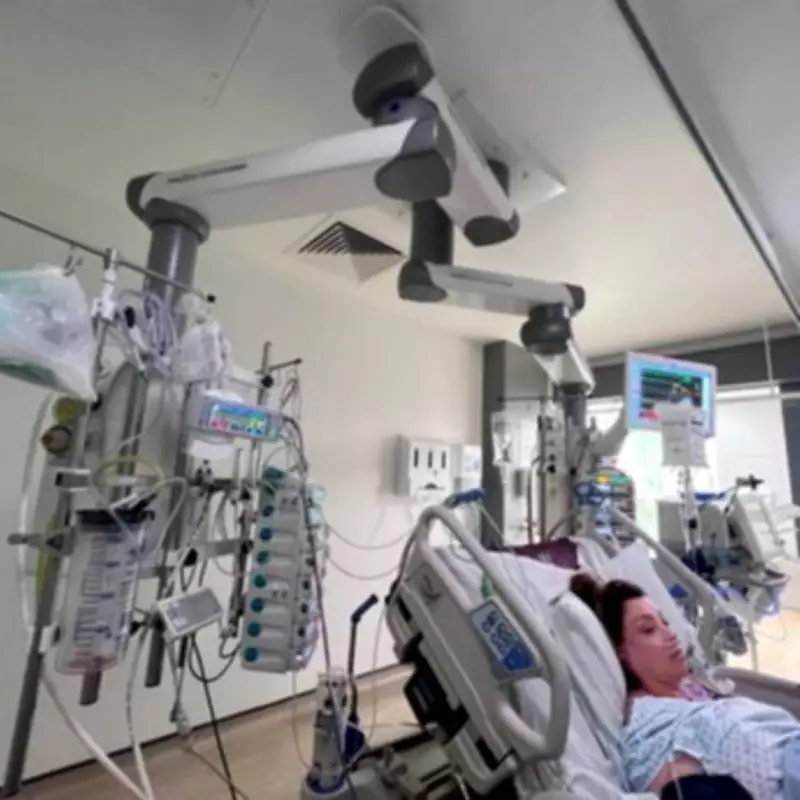
Chloe Jacobs, a 39-year-old teaching assistant from Newport on the Isle of Wight, woke in the early hours feeling dizzy and perspiring, unaware that she was moments from a life-threatening medical crisis. At 34 weeks pregnant, her initial symptoms seemed mild, but just ninety minutes later, she awoke to discover herself bleeding profusely, a terrifying prelude to a placental abruption that would nearly claim her life and that of her unborn daughter.
A Terrifying Night Unfolds
In the dead of night, at 1:30 am, Chloe experienced dizziness that prompted concern. She managed to drift back to sleep, but by 3:00 am, the situation escalated dramatically. Sitting on the toilet, she watched in horror as blood poured from her body "like a tap," she recounted. Her fiancé, Chris Smallwood, 40, immediately dialled for an ambulance, his hands trembling as he relayed the emergency to dispatchers.
The Isle of Wight and Hampshire ambulance service responded with remarkable speed, arriving at their home in under five minutes. Paramedics rushed Chloe to St Mary's Hospital on the Isle of Wight, where medical teams sprang into action. Upon examination, doctors confirmed that while her baby was stable, delivery needed to occur within thirty minutes to prevent catastrophic outcomes.

Emergency Delivery and Uncontrollable Bleeding
At 4:51 am, their daughter, Pixi, was delivered via emergency caesarean section, weighing a fragile 4lbs 12oz. However, the joy of birth was swiftly overshadowed by medical urgency. Medics discovered that Chloe's placenta had partially separated from her womb, a condition known as placental abruption, causing severe haemorrhaging that defied initial control efforts.
Just twenty minutes after Pixi's arrival, doctors informed Chris that they needed to place Chloe into an induced coma to manage the bleeding. The scene in the operating theatre grew increasingly tense, with approximately twenty medical professionals working frantically. Chris, waiting anxiously outside, described hearing people running past the door and receiving updates every twenty minutes that the bleeding continued unabated.
A Battle for Survival
Chloe's condition deteriorated rapidly as she lost approximately eight litres of blood. At one critical juncture, Chris was instructed to contact Chloe's mother, a moment that shattered his composure. "I just broke down," he admitted, fearing the worst. Meanwhile, Pixi was transferred to the special care baby unit, where her breathing required support for five hours.
The medical team administered a staggering seventeen litres of transfusions, including nine litres of blood, supplemented by platelets and plasma. This heroic effort eventually stabilised Chloe, with doctors successfully halting the haemorrhage. Remarkably, she regained consciousness after just three-and-a-half hours, defying expectations of a twenty-four-hour coma.
Gratitude and Recovery
Both mother and baby have since returned home, recovering well from their ordeal. Chloe expressed profound gratitude, stating, "I'm so lucky and so grateful to be alive. I honestly can never thank the medical team enough." She reflected on the fragility of the situation, acknowledging that she or Pixi, or both, could easily have died.
Chris echoed these sentiments, praising the NHS for their lifesaving intervention. "We're so incredibly grateful and lucky to have the NHS," he said. "If this happened in many countries, Chloe and Pixi could easily not have survived, and in other countries, we'd be in millions of pounds worth of debt."
Chloe was discharged from hospital on March 10, with Pixi following on March 20 once her breathing had stabilised. Chris marveled at his partner's resilience, noting, "It's amazing that she's here and so well—no problems with organs or anything. She's so strong and so lucky."
The couple, who have been together since 2023 and discovered they were expecting Pixi in July, now cherish every moment with their daughter, whose due date was originally set for April 8. Their story serves as a stark reminder of the dangers of placental abruption and the critical importance of rapid medical response in maternal healthcare.