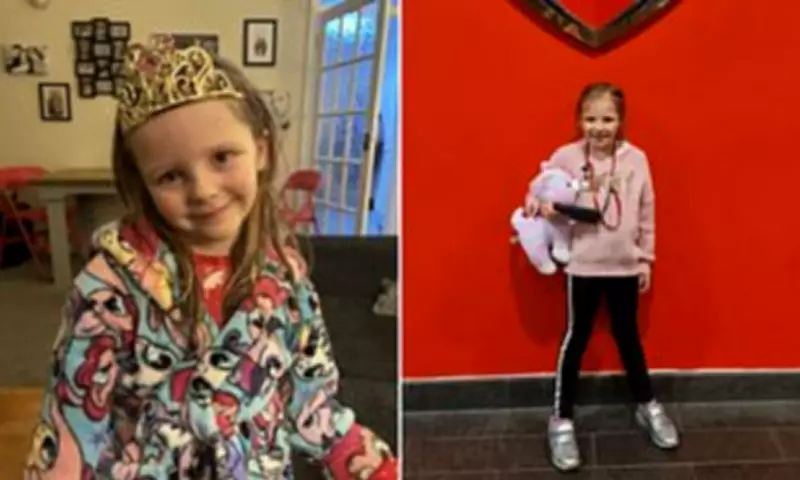
For most eight-year-old children, daily life revolves around playdates, school assignments, and occasional negotiations with parents regarding screen time limits. However, for young Daisy from Southend-on-Sea, her existence is structured around medical appointments and extensive periods spent on an iPad while confined to a hospital bed, as she confronts an exceptionally rare medical condition.
A Medical Mystery Unfolds
The child has been diagnosed with Human Papillomavirus (HPV), but for reasons that remain unexplained, her body has responded in an unusual manner. To date, Daisy has endured eight surgical procedures and faces the prospect of additional operations in the future.
The Initial Discovery
This challenging medical journey commenced in 2023 when five-year-old Daisy returned home from Greenways Primary School nursery with what her mother described as "blood in her knickers." Kara Hince, then 29 years old, experienced immediate panic and rushed her daughter to the accident and emergency department.

"I was completely panicked," Kara recalls, describing how her thoughts spiraled with worry. Daisy was admitted overnight, but the following morning, a medical professional dismissed the bleeding as an early onset of menstruation and discharged the child.
"I just didn't feel that was right at the time," Kara explains. "We all started our periods at very normal ages in our family. But it was the first time it happened. I just had to trust what I was being told and wait to see what happens. She was a normal, healthy child."
Escalating Concerns
Two weeks later, the symptoms reappeared, prompting another hospital visit. Initially, staff attempted to redirect them to a general practitioner, but Kara's mother, a breast cancer clinical nurse specialist, intervened. She insisted that a consultant at Southend University Hospital examine Daisy properly.
"They came and examined her, and within twenty-four hours we were at Great Ormond Street Hospital," Kara recounts. She later discovered her mother had been shielding her from the possibility that Daisy might have cancer, as the schoolgirl also exhibited small growths on her body that the family had previously overlooked as skin flaps.
Diagnosis and Emotional Impact
Medical specialists conducted a biopsy while Daisy was under anesthesia. Upon awakening, doctors delivered concerning news. "They told me they thought she had cancer," Kara explains. "They were ninety percent sure it was cancer - or it was something weird and wonderful that they had never seen before."
This revelation caused Kara to immediately break down emotionally. "Life completely stopped," she remembers. "I was seventeen weeks pregnant and it was meant to be an amazing, happy time. And on the day I turned seventeen weeks pregnant, I was told they thought Daisy might have cancer."
The Waiting Period
During the week-long wait for definitive results, Daisy required carrying everywhere at home due to a catheter insertion that left her struggling to walk. The entire family, including Daisy's father Steven Johnson, traveled to Great Ormond Street Hospital in London for the crucial results.
They received mixed news: while Daisy did not have cancer, she was diagnosed with Human Papillomavirus (HPV) - a viral infection typically associated with sexual transmission that causes painful growths, bleeding, and ongoing complications.
Understanding the Condition
According to the International Papillomavirus Society, approximately eighty percent of people will contract HPV at some point in their lives, with transmission occurring through skin-to-skin contact. However, Daisy's case presents unusual characteristics.
"Obviously I was massively relieved that it wasn't cancer," Kara acknowledges. "But that relief was very short-lived, because my thoughts started questioning how she got it. How has a five-year-old got this? It is heartbreaking. It is not their fault. I started questioning, 'But why? Why any child, but why my child?'"
Investigating Transmission
With understandable concerns about potential abuse, several family members gently questioned Daisy about whether anything inappropriate had occurred. The child consistently responded: "No, other than the doctors when they've been looking at me over the last few days, no one has hurt me."

The family and medical professionals remain uncertain about how Daisy contracted the virus, with one suggestion being possible transmission from a public toilet. "The only suggestion that the doctors gave me is that she may have gone to a public toilet, and used the toilet someone with HPV had used," Kara explains. "Most people wouldn't even react. But for some reason, something in her body reacted and caused all of this."
Ongoing Medical Challenges
By age eight, Daisy has undergone eight operations, each requiring catheterization, with growths returning after each procedure. "She would bleed and the growths would come back each time she flared up," Kara describes. "We would have to go to Southend University Hospital to the A&E. They would then refer her to Great Ormond Street Hospital, and we would normally be there within a day or two."
Experimental Treatment
After repeated recurrences, the London hospital initiated an intensive treatment trial last July involving the drug Avastin, administered through a port fitted into Daisy's chest. Commonly used for cancer patients to "starve" tumors, doctors hoped this approach would reduce the growths.
Initially, the treatment showed effectiveness until high protein levels appeared in Daisy's blood. Medical professionals subsequently halted the treatment due to concerns about potential kidney impact. "They don't know what's going on at the moment," Kara says. "She started producing protein as a side effect of the treatment."
Current Medical Status
Doctors have described themselves as "baffled," as scans reveal "nothing visibly wrong" with Daisy's kidneys, leading her case to be labeled "a mystery." The emotional strain has transformed Daisy into what her mother describes as "a different child."
"She handled it so beautifully when they put her to sleep," Kara observes. "We have never known a child handle it the way she does. She would laugh as they put her to sleep, but mentally it has taken a massive toll on her over time."
The child continues experiencing pain, primarily on her left side, while medical teams work to determine appropriate treatment approaches.
Personal Aspirations and Family Support
Despite her medical challenges and approximately fifty percent school attendance, Daisy maintains academic progress. "She keeps up with school and is not falling behind in anything academically," her mother proudly notes. "Her recent school report brought me to tears. I honestly can't explain how proud I am, considering everything that she is going through, we are just amazed by her."
Daisy, an enthusiastic Arsenal Football Club supporter, aspires to multiple professions. "She tells me, I am going to be a teacher in the day and then I am going to come home and be a nurse at night," Kara shares. "I will fit football in on the weekends."
Family Fundraising Efforts
Kara and her partner Billy Fraser are fundraising through GoFundMe to take Daisy and her two-year-old brother Theodore to Disney World in America. This wish originated from Daisy's profound love for Disney, particularly the film Inside Out, as a child who spends considerable time watching Disney content on her iPad during hospital stays.
"She watches videos of people going to Disney World and she has always said to me, 'if I could go anywhere, I'd go to Disney World and I'd go to America'," Kara explains.
Healthcare Response
Sharon McNally, Interim Chief Nursing Officer for Mid and South Essex NHS Foundation Trust, addressed the family's concerns: "We're very sorry that Daisy's family feel her care issues in 2023 were initially dismissed. We take any concerns raised extremely seriously. We'd welcome them getting in touch with our Patient Advice and Liaison Service to discuss what happened."
The family's experience highlights both the challenges of rare medical conditions in children and the resilience demonstrated by young patients facing extraordinary health circumstances.