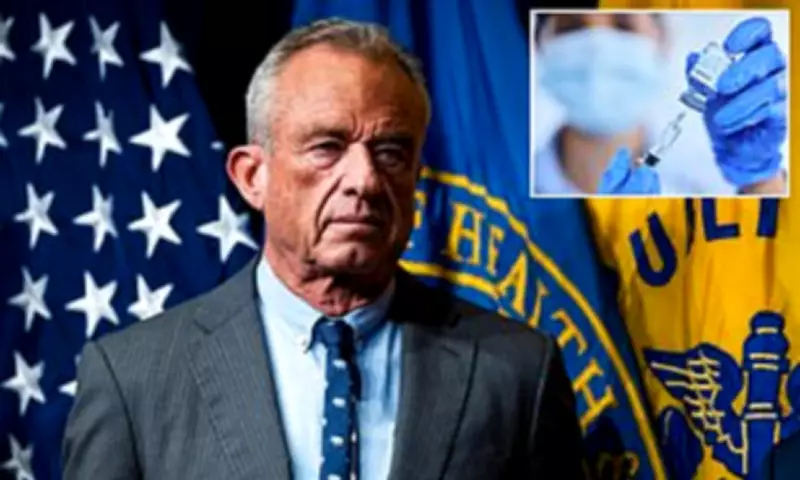
Federal Judge Temporarily Blocks Kennedy's Childhood Vaccine Policy Changes
A federal judge has issued a temporary block against federal health officials' plans to reduce the recommended number of childhood vaccines. Judge Brian E. Murphy ruled on Monday that Health Secretary Robert F. Kennedy Jr. likely violated federal procedures when he overhauled a key vaccine advisory committee, which had helped secure the controversial reforms.
Immediate Halt to Vaccine Recommendation Changes
The judge's decision immediately halts Kennedy's order to end broad recommendations for all children to be vaccinated against several illnesses. The affected vaccines include those for flu, rotavirus, hepatitis A, hepatitis B, certain forms of meningitis, and RSV. Additionally, the ruling stopped a meeting of a Kennedy-appointed vaccine advisory committee that was scheduled to convene this week in Atlanta.
Important clarification: The judge's order is not the final word on the matter. These blocks are temporary, pending either a full trial or a decision for summary judgment in the ongoing legal case.

Legal Challenge and Federal Response
The order issued Monday represents the latest development in a lawsuit originally filed in July 2025 by the American Academy of Pediatrics (AAP) and several other medical groups. Federal health officials have indicated they plan to appeal the decision.
Department of Health and Human Services spokesman Andrew Nixon stated: 'HHS looks forward to this judge's decision being overturned just like his other attempts to keep the Trump administration from governing.'
Background of the Legal Dispute
The lawsuit in federal court in Boston initially focused on Kennedy's decision to stop recommending COVID-19 vaccinations for most children and pregnant women. As Kennedy took additional steps that alarmed medical societies, the plaintiffs asked Judge Murphy to address those policy changes as well.
The legal challenge also examined Kennedy's actions concerning the Advisory Committee on Immunization Practices (ACIP), which advises public health officials on vaccine recommendations for doctors and patients. Kennedy, a prominent anti-vaccine activist before becoming the nation's top health official, fired the entire 17-member panel last year and replaced it with a group that includes several anti-vaccine voices.
Judge's Findings on Committee Reconstitution
Judge Murphy, who was nominated to the bench by President Joe Biden, determined that Kennedy's reconstitution of ACIP likely violated federal law. He ordered the appointments and all decisions made by the reconstituted committee to be put on hold.
Richard Hughes IV, an attorney representing the AAP, explained the practical implications: 'ACIP as currently constituted cannot meet. How can a committee meet without nearly the entirety of its membership?' The ACIP had been scheduled to meet this week to discuss COVID-19 vaccine safety among other issues, but that gathering has been postponed.
Expert Reactions and Historical Context
Jason Schwartz, a Yale University vaccine policy expert who has studied the committee, called the legal halting of an ACIP meeting 'unprecedented' in its 62-year existence. Hughes described the judge's order as 'a momentous step toward restoring science-based vaccine policy,' a sentiment echoed by leaders of several doctors' groups and public health organizations.
When Trump administration officials overhauled the childhood vaccine schedule, they claimed it wouldn't result in families losing access to vaccines or cause insurers to stop covering them. However, Dr. Andrew Racine, president of the AAP, noted that the changes left many Americans confused, as doctors' groups, public health organizations, and many states continued to recommend licensed vaccines.
State-Level Rejection and Public Guidance
Several doctors' groups asserted that the changes were not based on solid evidence and advised doctors and patients to follow guidance that was previously in place. Health officials in 30 states have rejected at least some of the new recommendations.

Dr. Racine expressed hope that the judge's order would bring clarity to the situation: 'If anyone has any questions about what's the appropriate vaccine schedule for their children, the best thing to do is to talk to their pediatricians.'
Historical Precedent and Future Implications
In December, an influential panel of US vaccine advisers voted to revoke a longstanding recommendation that all babies receive hepatitis B shots within 24 hours of birth—a move expected to reverse the country's progress toward eliminating the disease.
Schwartz predicted that federal health officials would continue expressing 'their deep skepticism regarding the importance of vaccination' and embracing 'unsupported vaccine safety allegations.' Following the ruling, one of Kennedy's appointees to the committee, Dr. Robert Malone, urged the Trump administration to keep pursuing Kennedy's vaccine policy changes, writing on Substack: 'A district court order is a delay, not a defeat.'
The legal battle continues as both sides prepare for further proceedings, with significant implications for childhood immunization policy and public health governance in the United States.