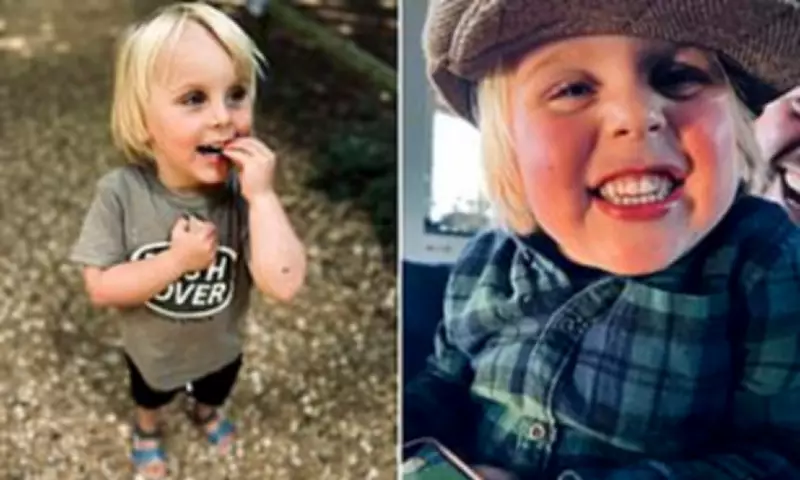
The familiar adage 'mother knows best' carries profound and painful significance for Storm Filitz, whose maternal instincts alerted her to her son Grayson's health struggles from his earliest days. Born in December 2021, Grayson exhibited signs of distress that differed markedly from his older sister Sky's infancy, crying frequently and appearing consistently unhappy as he grew.
The Long Road to Diagnosis
Storm and her husband Peter began voicing concerns when Grayson failed to meet developmental milestones, embarking on a frustrating journey through the healthcare system that would eventually reveal their son's diagnosis of Duchenne muscular dystrophy (DMD). This severe, progressive genetic disorder causes muscle degeneration and typically limits life expectancy to around thirty years.
Missed Milestones and Medical Dismissals
'Grayson just consistently missed all his milestones,' Storm told the Daily Mail. 'He only sat up without assistance at eight months, started crawling at the age of one and took his first very wobbly steps on his second birthday. He was also non-verbal, only saying two words: Mama and Dada.'

Despite raising concerns during three postnatal check-ins, Storm felt repeatedly dismissed by healthcare professionals. 'The nurses kept saying to me he was okay and I kept being fobbed off by GPs, who said he was a "late bloomer",' she recounted. 'I kept saying "no, there is something wrong with my child". He seems to always be in pain.'
Private Consultations and International Advice
The Southampton family's frustration with NHS responses led them to seek private medical help in 2023 when Grayson was one. A private paediatrician in Windsor suggested hypermobility might explain his unsteadiness, while an X-ray for hip dysplasia returned negative results. The consultation concluded with familiar advice: 'your son is fine, just give it a couple of months and see how he gets on. He is a late bloomer.'
Facing a year-long NHS waiting list for paediatric consultation, the family turned to international options. Storm's sister Kristy, living in Portugal, suggested a paediatric neurologist consultant in Lisbon. A FaceTime consultation in 2023 raised concerns about potential autism and recommended specific tests, but the NHS GP responded that most were unavailable through the service.
The Devastating Diagnosis
After another year of waiting, the family secured a second UK medical opinion from a private paediatric neurologist in Bournemouth in July 2024. This specialist immediately recognized the need to rule out Duchenne and Becker muscular dystrophy, quoting £10,000 for necessary tests the family couldn't afford.
Finally accessing NHS specialist care in January 2025, the Filitz family underwent genetic testing that initially returned negative results after a six-month wait. 'We had a sigh of relief,' Storm remembered. However, further testing revealed the devastating truth: Grayson had tested positive for a rare type of Duchenne muscular dystrophy.
'I just collapsed on the floor because I didn't know what else to do,' Storm recounted of receiving the September diagnosis. 'I think I may have lost consciousness because I didn't hear what the doctor said. I was just in shock. The doctor asked me to hand the phone to my husband, who was physically sick.'
Treatment Challenges and Fundraising Efforts
Grayson's rare mutation of the DMD gene makes him ineligible for standard gene therapy treatments. His only current hope lies with Elevidys, a new drug unavailable in the UK but accessible in America at a staggering cost of £3.5 million.
Storm's sister Kirsty, who knew the scientist who developed Elevidys, introduced the family to this treatment option, prompting the creation of a GoFundMe campaign to raise the enormous sum required. Grayson has since been placed on steroids he'll need for life and attends 'consultation after consultation' to manage his condition.
A Mother's Perspective
'I thought finally we can do something. We can help him,' Storm reflected. 'I didn't know how to help him before. I was frustrated the whole time because I didn't know what to do. I was trying to be a mum to this little boy but he was struggling every single day.'

Storm described Grayson as 'a very gentle little soul' who 'gets really frustrated' when he sees other children his age performing activities he cannot manage. 'He doesn't keep to himself and loves to play with other kids,' she said. 'We know he sees other children his age doing all these things he can't do, and he gets really sad. And yet he tries to run and jump but he can't.'
The family's experience highlights both the power of parental intuition and the challenges families face navigating complex medical systems when seeking diagnoses for rare conditions. Duchenne muscular dystrophy, which notably claimed the life of motoring icon Enzo Ferrari's son Alfredo at age 24 in 1956, remains without a cure, making early intervention and treatment access critical for affected families.