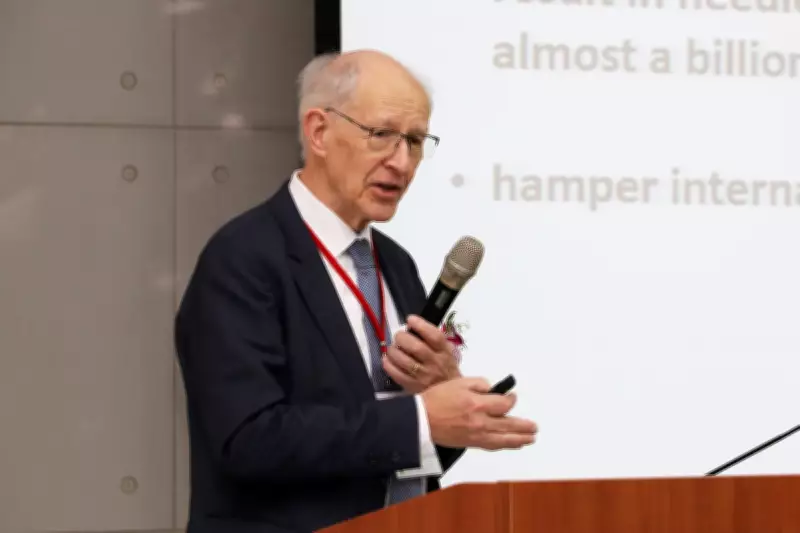
Dutch Food Scientist Awarded World Food Prize for Revolutionising Global Safety Standards
The World Food Prize has been awarded to Dutch food scientist Huub Lelieveld for his pioneering work in establishing modern food processing safety standards that are now implemented globally. The organisation announced on Wednesday that Lelieveld's six decades of research and advocacy have directly prevented millions of cases of foodborne illness while simultaneously reducing significant food waste across international supply chains.
Transforming Illogical Systems Through Hygienic Innovation
Lelieveld began his career as a food researcher at multinational corporation Unilever during an era when he considered prevailing food safety mechanisms fundamentally "illogical." At that time, food products were typically sterilised or chemically preserved after production, requiring equipment to be shut down multiple times daily for intensive cleaning procedures. This approach proved both inefficient and time-consuming, while processed foods relied heavily on preservatives, salt, sugar, and acids to minimise contamination risks—compromising both flavour profiles and nutritional value.
"I realised very soon that they did things in the wrong way, in my view," Lelieveld revealed in an exclusive interview with The Associated Press. "From the beginning, I've been working on convincing people that you should do it in a different way."

Developing and Disseminating Life-Saving Technology
Collaborating with colleagues, Lelieveld developed revolutionary hygienic production methods and equipment that transformed food manufacturing efficiency while dramatically reducing chemical dependency. After successfully scaling these processes within Unilever and demonstrating their effectiveness, the corporation granted him permission to publish the research for global dissemination.
"My philosophy was: You should not compete on food safety," Lelieveld explained. "Spreading the technology, the hygienic technology, was very important." This commitment to open knowledge sharing has proven particularly crucial given World Health Organization statistics indicating unsafe food causes approximately 600 million foodborne illnesses and 420,000 preventable deaths annually worldwide.
Establishing Global Harmonisation for Food Security
Following four productive decades at Unilever, Lelieveld founded the Global Harmonization Initiative in 2004 to promote international consensus on food and trade regulations. This nonprofit organisation leverages a network of several thousand scientists worldwide to address critical food security challenges while facilitating comprehensive food safety education programmes.
"GHI is extremely useful because it has this enormous pool of knowledge about food safety and food protection," Lelieveld emphasised, highlighting the initiative's collaborative approach to solving complex global food system challenges.
Addressing Persistent Challenges in Safe Food Access
Despite significant progress, Lelieveld acknowledges persistent barriers to universal safe food and water access. He advocates for developing systems enabling local safe food and water production even when cross-border goods movement faces restrictions, drawing an evocative parallel: "You can't stop the transport of water through the air, with the clouds. You can produce safe water everywhere, but we need to distribute this knowledge to the people that need it and that is the biggest challenge."
The Iowa-based World Food Prize—founded by Norman Borlaug, who received the 1970 Nobel Peace Prize for revolutionising agricultural yields—includes a substantial $500,000 award alongside its prestigious recognition. Lelieveld's selection underscores the profound global impact of his simple yet powerful guiding principle: "I just did what I thought was right. I want everybody to have enough food but ... it should also be safe."