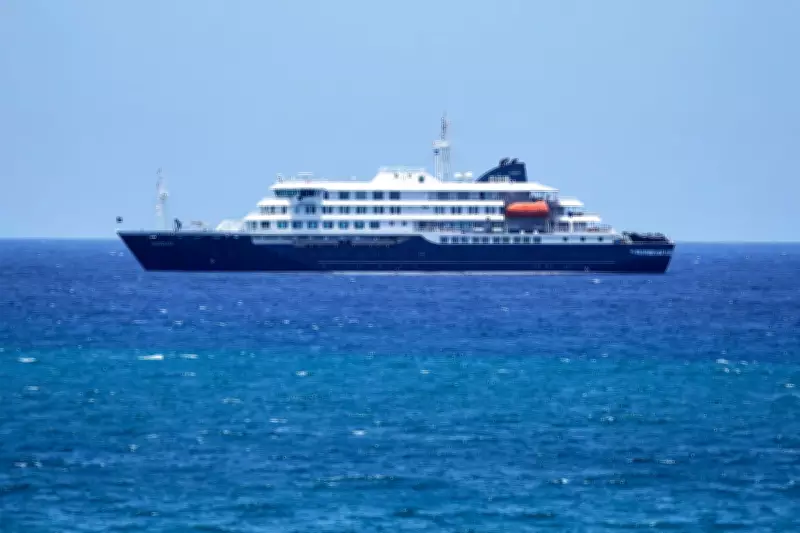
A British doctor with suspected hantavirus has been medically evacuated from the cruise ship linked to the outbreak, allowing the vessel to continue its journey to the Canary Islands.
Evacuation and Medical Transfer
The crew member, understood to be a doctor on the ship, along with a Dutch crew member and another passenger, were taken from the Dutch-flagged cruise ship MV Hondius for onward travel to the Netherlands, the World Health Organisation (WHO) confirmed. Spanish health officials said that the British medic is now in a more “stable condition” after previously being in a “critical condition”.
Ship Cleared to Proceed
The evacuation means the ship can now continue on its three-day journey to the Canary Islands after Spanish authorities gave permission for the boat to dock. However, a row has erupted with the president of the Canary Islands expressing concern over the ship docking in Tenerife. It had been anchored off Cape Verde while arrangements were put in place to evacuate the crew members.

WHO Response
Dr Tedros Adhanom Ghebreyesus, director-general of the global health body, posted on X: “Three suspected hantavirus case patients have just been evacuated from the ship and are on their way to receive medical care in the Netherlands in co-ordination with WHO, the ship’s operator and national authorities from Cabo Verde, the United Kingdom, Spain and the Netherlands.” He added that WHO continues to work with the ship’s operators to closely monitor the health of passengers and crew, and that at this stage, the overall public health risk remains low.
Passenger Confinement and Health Measures
Passengers are confined to their cabins while “disinfection and other public health measures are carried out”, the WHO said on Tuesday. An update from health officials in Spain on Tuesday said: “The World Health Organisation has explained that Cape Verde cannot carry out this operation. The Canary Islands are the closest place with the necessary capabilities. Spain has a moral and legal obligation to help these people, among whom are also several Spanish citizens.”
Political Concerns
The leader of the regional government of the islands expressed concern over the plan, with Fernando Clavijo writing on X that he has requested a meeting with Spanish President Pedro Sanchez “due to the lack of co-ordination and information regarding the cruise ship affected by a hantavirus outbreak”. In a briefing, Spanish health minister Monica Garcia said that none of the remaining passengers on board have symptoms. The British citizen who has been evacuated from the cruise ship was a doctor, she said. The medic is now in a more “stable condition” after previously being in a “critical condition”, Ms Garcia added. She said that the boat will dock in Tenerife and people will be repatriated to their own countries with “medical guarantees” and “all the transportation will be done trying to avoid contact with local citizens”.
Expert Opinions
Commenting, Jose Miguel Cisneros Herreros, head of the Infectious Diseases Department at the Virgen del Rocío University Hospital in Seville, said: “It is right for the Spanish government to allow the ship to dock in our country, because the passengers and crew need to disembark and be assessed, and we are the nearest country with a healthcare system capable of doing so.” Some 19 British nationals were listed as passengers on the ship, which was sailing from Argentina to Cape Verde, with four British crew members. Prime Minister Sir Keir Starmer has said plans are being made for the “safe onward travel” of Britons on the ship. The Foreign Office confirmed that it has been directly in touch with all British passengers on board the ship.
Cases and Virus Variant
A British passenger and the British crew member are among those taken ill in the suspected outbreak, which has been linked to three deaths. The World Health Organisation said that there are eight cases, three of which are confirmed, after a passenger on the boat presented himself to a hospital in Zurich, Switzerland, and was confirmed to have the virus. The British passenger was medically evacuated from the ship on April 27 and remains in isolation in hospital in Johannesburg, South Africa.

Commenting on the variant of the virus linked to the outbreak, the Andes virus, Professor Sir Andrew Pollard, director of the Oxford Vaccine Group at the University of Oxford, told BBC Radio 4’s Today programme: “With this particular hantavirus, the Andes virus, it is known very rarely to spread between people with close contact, usually symptomatic individuals who are in close contact with each other. That’s important because it means it is very easy to isolate people who are unwell and to follow sort of quarantine and so on to avoid spread to other people. It’s not like the situation we had with Covid-19 in the pandemic where people could spread even without symptoms, and therefore it was able to spread very easily in the population.” He added: “I think the risk is essentially zero of spread outside of this particular outbreak, because the authorities have recognised this and they know exactly what to do to make sure that the individuals are isolated and there’s no-one with transmission now that we know what we’re dealing with.”
Dr Jacqueline Weyer, acting deputy executive director for the National Institute for Communicable Diseases in South Africa, said the Andes virus is a “slow burner” and “moves really slowly” which “allows a window of opportunity to contain the outbreak”. But she told Sky News that the British passenger in hospital in Johannesburg will be under “strict isolation precautions to ensure that we don’t see onward transmission”. She said that investigations have found no rodent infestations on the ship itself and that the “exposure event” was probably through rodent exposure in Argentina.