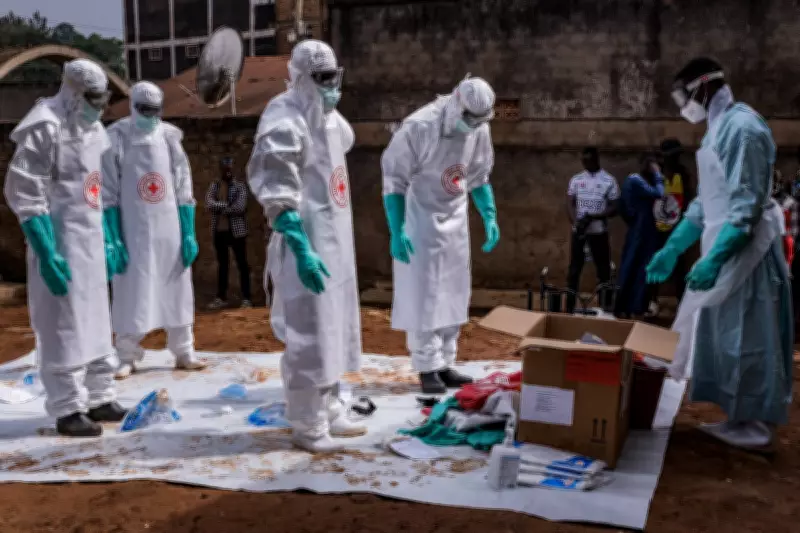
The head of the World Health Organization has called for an “immediate ceasefire” in the Democratic Republic of Congo (DRC) as suspected cases of Ebola near 1,000. The virus is spreading through conflict-ravaged provinces in eastern DRC faster than health workers can respond.
Conflict Hinders Ebola Response
Ongoing clashes in the Ituri province are causing mass displacement of people who have been potentially exposed to the virus, making it harder for health workers to control the outbreak. Tedros Adhanom Ghebreyesus, director-general of the WHO, wrote on social media that the region is facing a “catastrophic collision of disease and conflict”.
Calling for a ceasefire, he warned that health workers “cannot isolate the sick while bombs are falling”. “Stopping this Ebola transmission depends entirely on humanitarian access. Yet ongoing clashes are driving mass displacement, pushing exposed contacts into overcrowded camps and severing critical containment corridors. Frontline workers are risking everything, while attacks on health facilities make tracking cases and their contacts nearly impossible,” the health chief said on X.

He added: “We cannot build community trust or isolate the sick while bombs are falling. We urge all warring parties to agree to an immediate ceasefire to contain this outbreak. To allow us safe and sustained access for medical teams. We plea to prioritise human survival above everything else.”
Escalating Conflict and Displacement
The mineral-rich east of DRC has battled war for decades as numerous armed groups have competed with central authorities for power. However, fighting escalated at the start of 2025, when a rebel group known as the M23 made major advances across the east. According to the UN humanitarian office, almost 1 million people have been displaced by conflict in the province that is also battling an Ebola outbreak.
Ebola Cases and Regional Spread
Latest data from WHO shows there are 906 suspected cases of Ebola and 223 suspected deaths in DRC. There are also 105 confirmed cases and 10 deaths in DRC, while Uganda has seven confirmed cases and one death. The Red Cross has also warned ten other African countries are at risk, including: Rwanda, Kenya, Tanzania, Angola, Burundi, the Central African Republic, the Republic of Congo, Ethiopia, South Sudan and Zambia.
Ugandan authorities have ordered the immediate closure of their border, except to Ebola response teams, humanitarian aid and food, in an attempt to control the spread. Those who are able to cross the border from DRC to Uganda will be asked to self-isolate for 21 days, Diana Atwine, a senior Ugandan health official, told a press conference on Wednesday. But WHO has warned against such measures as it could push people to informal border crossings that are not monitored.
Background on Ebola
Ebola was first discovered in the Democratic Republic of Congo in 1976, making this outbreak the 17th in the country. The current Ebola outbreak is of the Bundibugyo strain, which has a fatality rate of between 21 per cent and 50 per cent. Symptoms include muscle aches, high temperature, headache and sore throat, as well as vomiting and diarrhoea.
There is currently no cure for the virus, which is passed through sweat, blood, faeces or vomit, but scientists at Oxford University are working urgently to develop a vaccine which could be used in case the virus spirals out of control.