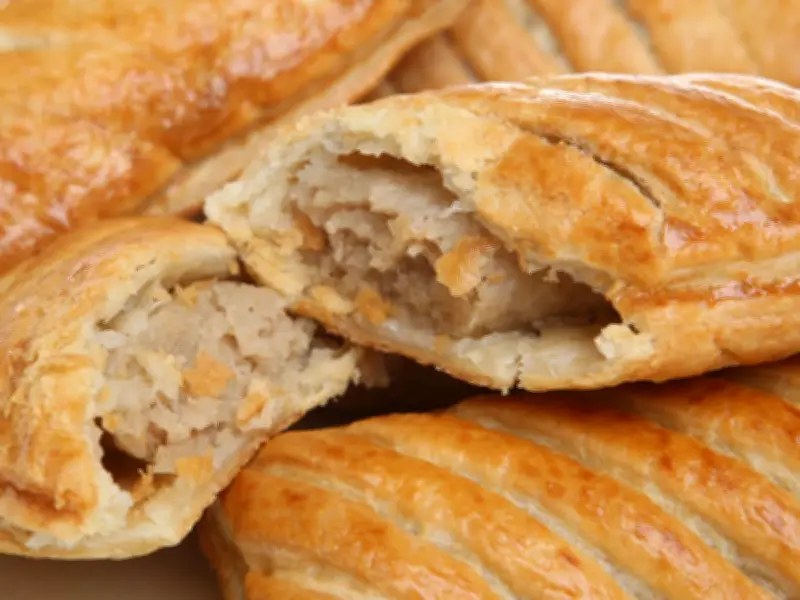
Researchers at Heriot-Watt University in Edinburgh are developing a new method to create healthier puff pastry for sausage rolls, a beloved British snack. With an estimated 10-15 million sausage rolls sold weekly in the UK, a single serving can contain over 60% of an adult's recommended daily saturated fat intake. The team aims to significantly reduce saturated fat while maintaining the distinctive flaky texture and taste.
Oleogelation: A Promising Technique
The project focuses on replacing solid fats used in laminated pastry with healthier liquid oils, such as sunflower or rapeseed oil, which are lower in saturated fat. This is achieved through a process called oleogelation, which transforms liquid oils into a solid-like fat. Professor Stephen Euston from Heriot-Watt’s School of Engineering and Physical Sciences explained: “We want to lower the level of saturated fat while keeping the taste and texture that people love. We’re focused on sausage rolls, but this also applies to other baked goods that contain laminated pastry such as croissants, Danish pastries and sweet or savoury turnovers.”
Structural Challenges in Pastry Making
“Making flaky pastry is surprisingly complicated,” Prof Euston noted. “The fat is not just there for flavour; it plays a crucial structural role in the pastry. You need the fat sitting between the layers of dough so that when the pastry bakes, steam forces those layers apart and gives you that flaky texture people expect. Simply replacing the fat with a healthier oil doesn’t work, because liquid oils lack the structure needed to separate the pastry layers.” The team aims to mimic the behaviour of traditional fats using oleogels, which could deliver the same flaky texture without the high saturated fat content.

Environmental and Manufacturing Benefits
The researchers are focusing on oils from crops that can be grown in the UK to minimise environmental impact. Additionally, the new oleogels may remain stable at higher temperatures, potentially reducing the need for repeated chilling during production. Prof Euston said: “We are hoping our oleogels will stay stable at higher temperatures, which means manufacturers may not have to chill the pastry as much. If we are lucky, they might not need to chill it at all.” This could lead to energy savings and streamlined production processes.
Project Funding and Collaboration
The 10-month project is funded by the UK Research and Innovation Engineering and Physical Sciences Research Council (UKRI EPSRC) and involves collaboration with industry partners New Food Innovation and AB Mauri. Dr Andrew Bourne, UKRI EPSRC’s executive director for innovation and partnerships, commented: “UKRI EPSRC’s Impact Acceleration Awards use public funding to turn promising research into practical solutions, and this project does exactly that. By taking innovative food science out of the lab into the kitchen and testing it with everyday consumers, it has the potential to make the nation’s favourite snacks healthier and make a genuine difference to our health and wellbeing.”
Broader Applications
If successful, the technology could be applied to other pastries like croissants, Danish pastries, and turnovers. The team is also exploring whether oleogelation could reduce saturated fat in vegan cheese alternatives, potentially broadening the impact on healthier eating.