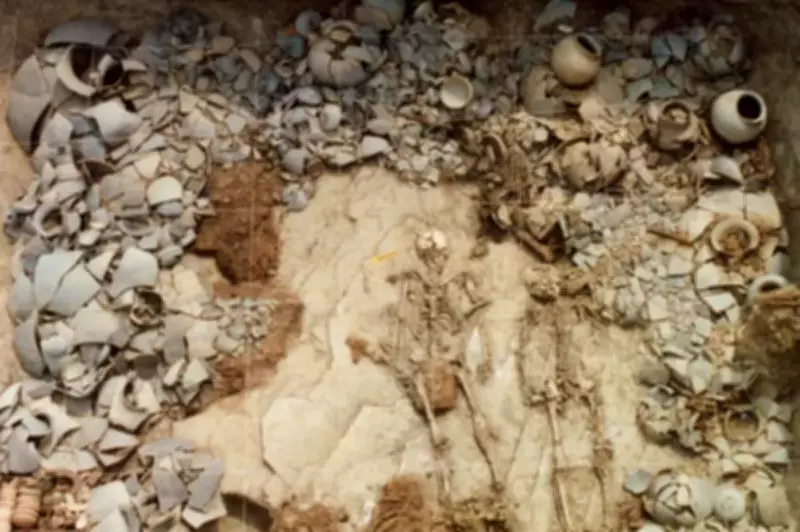
Groundbreaking new research has uncovered startling evidence that entire families were systematically sacrificed around 1,500 years ago in ancient Korea, as part of royal rituals honouring the monarchy. The findings, based on a comprehensive genetic analysis of 78 human remains excavated from the Gyeongsan archaeological site, provide the first large-scale scientific confirmation of the social structure and ritual practices of the Silla Kingdom.
Evidence of Systematic Human Sacrifice
The study reveals clear evidence of the practice known as 'sunjang', where individuals were ritually killed and buried alongside deceased royalty or nobility. Researchers discovered that some tombs contained multiple closely related family members, including parent-child pairs, indicating that whole family units were sacrificed together in these ceremonies.
A Hereditary 'Sacrificial Caste'
Perhaps most significantly, the genetic data suggests the existence of what researchers are calling a 'sacrificial caste' - specific families whose roles in these rituals were inherited across generations. This implies that certain lineages were designated for sacrifice, with their social status and fate being predetermined by birth rather than circumstance.

Insights into Ancient Kinship Structures
The analysis also reveals that close-kin marriages were common not only among the Silla royal elites but also among those selected for sacrifice. This parallel practice offers fascinating new insights into ancient Korean kinship structures and social organization, suggesting complex relationships between different social strata within the kingdom.
The research represents a major breakthrough in understanding the Silla Kingdom's social hierarchy and ritual practices. By combining archaeological evidence with advanced genetic analysis, scientists have been able to reconstruct aspects of ancient Korean society that were previously only hinted at in historical records. The discovery of this hereditary sacrificial system challenges previous assumptions about social mobility and family roles in ancient Korean civilization, while providing concrete evidence of ritual practices that have long been the subject of scholarly debate.