

Amateur Archaeologist's Decades-Long Quest Reveals Claims of Ancient Submerged Metropolis
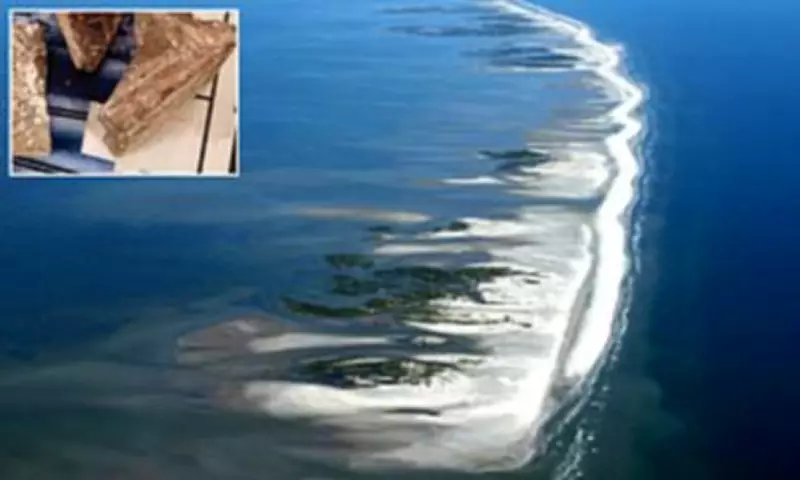
An amateur archaeologist has put forward a remarkable assertion that he has uncovered the remnants of an ancient city, believed to have flourished approximately 12,000 years ago, submerged off the coast of Louisiana. Retired architect George Gelé states he has identified clues suggesting that 'hundreds of buildings' lie buried beneath the waters adjacent to the Chandeleur Islands, a series of uninhabited barrier islands situated about 50 miles east of New Orleans in the Gulf of Mexico.
Underwater Sonar Images and Pyramid Discovery
For nearly five decades, Gelé has been capturing underwater sonar images that he interprets as revealing the remains of significant structures. Among these, he describes a colossal 280-foot-tall pyramid emerging from the seafloor. Intriguingly, Gelé claims this pyramid emits a powerful surge of electromagnetic energy, which has reportedly caused boat compasses to spin erratically when vessels pass overhead. Dubbed the city of Crescentis, Gelé explained to local station WWL-TV that these submerged formations, located roughly 30 feet below the water's surface and buried under an additional 100 feet of sediment, appear to be 'geographically related to the Great Pyramid of Giza' in Egypt.
Theory Based on Granite Mounds and Ice Age Context
Although Gelé's findings have not been published in peer-reviewed scientific journals, he argues the site could date back to the conclusion of the last Ice Age, around 11,700 years ago, when rising sea levels inundated extensive coastal landscapes. The cornerstone of his theory rests on mysterious granite mounds discovered beneath Chandeleur Sound. Granite is not naturally occurring in Louisiana, leading Gelé to believe these stones were intentionally transported and assembled. 'Somebody floated a billion stones down the Mississippi River and assembled them outside what would later become New Orleans,' Gelé remarked, reflecting on over five decades of study at the site.

Personal Expeditions and Local Accounts
Gelé has personally financed and conducted more than 40 underwater research expeditions in the area since 1974. While he officially unveiled his discoveries to the public in March 2022, his interview with WWL-TV has recently regained attention. During this interview, local shrimper Ricky Robin, who has escorted Gelé to the site on multiple occasions, recounted that his boat's compass spun completely around near the suspected pyramid tip. 'Everything will go out on your boat. All your electronics like you were in the Bermuda Triangle,' Robin stated. He added that other fishermen have shared tales of retrieving strange, square rocks in their nets, which he linked to the pyramid's location.
Scientific Skepticism and Alternative Explanations
Despite the allure of a lost city, several scientists have proposed more conventional interpretations for the enigmatic underwater mounds. Gelé himself considered alternative possibilities during a 2014 presentation, such as the stones originating from construction debris or multiple shipwrecks. However, he noted that construction debris typically only appears on the mound surfaces, and granite blocks, being costly, would unlikely be discarded so readily.
A separate study by Texas A&M University in the late 1980s concluded that the underwater granite likely stemmed from shipwreck activity or ballast stones discarded from vessels. Historians speculate that Spanish or French ships might have dumped these stones to lighten their loads when navigating shallow waters en route to New Orleans.
In 2011, local newspaper The Advocate investigated the mystery, consulting LSU archaeology professor Rob Mann. He suggested the granite could be remnants of a 1940s artificial reef project, involving the dumping of construction materials into the water. 'I think simply searching underwater at this point won't give us any more answers,' Mann told the publication. 'When the historical archive work is done, looking at records and newspapers, that's when we will know what it is.' The state's archaeologist at the time concurred, noting the formations seemed to result from large barge loads of stone being dumped, yet questions about the purpose and location remain unresolved.






