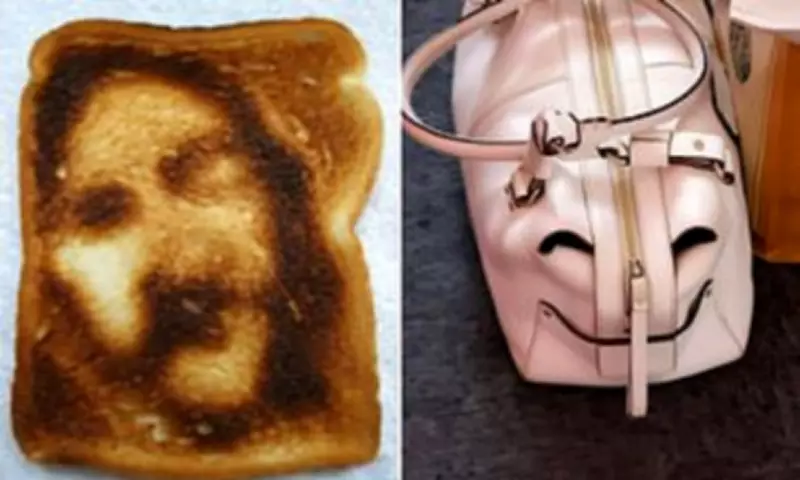
Many people frequently notice faces in everyday objects, from religious figures in toast to human-like features on Mars. This phenomenon, known as face pareidolia, has been the subject of a new study that uncovers a surprising bias: individuals are more likely to see male faces than female ones in these random patterns.
Research Methodology and Findings
Researchers from the University of New South Wales conducted experiments involving 70 participants. They were shown images of objects, such as a handbag with a zip and buckles forming a mouth, and abstract visual noise. Participants were asked to assign ages, genders, and emotions to any faces they perceived.
Clear Male Bias Emerges
The results revealed a strong tendency to identify male faces. Dr Lindsay Peterson, the lead author, explained, 'For whatever reason, it seems like we've got this template stored in our brains about what a basic human face is, and it resembles a male face.' This bias was consistent across different age groups, including children as young as four, suggesting it may be hardwired into our cognitive processes.

Anger and Threat Perception
Additionally, when faces in objects were vague or ambiguous, participants often perceived them as angry. This indicates that our brains might instinctively interpret these patterns as threats before a proper evaluation occurs. Dr Peterson added, 'Your lizard brain is telling you that the safest thing is to assume it's a threat and then deal with it.'
Experiments and Interpretations
In the first experiment, the handbag image consistently evoked perceptions of a young, happy, smiling face. However, the visual noise images led to diverse interpretations, such as Buddha, angels, demons, or dragons, despite being essentially random patterns.
Second Experiment Insights
A second experiment introduced vertical symmetry to mimic facial structure. Even without clear features, participants repeatedly reported seeing angry, male faces. This reinforces the idea that social and cultural biases, along with innate brain mechanisms, play a role in how we process these illusions.
Understanding Face Pareidolia
Face pareidolia is a psychological response where people see faces or significant items in random stimuli. It is a form of apophenia, which involves finding patterns in unconnected data. This phenomenon has been documented for decades and has sparked public interest, with platforms like Flickr and Reddit hosting thousands of user-uploaded images.
Scientific and Social Implications
The study, published in Royal Society Open Science, highlights that while face pareidolia is well-studied, the nature of the faces perceived was previously unclear. The findings suggest our brains are pre-determined to recognize faces, even when none exist, which underpins vital social and cognitive functions. The researchers plan to explore how these biases might shift under different conditions in future studies.
Historical Context and Examples
Notable instances of pareidolia include the 'face on Mars' spotted by a Viking orbiter in 1976, later proven to be sand dunes, and various religious images seen in unexpected places. These examples illustrate how our minds actively seek familiar patterns in the environment.
Overall, this research sheds light on the intricate ways our brains interpret the world, revealing deep-seated biases in perception that influence how we interact with our surroundings.