

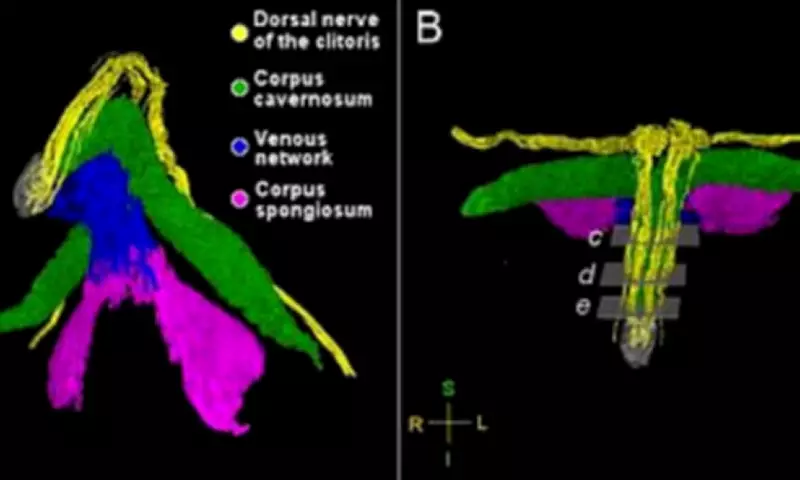
Groundbreaking Clitoris Map Created Using Advanced X-Ray Technology
In a landmark scientific achievement, researchers have successfully mapped the clitoris for the very first time, revealing intricate nerve networks that are essential for female sexual pleasure and orgasm. This pioneering work, conducted by scientists at Amsterdam UMC, utilized state-of-the-art X-ray imaging techniques to scan two postmortem female pelvic samples, providing unprecedented insights into this often-misunderstood organ.
Unveiling the Complex Nerve Architecture
The research team employed micron-scale CT scans with a synchrotron radiation X-ray source, enabling them to visualize nerve structures as small as 0.2mm in diameter. Their findings revealed a sophisticated web of nerves branching throughout the clitoris, challenging previous anatomical assumptions and providing new understanding of female sexual physiology.
The clitoris stands as the only human organ dedicated exclusively to providing pleasure, composed of nerves that transmit electrical impulses between the brain and the body, facilitating sensory perception and response to touch. While the glans (tip) of the clitoris is externally visible, the majority of the organ resides internally, making comprehensive mapping historically difficult.

Surprising Discoveries About Clitoral Sensation
One of the most significant revelations concerns the dorsal nerve of the clitoris (DNC), which is responsible for clitoral sensation. Contrary to earlier studies suggesting this nerve gradually diminishes toward the tip, the new research demonstrates it maintains a complex, tree-like branching pattern within the clitoral glans.
"The DNC does not diminish but instead exhibits a complex tree-like branching pattern within the clitoral glans," the researchers explained in their study, which has been published as a preprint on bioRxiv.
Overcoming Historical and Technical Challenges
The detailed anatomy of the clitoris has long presented challenges for scientific investigation. As lead researcher Ju Young Lee and colleagues noted, "The detailed anatomy of the clitoris is challenging to address through gross dissection, as most of its parts are embedded internally, surrounded by pubic bone and several pelvic organs."
While magnetic resonance imaging can capture three-dimensional morphology, it lacks the spatial resolution needed to resolve detailed structures. The advanced X-ray techniques employed in this study have overcome these limitations, providing the first comprehensive visualization of the clitoris's intricate nerve network.
Cultural Taboos and Scientific Progress
The researchers emphasize that cultural taboos surrounding female sexuality have hindered scientific investigation of the clitoris for centuries, despite early references dating back to Aristotle. They hope this groundbreaking map will help break these taboos and address significant knowledge gaps in women's sexual health.
Notably, the penis was mapped more than three decades ago, highlighting the disparity in scientific attention between male and female sexual anatomy. This new research represents a crucial step toward rectifying this imbalance and advancing understanding of female sexual health.
Clinical Implications and Surgical Applications
The detailed clitoris map has important clinical implications, particularly for female genital cosmetic surgeries. The researchers note that procedures such as labiaplasty have increased dramatically in recent years, with a 70% rise documented between 2015 and 2020.
This new anatomical understanding could help redefine the "danger zone" used by surgeons to avoid nerve damage during such operations, potentially improving surgical outcomes and reducing complications. By providing precise visualization of nerve pathways, the map offers valuable guidance for medical professionals performing procedures in this sensitive anatomical region.
The Amsterdam UMC team's work represents a significant advancement in anatomical science and women's health research, offering new insights into an organ that has remained largely mysterious despite its crucial role in female sexual experience and wellbeing.






