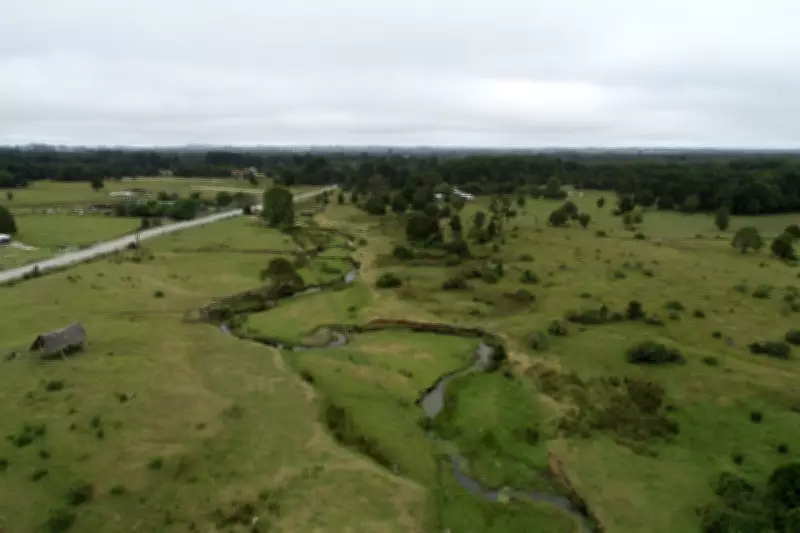
Monte Verde Age Challenged: New Study Questions Key Human Migration Site
A new scientific investigation has cast doubt on the established age of Monte Verde, the archaeological site in Chile that has long been considered crucial evidence for the earliest human settlement in the Americas. For decades, Monte Verde provided the strongest evidence, with artifacts and remains dated to approximately 14,500 years ago, including footprints, wooden tools, building foundations, and an ancient fire pit.
Geological Reinterpretation Challenges Timeline
The recent study, published in the journal Science, proposes a significant reinterpretation of the site's geology. Researchers sampled and dated sediments from nine areas along the nearby Chinchihuapi Creek, analyzing landscape changes over millennia. They identified a layer of volcanic ash from an eruption dating back about 11,000 years ago.
According to study co-author Claudio Latorre of the Pontifical Catholic University of Chile, anything above this ash layer—including the Monte Verde wood and artifacts—must be younger. "We basically reinterpreted the geology of the site. And we came to the conclusion that the Monte Verde site cannot be older than 8,200 years before present," Latorre stated. The researchers suggest that landscape alterations, such as stream erosion mixing old and new layers, may have led to incorrect dating of ancient wood as part of the Monte Verde site.

Scientific Controversy and Criticism
However, the findings have sparked considerable controversy within the archaeological community. Several scientists, including those involved in the original excavations, strongly dispute the new conclusions. Michael Waters of Texas A&M University, who was not involved in either study, commented, "They have provided, at best, a working hypothesis that is not supported by the data they presented."
Critics argue that the study analyzed samples from areas surrounding Monte Verde where the geology is not comparable to the site itself. They also contend there is insufficient evidence that the volcanic ash layer once covered the entire landscape. Furthermore, the study fails to adequately explain artifacts directly dated to 14,500 years ago, such as a mastodon tusk tool, a wooden lance, and a burned-tip digging stick.
Archaeologist Tom Dillehay of Vanderbilt University, who led the initial excavation, emphasized in an email, "This interpretation disregards a vast body of well-dated cultural evidence." In response, the new study's authors, including co-author Todd Surovell of the University of Wyoming, maintain they sampled within, upstream, and downstream of the site and question the reliability of the dated artifacts.
Implications for Human Migration Theories
Monte Verde is pivotal to understanding how humans first reached the Americas. Previously, scientists believed the earliest arrivals were the Clovis people around 13,000 years ago, known for their distinctive stone tools. The discovery of Monte Verde, though initially controversial, seemed to refute this theory. Since then, other North American sites like Cooper’s Ferry in Idaho and the Debra L. Friedkin site in Texas have been found to predate the Clovis culture.
A revised date for Monte Verde could reopen debates about migration routes from Asia to the Americas. Key questions include whether humans arrived during the parting of massive ice sheets in Canada, revealing an ice-free corridor, or if they traveled along the coast by boat or over mixed terrain. Surovell noted that a new date might influence discussions on the most likely early human routes, with future independent analyses of other sites potentially providing clarity.
"Given enough time and given the ability to do science, science is self-corrective. It eventually reaches the truth," Surovell concluded, highlighting the ongoing nature of scientific inquiry in unraveling the complex story of human migration to the Americas.