Archaeological Feud Erupts Over Claims of Hidden Second Sphinx at Giza
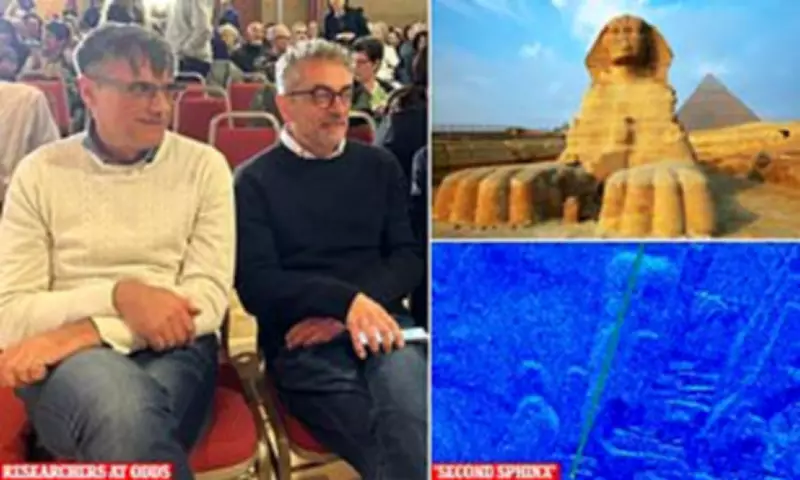
A dramatic public rift has emerged between two researchers previously involved in groundbreaking discoveries at Egypt's Giza Plateau, centered on controversial claims of a hidden second Sphinx buried beneath the ancient site. The dispute pits radar engineer Filippo Biondi against Egyptologist Armando Mei, exposing fundamental disagreements about archaeological methodology and interpretation of ancient evidence.
The Controversial Claim
Filippo Biondi stunned the archaeological community last week when he announced on the Matt Beall Limitless podcast that satellite radar scans had revealed what he believes is a mirror image of the Great Sphinx buried beneath the Giza Plateau. Biondi, who specializes in synthetic aperture radar (SAR) and Doppler tomography techniques, presented preliminary scans showing what he described as a symmetrical structure adjacent to the known monument.
'We have recently gathered some extremely satisfying experimental results that offer a different perspective,' Biondi told the Daily Mail, adding that final results would be presented at a conference in Bologna on June 21.

Biondi's claim rests primarily on his interpretation of the Dream Stele, an inscribed granite slab erected between the paws of the Great Sphinx by Pharaoh Thutmose IV around 1401 BC. The stele features two sphinx carvings, one facing west and the other east, which Biondi believes represents actual physical monuments rather than symbolic imagery.
The Scientific Rejection
Armando Mei, Biondi's former colleague on the Khafre Research Project, has publicly rejected these claims, creating a significant schism between the once-aligned researchers. 'From both a personal and scientific standpoint, I do not believe that a second Sphinx exists on the Giza Plateau,' Mei told the Daily Mail.
Mei's rejection is based on multiple lines of analysis including archaeological, geometric, geological and tomographic evidence. He argues that the duplication of sphinx imagery in ancient Egyptian art typically served symbolic purposes rather than representing multiple physical monuments.
'We are not dealing with a descriptive representation of physical reality, but with a symbolic-conceptual construction,' Mei explained, noting that similar dual sphinx representations appear in other ancient Egyptian scriptures, notably inside the Tomb of Ramses VI.
Background of Collaboration and Separation
The two researchers had worked together for years as part of the Khafre Research Project, which announced in March 2025 the discovery of massive shafts and chambers beneath the pyramids and the Great Sphinx. Their partnership combined Biondi's advanced radar techniques with Mei's deep knowledge of Egyptian history and prior explorations.
However, Mei revealed he stepped away from the project in January after not receiving updates on developments since June 2025. 'The reasons I was left in the dark were never clearly explained,' he noted.
Biondi acknowledged the separation but maintained that 'we remain in close contact and maintain a friendly relationship.' He described Mei's departure as pursuing other professional opportunities.
Geometric Arguments and Geological Counterpoints
Biondi's geometric analysis involves drawing lines from the center of Khafre's pyramid to the existing Sphinx, then repeating measurements from the neighboring pyramid to identify what he claims is a mirrored location. He describes this as showing 'precise geometrical correlation' with near-perfect symmetry.
According to Biondi, this places the potential second Sphinx beneath a small mound approximately 108 feet high, located at the back of the Pyramid of Khufu and adjacent to the Pyramid of Khafre. He believes scans also reveal mirrored networks of shafts and chambers beneath both locations.
Mei strongly disputes this interpretation, arguing that true Egyptian architecture follows strict, measurable lines that connect logically with pyramids, temples and causeways. 'The locations proposed by Biondi do not match the established layout of Giza,' he stated, suggesting they fall outside the known architectural system.

Mei also pointed to geological factors, noting that the Giza Plateau's calcarenite limestone naturally forms cavities and irregular shapes through erosion that can appear artificial. The mound identified by Biondi, according to Mei, shows no visible signs of carving or architectural shaping that would suggest human construction.
Broader Implications for Archaeological Research
The dispute highlights broader tensions in archaeological research between technological approaches and traditional Egyptological methods. Mei expressed concern that 'speculative announcements are altering the nature of the research and are placing what remains of the team in a position of opposition, rather than convergence, with the Egyptian authorities.'
Biondi has faced online criticism from those challenging his findings, which he dismissed as lacking scientific rigor. Despite the controversy, he expressed respect for leading Egyptologist Dr Zahi Hawass, who has previously dismissed the second Sphinx claims.
Interestingly, both researchers agree on their earlier 2025 discovery of underground structures beneath the pyramids. 'Below the pyramids, yes, the data are consistent,' Mei confirmed, noting that four independent groups of satellites produced comparable results.
Uncertain Future for Giza Research
The upcoming June 21 conference in Bologna may represent a turning point not just for this specific controversy, but for Biondi's involvement in Giza research altogether. He revealed that 'after the June 21st event, I plan to conclude my studies on the Giza Plateau for good,' citing growing competition and criticism surrounding the project.
This public feud between former collaborators underscores the complex interplay between technological innovation, traditional archaeological methods, and the interpretation of ancient evidence in one of the world's most studied archaeological sites. As both researchers prepare their final arguments, the archaeological community watches closely to see how this dramatic disagreement will influence future explorations at Giza.