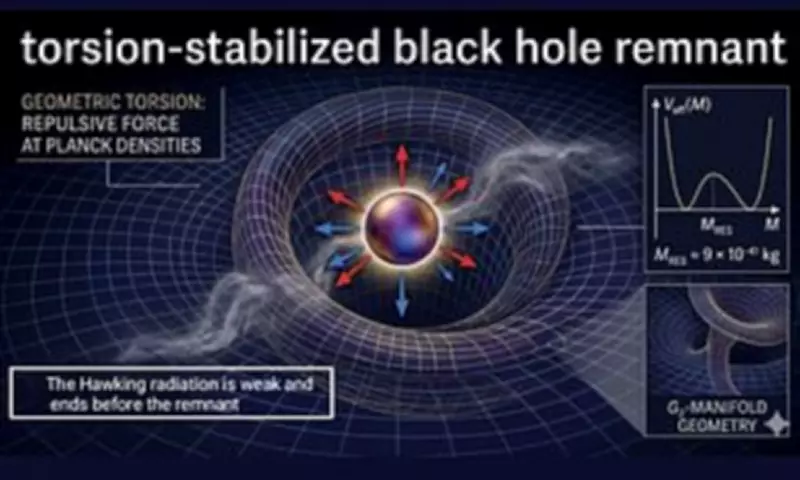
In a revelation that sounds more like science fiction than established fact, scientists now propose that our universe possesses not four, but seven dimensions. Beyond the familiar dimensions of height, length, depth, and time, physicists argue for three additional 'folded' layers of reality. This radical theory is far from mere speculation; researchers believe it could resolve one of the most persistent puzzles in the history of physics: the black hole information paradox.
The Black Hole Conundrum and Hawking's Discovery
Traditionally, black holes were viewed as cosmic voids from which nothing, not even light, could escape. However, in the 1970s, Stephen Hawking revolutionised this understanding by demonstrating that black holes emit radiation, gradually evaporating over time. This discovery led to a major problem: it appears to violate a fundamental rule of quantum physics, which states that information cannot be destroyed. This contradiction is known as the information paradox.
Co-author Richard Pinčák, a senior researcher at the Slovak Academy of Sciences, explained the paradox using an analogy: "Imagine you throw a book into a fire. The book is destroyed, but in principle you could reconstruct every word from the smoke, ash, and heat—the information is scrambled, not lost." Yet, according to Hawking's theory, black holes should eventually vanish entirely, seemingly erasing all information they once contained, creating a clash between classical and quantum physics.

A Seven-Dimensional Solution
A team of researchers now claims to have found a solution to this 50-year-old enigma, but it hinges on the universe having seven dimensions. Dr Pinčák elaborated: "We experience three dimensions of space and one of time—four dimensions in total. Our model proposes that the universe actually has seven dimensions: the four we know, plus three tiny extra dimensions curled up so tightly that we cannot directly perceive them."
This seven-dimensional framework allows spacetime not only to fold but to twist, generating a new physical effect called torsion. The resulting 'torsion field' is crucial to understanding black hole evaporation. As a black hole shrinks to minuscule scales, its seven dimensions tangle into a knot. When this knot becomes sufficiently small, the folding of hidden dimensions creates an outward force that halts complete collapse, leaving behind an incredibly tiny remnant, approximately 10 billion times smaller than an electron.
Preserving Information and Implications
This twisted knot of hidden dimensions retains all the information that fell into the black hole, acting as a permanent memorial. Thus, the black hole never truly disappears; it becomes a 'torsion-stabilised black hole remnant,' ensuring information is never lost and resolving the paradox. Dr Pinčák noted, "Instead of disappearing, black holes shrink so much that their hidden dimensions knot and twist into a shape that keeps them stable forever."
The theory's implications extend beyond black holes. Researchers suggest the three hidden dimensions and torsion field could explain the Higgs mechanism, which gives particles mass, and that these remnants might constitute dark matter, accounting for 27% of the universe's mass. However, testing this requires detecting particles with extra dimensions, known as 'Kaluza-Klein particles,' which are far beyond current technological capabilities, such as those of the Large Hadron Collider.
Future Prospects and Challenges
Scientists may eventually find evidence of seven-dimensional structures in the Cosmic Microwave Background radiation or primordial gravitational waves from the Big Bang. Yet, the necessary technology remains distant, leaving this solution as a tantalising possibility. The study underscores the ongoing quest to unify quantum mechanics and general relativity, offering a novel perspective on the fabric of reality.
Black holes, with gravitational pulls so strong that not even light can escape, continue to captivate researchers. They are thought to form from collapsing gas clouds or giant stars, with supermassive black holes at galactic centres. This new theory adds a layer of complexity to our understanding, suggesting that even in their demise, black holes leave a lasting imprint in a multi-dimensional cosmos.