

For centuries, the resurrection of Jesus has been hailed as the central 'mystery of faith' in Christian theology. Now, scientists have stepped into the debate, claiming to have uncovered evidence that may lend credence to this biblical event. Paolo Di Lazzaro, an Italian physicist and chief researcher at the ENEA Research Centre in Frascati, Italy, dedicated five years to attempting to reproduce the enigmatic body image seen on the Shroud of Turin.
The Shroud's Mysterious Origins
The Shroud of Turin is a revered relic, believed by many to be the burial cloth that wrapped Jesus after his crucifixion. It is said to bear a faint image of a man, which some attribute to the resurrection. This 14-foot-long linen cloth first appeared in public during the 1350s, exhibited in a small collegiate church in Lirey, a village in northern France. While some skeptics dismiss it as a medieval forgery, its origins remain a topic of intense speculation and religious significance.
Groundbreaking Laser Experiments
Di Lazzaro and his team embarked on a series of innovative experiments using powerful ultraviolet lasers. Their goal was to recreate the image by firing intense bursts of ultraviolet light at clean linen fabric, similar to the shroud. This process altered the chemical structure of the outer fibers, turning them a faint yellow color. The researchers used linen woven between 1930 and 1950, which had never been washed or chemically treated, to ensure predictable material behavior.

Over years of testing, they identified precise laser settings—including pulse duration, energy strength, and number of bursts—that produced discoloration akin to features on the Shroud. The results showed several key similarities: coloration limited to the tops of threads, adjacent fibers remaining uncolored, reduced fluorescence, and a faint negative-style appearance. These characteristics align with previous documentation of the Shroud of Turin.
Energy Requirements Beyond Current Capabilities
Despite successfully creating small areas of shroud-like discoloration, the team faced a significant hurdle. Recreating the full body image proved impossible with modern technology. Their calculations revealed that producing a life-sized image would require an extraordinary burst of ultraviolet energy delivered in an extremely short timeframe. Di Lazzaro estimated this would necessitate 34,000 billion watts of energy traveling in one 40th of a billionth of a second—a power level he stated, 'We don't have that power on Earth.'
This finding was recently discussed on the Shaw Ryan Show, where biblical scholar Jeremiah Johnston highlighted the implications. Johnston suggested that the image's creation might involve a nuclear event, given the immense energy required. He explained, 'Science has proven and published that we have to ask how this image is there? And there was a chemical change to the shroud that if it had lasted longer, it would've just scorched or burned up.'
Scientific Caution and Religious Debate
Scientists involved in the study, published by Di Lazzaro in 2010, caution that while their experiments produced linen discoloration similar to microscopic features of the shroud, they do not provide definitive proof of how the original image was formed. The ENEA Research Centre has over three decades of experience studying ultraviolet radiation's interaction with materials, showing it affects only the outermost surfaces without penetrating deeply—a crucial point since the Shroud's image is known to be extremely shallow.
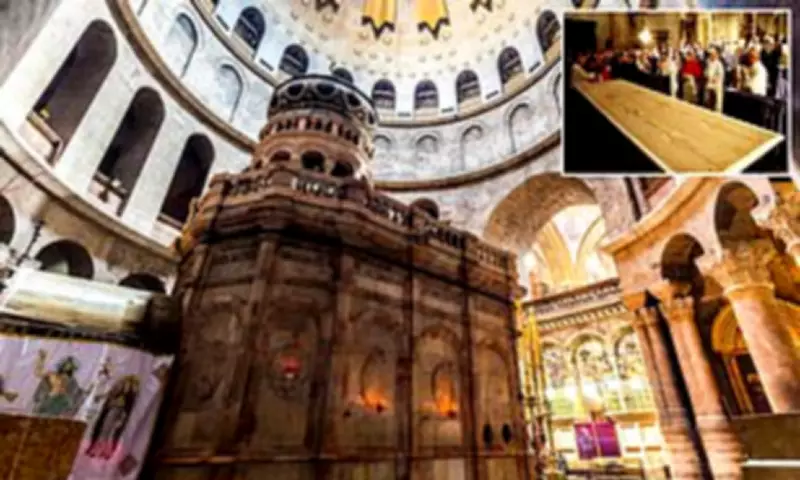
Meanwhile, within Christianity, debates persist not only about the shroud but also about Jesus's burial location. Some believe it was the Garden Tomb, while others point to the Church of the Holy Sepulchre. This scientific inquiry adds a new layer to these discussions, bridging faith and technology in an ongoing exploration of one of history's most profound mysteries.






