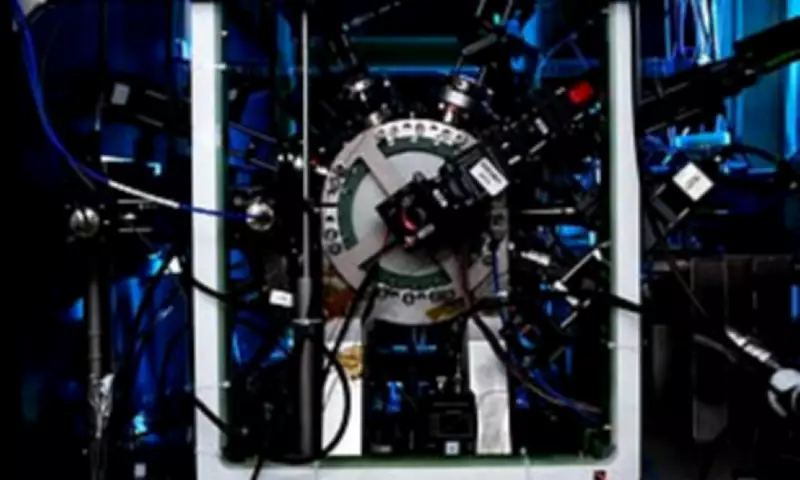
Groundbreaking Strontium Clock Could Redefine the Second by 2030
Scientists have engineered a clock of unprecedented precision, capable of redefining the fundamental unit of time: the second. This strontium optical lattice clock stands as one of the most accurate timepieces ever constructed, measuring seconds to an astonishing 19 decimal places.
Unparalleled Accuracy and Its Implications
To grasp this level of precision, consider that if the clock operated for 30 billion years—more than twice the current age of the universe—it would deviate by merely a second. This remarkable feat stems from significant technological advancements, marking a major breakthrough in optical clock technology. According to a report in the journal Metrologia, the research team stated their clock "achieves accuracy at the level required for the roadmap of the redefinition of the second."
Beyond timekeeping, the clock holds promise for diverse scientific fields. Researchers highlight its potential to aid in the search for dark matter and provide specific measurements of Earth's gravitational field, opening new avenues for exploration.

Evolution of Time Measurement
Historically, time was defined as a fraction of a day, with one second representing 1/86,400 of 24 hours. However, variations in Earth's rotation rendered this method inaccurate. The advent of atomic clocks in the 1950s revolutionized precision, leading to the current definition since 1967: a second equals 9,192,631,770 oscillations of the cesium-133 atom.
While cesium-based clocks are highly precise, they involve a margin of error due to cesium atoms oscillating nine billion times per second. In contrast, strontium oscillates at a dramatically faster rate of 700 quadrillion "ticks" per second, offering superior accuracy. The researchers noted, "This performance meets the 2 x 10^–18 single-clock accuracy requirement for redefining the SI second."
Path to Official Redefinition
For the official definition to change, at least three optical clocks with identical "ticks" and requisite precision must be operational across different institutions. With two other strontium optical clocks already meeting this milestone, this third achievement brings scientists closer to their goal. The timeline is governed by the General Conference on Weights and Measures (CGPM), which convenes every four years. The committee has been tasked with preparing a proposal for the new definition to be presented at the 29th CGPM meeting in 2030.
The researchers from the Chinese Academy of Sciences emphasized, "The new achievement provides a viable technological path for developing portable and space-based optical clocks. It could support future applications including tests of fundamental physical laws, next-generation satellite navigation systems, and the establishment of a unified ultra-precise global time standard."
How Optical Clocks Function
Optical clocks represent a next-generation advancement over traditional atomic clocks, utilizing light frequencies instead of microwaves. Key components include atoms like strontium or aluminium, prized for their stable optical transitions. Electrons within these atoms jump between energy levels, interacting with light at precise frequencies that serve as the clock's "ticking" signal.
These devices are crucial for applications such as GPS navigation, mapping Earth's gravity, and fundamental physics research, underscoring their role in pushing the boundaries of scientific measurement.