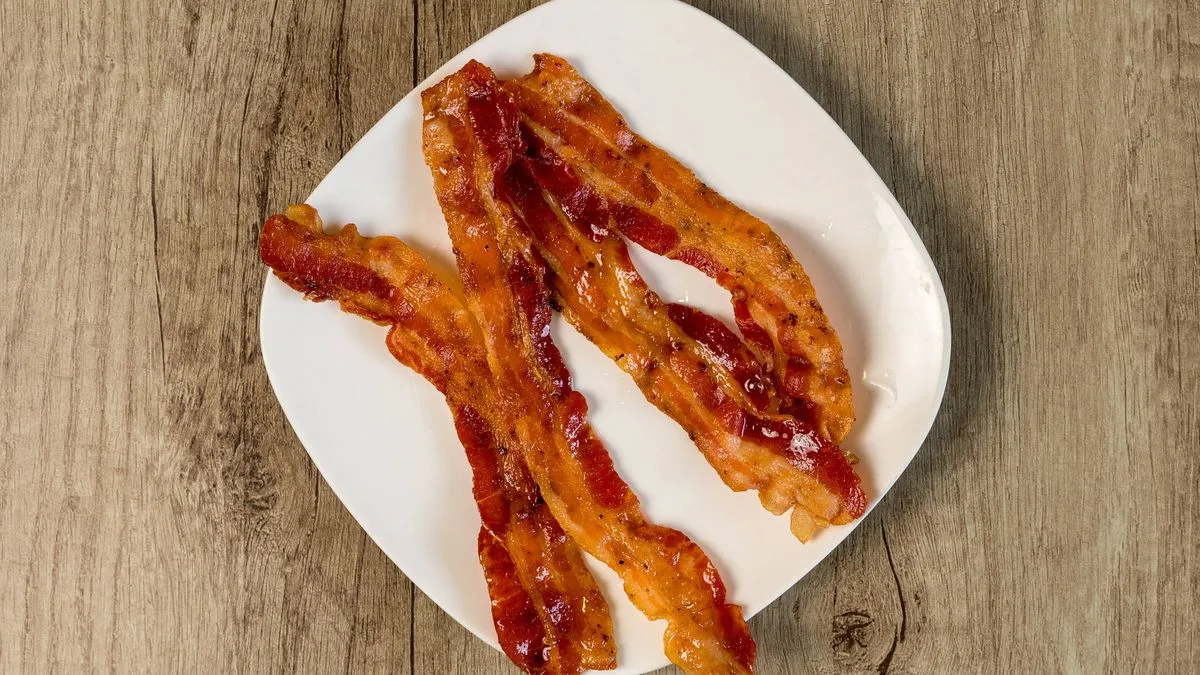
Bacon can be cooked and added to numerous dishes, from indulgent scrambled eggs and substantial burgers to a tasty quiche, diced and sprinkled over a crisp jacket potato, or even stacked on pancakes for a pleasing sweet and savoury pairing. Regarding the preparation technique, though, there are essentially two preferences - those who like a uniformly crispy, well-cooked rasher and those who opt for something slightly chewier.
For senior lifestyle journalist Angela Patrone, the optimal way to prepare bacon is uniformly crisped - yet she has found it challenging to maintain consistency in her bacon-cooking approach. She explained: "Most of the time, my preferred method is to use the air fryer, but occasionally, I do cook bacon in the pan. To determine which delivers the best results, I've cooked bacon in the frying pan, in the oven and in the air fryer. The method that performed the best didn't require any cleaning afterwards, but there was a drawback to it."
This continues to be the most commonly employed technique for preparing bacon, needing nothing beyond placing rashers into a heated pan. For this method, Angela warmed the pan over a moderate heat before laying out the bacon strips in a single layer. Given the dimensions of the pan, she could only reasonably accommodate four rashers. Angela prepared her bacon for eight to 10 minutes, flipping it midway through. She remarked: "If you favour your bacon being more chewy than crispy, then this is the technique for you. While there was a slight crisp to it, the crispiness was very minimal."

Using an air fryer to prepare bacon offers the advantage of hands-free cooking, but it comes with certain compromises. Angela preheated her air fryer to 180°C, then arranged three bacon slices vertically at the bottom of the air fryer basket. She commented: "I cooked the bacon for roughly seven minutes, flipping halfway through. This is a technique for anyone who prefers bacon with contrasting textures. Some parts of the bacon will be pleasantly chewy while others will be thoroughly rendered and crispy. While this is a solid option, it was not my favourite out of all three of the cooking methods."
Following her other two experiments, Angela only had three rashers of bacon remaining to test the oven technique. Oven cooking is ideal for preparing large quantities of bacon simultaneously. She explained: "For this approach, I started by preheating the oven to 180°C fan and placed the bacon on a lined baking tray. Bake until crispy, about 20 minutes, turning the bacon over halfway through cooking. The ultimate method to cook evenly crispy and consistent bacon, particularly in large quantities, is in the oven. This was my preferred technique, as it ticked all the crucial boxes: hands-off cooking, perfectly crispy bacon and no mess."
The only downside to this method is that cooking bacon in the oven takes roughly double the time compared to other approaches.