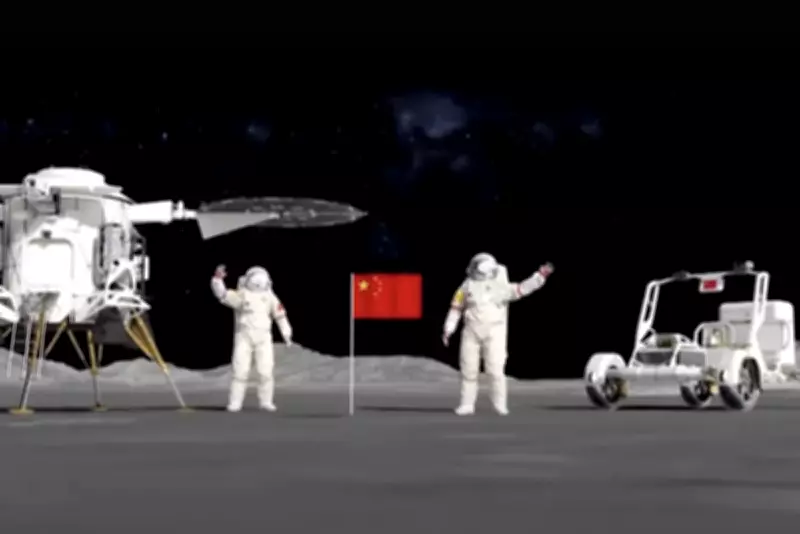
China has unveiled an AI-powered humanoid robot destined for lunar deployment as part of the upcoming Chang'e-8 mission in 2029. Developed by the Hong Kong University of Science and Technology (HKUST), the 100-kilogram (220-pound) robot is designed to serve as a porter, transporting and installing instruments at various lunar locations before a crewed landing.
The robot features a humanoid upper body with two arms mounted on a four-wheeled module equipped with solar panels. According to HKUST professor Gao Yang, the robot will land at a different part of the Moon's south pole compared to the planned Chang'e-7 mission, which is expected to carry the first humanoid robot to the lunar south pole. "We are curious about all of it," she told the South China Morning Post, adding that the onboard artificial intelligence will enable the robot to "identify and trace objects, allowing it to formulate a strategy before executing a task."
China's lunar ambitions
The China National Space Administration (CNSA) aims to send humans to the lunar surface by 2030, building on a series of ambitious space missions over recent decades. The Chang'e-8 robot is a key step in preparing for this crewed landing, as it will set up equipment and conduct preliminary surveys.

Competition with NASA
Meanwhile, NASA is targeting a crewed lunar return by 2028 under the Artemis IV mission, a timeline that has already shifted from an original 2024 goal due to technical challenges and development delays. The complexity of SpaceX's Starship Human Landing System (HLS), which requires orbital refueling—a feat never achieved at this scale—has raised concerns. Former NASA administrator Jim Bridenstine told a Senate Committee in September that the US could fall behind China. "Our complicated architecture requires a dozen or more launches in a short time frame, relies on very challenging technologies that have yet to be developed, like cryogenic in-space refueling, and still needs to be human rated," he said. "Unless something changes, it is highly unlikely the United States will beat China's projected timeline to the Moon's surface."
SpaceX's Starship has conducted only two test flights since Bridenstine's remarks, with the next test scheduled for later this month. The race to return humans to the Moon continues to intensify, with both nations pushing technological boundaries.