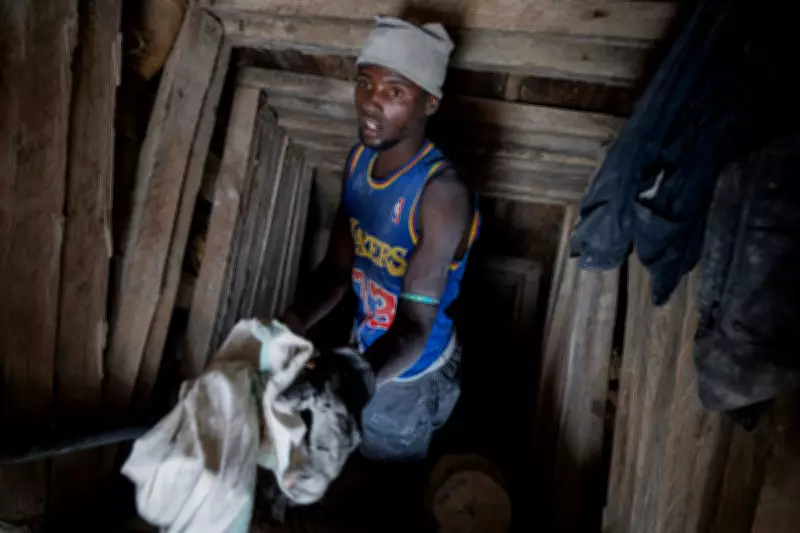
Far from the headlines about Iran, the global impact of Donald Trump's presidency will reverberate for decades to come. As The Independent reports from Rubaya, a town in the Democratic Republic of Congo where the administration is pursuing foreign mining interests, the fingerprints of this fortune-focused government are visible across the planet.
The Retreat from Traditional International Aid
Since the closure of the United States Agency for International Development last summer, reductions in overseas assistance budgets have cascaded through Western governments like falling dominoes. The United Kingdom represents just one of numerous relatively affluent nations gradually distancing itself from the United Nations-mandated target of allocating 0.7 percent of GDP toward development in the world's poorest countries.
Last week, the British foreign secretary indicated that UK aid would become significantly more concentrated on conflict zones such as Ukraine, Palestine, Lebanon, and Sudan, with savings redirected to bolster domestic defence spending. These represent retrograde steps, not merely from a moral standpoint but also in terms of what should constitute the self-interest of the wealthy global north.

The Forces Driving Migration and Displacement
Wars, droughts, famines, the escalating climate crisis, and a profound absence of economic opportunities serve as powerful drivers behind the waves of migration from Africa and Asia into Western nations. Current events demonstrate no foreseeable conclusion to such dislocations. Foreign policy and international assistance could accomplish substantially more to prevent these human tragedies, most of which impose the heaviest burden of supporting refugees upon typically underdeveloped countries nearest to where crises unfold.
This pattern has persisted throughout much of this century, which explains why The Independent is reporting from resource-rich central Africa about an alternative to the previous model of international aid. This approach is encapsulated in President Trump's mercenary declaration: "We're going to take out some of the rare earth and the assets, and pay. And everybody's going to make a lot of money."
The Congo Mining Deal and Regional Instability
Such an arrangement has been negotiated between the Trump administration, American mining interests, and Democratic Republic of Congo President Felix Tshisekedi. The DRC has experienced minimal stability since its hurried independence from Belgium in 1960, enduring nearly constant civil wars following the collapse of the Mobutu regime in 1994.
A similar situation prevails in neighbouring Rwanda, which supports the M23 rebel group controlling mines in the Rubaya area of eastern DRC. Nevertheless, these mines continue operating, generating substantial profits for those in control while providing considerably less for the miners themselves, who undertake highly perilous work, and for the broader populations of the DRC or Rwanda.
Trump's Global Resource Strategy
Over the past year, as reported, Mr Trump has threatened to acquire Greenland, which remains Danish territory, toppled Venezuela's president, and exploited Ukraine's conflict with Russia in attempts to secure similar access to raw materials demanded by modern American industries. His confrontation with Iran may temporarily hinder these efforts, but his strategic objective remains unchanged—he seeks to claim foreign mines as his own.
The Critical Importance of Coltan
Rubaya stands as a dominant producer of coltan, a substance essential for manufacturing electronic components in consumer products like smartphones and within defence industries, particularly drones. This single site accounts for approximately 30 percent of global supply, while the DRC collectively provides 80 percent of worldwide coltan. In today's world, such critical resources have become as vital as oil and natural gas.

It is only fair to acknowledge that commercial extraction and industrial development can potentially coexist with initiatives to provide clean water to communities or eradicate "neglected tropical diseases"—the type of work undertaken by the Gates Foundation, which also supports The Independent's journalism in this field. In southern DRC, this coexistence might be possible, but in the occupied, lawless eastern region, it is not. There appears to be no American funding dedicated to establishing peace in that area.
The Indispensable Role of Diplomacy
Diplomacy, the international community, and United Nations agencies clearly retain an indispensable role to play in this regard. The impact of Donald Trump's second term upon the world beyond America will be measured for decades. Already, it seems no region has remained untouched by the sweeping chaos and upheaval unleashed by this astonishing president.
With blind logic, he presents arguments that appear inarguable. From Iran to the DRC, he speaks in terms of prices and deals rather than human lives. There exists, naturally, a significant geopolitical dimension to this dynamic: the rivalry between the United States and China.
Geopolitical Competition with China
For decades, through initiatives like the Belt and Road, the Digital Silk Road, the Global Development Initiative, and other policies in emerging and developing economies, China has linked security of critical mineral supplies to diplomatic and security objectives. The West, meaning primarily America, has scarcely attempted to compete.
Under Donald Trump, whose mindset naturally aligns foreign policy with commercial gain, this situation has begun to change. The optimistic perspective envisions the United States, China, and possibly Europe competing to accelerate economic development in the global south, accompanied by proportional improvements in living standards for Earth's most vulnerable populations.
The Danger of Neo-Colonialism
The peril, unfortunately supported by substantial evidence, is that this new model of international development merely represents neo-colonialism. Or indeed, nihilism, entirely devoid of any values whatsoever. The mixed experience of the Democratic Republic of Congo strongly suggests that a more altruistic development model still has a role to play.
In this model, governments, charities, and non-governmental organizations remain vital to reducing poverty and promoting peace—while the media plays a crucial role in conveying these stories to the widest possible audiences.