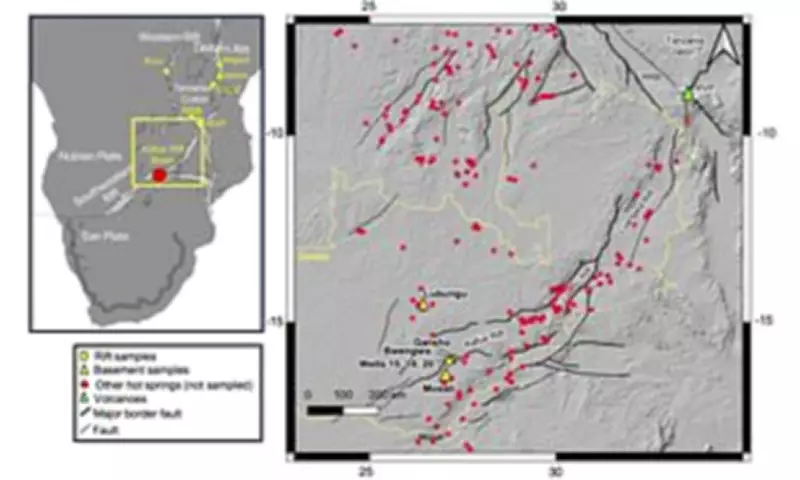
Scientists have discovered a new tectonic boundary forming beneath Zambia, and it could eventually tear Africa in two. The Kafue Rift is part of the Southwest African Rift System, a vast 1,500-mile (2,500 km) network of cracks in Earth's crust stretching from Tanzania to Namibia. Researchers believe this could one day become the edge of a new tectonic plate boundary, splitting Africa into the Nubian and Somali plates.
Evidence from Hot Springs
New research reveals that Earth's crust has cracked apart under the Kafue Rift. Gases in Zambia's hot springs contain helium and carbon isotopes that indicate the boundary has broken all the way through the Earth's outer layer. This crack allows fluids to escape from the hot, viscous mantle and bubble up to the surface.
Co-author Professor Mike Daly, from the University of Oxford, explains: 'This fluid connection is evidence that the fault boundary of the Kafue Rift is active. Therefore, the Southwest African Rift Zone is too – and may be an early indication of the break-up of sub-Saharan Africa.'

Isotope Analysis
Isotopes – different forms of elements – exist in varying concentrations in the crust and in the mantle below. Scientists can determine where liquids are emerging from based on the ratios of certain isotopes. In the new study, researchers took samples of gas from eight geothermal springs across Zambia: six in the Kafue Rift and two outside it.
They found that all gases inside the rift had unusually high levels of helium isotopes, matching those found within the mantle, while those outside the rift did not. Similarly, only samples from inside the rift valley had levels of carbon dioxide matching those found in mantle fluids. These gases could not have come from the air since the isotope ratios do not match the atmosphere, nor could they have originated from surrounding rocks.
Dr Daly says this indicates the springs have 'a direct connection with the Earth's mantle, which lies between 40 and 160 km below the Earth's surface.'
Geological Implications
Scientists had previously suspected that the Kafue Valley could hide a rift due to its topography and high number of geothermal anomalies. However, it is only now that researchers have evidence that the rift has truly broken through the crust.
In the short term, this could prove hugely beneficial to local economies by unlocking easily accessible geothermal power. While there might be some increases in seismic or volcanic activity in the future, these changes occur on such a long timescale that they pose no immediate threat.
On the geological scale, this development could prove even more important for Africa. Lead author Professor Ruta Karolyte, from the University of Oxford, told the Daily Mail: 'This rift is at the earliest recognisable stage. We can see the faults, measure the presence of mantle gases at the surface, but there is no volcanism yet. In geological terms, this is the very beginning of the process.'
Future Break-Up
For a rift to become a true plate boundary, the break must penetrate deep enough through the lithospheric mantle to trigger partial melting, producing mid-ocean ridge basalt. There is currently no guarantee that this will happen at the Kafue Rift, but researchers say it is a likely spot for the transformation to occur.
Africa is already splitting slowly along a more developed line of cracks called the East African Rift System. However, the rate at which these rifts are pulling apart is very slow. Dr Daly explains: 'On almost all sides of Africa there are mid-ocean ridges tending to inhibit east-west or north-south extension, so break-up and spreading does seem to struggle to establish itself.'
Nevertheless, the Southwest African Rift System has all the characteristics required to break away and much more favourable surrounding geology. This means that the formation of the Kafue Rift could be the first movements towards Africa splitting in two over the next few hundred million years.