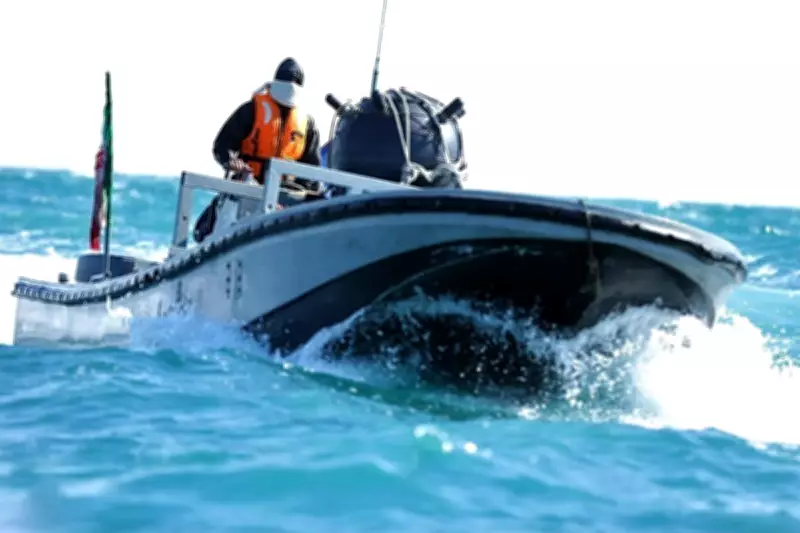
The United States renewed military strikes against Iran on Monday, targeting missile launch sites and boats it accused of laying mines in the Strait of Hormuz. US Central Command spokesperson Captain Tim Hawkins stated that the military “eliminated” two Islamic Revolutionary Guards Corps vessels observed deploying mines in the strategic waterway. Additionally, a surface-to-air missile site in Bandar Abbas was taken out. The Pentagon framed these operations as defensive measures aimed at “protecting our troops from threats posed by Iranian forces,” while US Secretary of State Marco Rubio insisted that the Strait must be opened “one way or the other.”
Background of the Conflict
Since the outbreak of war on 28 February, Iran has deployed small surface vessels to scatter mines across sections of the Strait of Hormuz, a critical maritime chokepoint that typically handles roughly one-fifth of global oil and liquefied natural gas trade. The mining campaign has effectively blocked at least 6,000 ships from transiting the strait. According to US officials who spoke to the New York Times last month, Tehran is unable to reopen the waterway because it cannot locate all its own mines and lacks the necessary equipment to remove them, leaving approximately 700 vessels stranded in the Gulf after three months.
British Involvement and Mine-Clearing Efforts
Hundreds of British sailors are currently stationed off the coast of Gibraltar aboard the RFA Lyme Bay, awaiting deployment for a mine-clearing mission to the Strait of Hormuz, though the operation remains uncertain. Commander Gemma Britton, who leads the Navy’s Mine and Threat Exploitation Group, told the Associated Press that Iran may have a “huge” variety of mines scattered across the strait. These could include rocket-propelled mines, cabled mines, or seabed mines triggered by sound, movement, or light. The immediate priority, she explained, is to clear a transit lane allowing trapped ships to exit, followed by a lane for inbound vessels. However, fully clearing the entire strait could take months or even years.

Iran's Mine Arsenal
Experts at the Strauss Center estimate that Iran possesses a stockpile of at least 2,000 mines, including Soviet, Western, and Iranian-made drifting and moored contact mines. The country is also believed to maintain a substantial collection of more advanced bottom and rising mines acquired from Russia, China, and North Korea. Mines are relatively inexpensive; a simple contact mine can cost as little as $1,500 (£1,123). Iran primarily deploys mines using frogmen on small boats resembling ordinary fishing vessels, forming an informal maritime militia that is nearly impossible to identify and neutralize, according to the Wall Street Journal.
Types of Iranian Mines
Iran’s Maham series forms a significant part of its naval arsenal. The Maham-2 mine can be deployed on the seabed at depths of 10 to 50 meters, targeting submarines and surface vessels with a 350-kilogram explosive charge and magnetic and acoustic sensors, per Collective Awareness to UXO (CATUXO). The Sadaf-02 mine sits just below the waterline and detonates on contact with a passing ship, containing about 114 kilograms of explosives. Limpet mines, such as the Maham 4, are attached to ships by frogmen using nail guns or magnets, operating at depths between one and 40 meters, with timers adjustable from 10 minutes to six hours for a large explosion.
Damage Caused by Sea Mines
The primary purpose of sea mines is to damage or sink ships and submarines through underwater explosions that breach hulls. Seabed mines create a pressure differential between an expanding gas bubble and the surrounding water, generating a void that collapses and produces damaging shock waves. Limpet mines detonate upon contact or when triggered by a ship’s acoustic or magnetic signature.

Mine Removal Techniques
Modern autonomous systems can scan the seabed and water column using sonar to locate mines in roughly half the time required by crewed vessels. Sea drones equipped with sonar produce images of underwater objects, from fishing traps to pipelines, which are then analyzed to identify mines. Advanced acoustic systems and cameras can further investigate suspicious targets, Commander Britton noted. Some systems aboard the RFA Lyme Bay can be loaded onto smaller autonomous vessels launched from the mother ship, reducing the number of personnel entering hazardous areas. Once a mine is located, a diver typically places an explosive charge and detonates it from a safe distance. However, the RFA Lyme Bay is trialing a remotely operated vehicle that can dive, place a charge near a mine, and detonate it remotely.