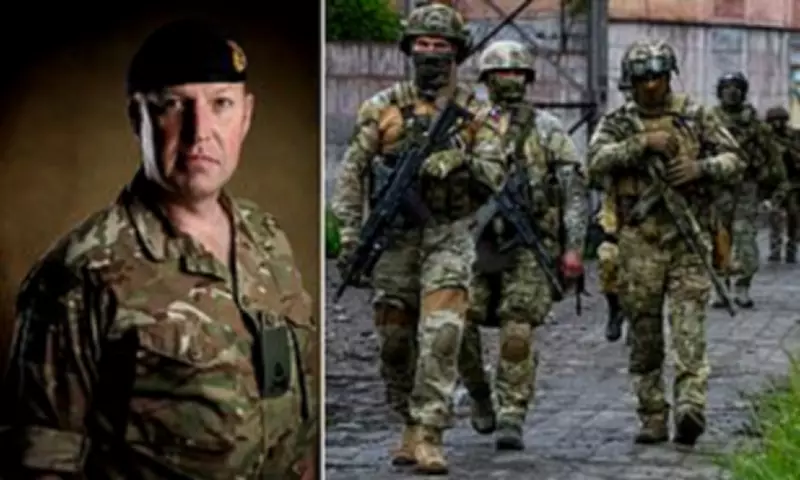
One of the UK's top army chiefs has warned that the Russian army is a 'formidable foe' and 'significantly more lethal' now than when Vladimir Putin invaded Ukraine. Lt Gen Mike Elviss, who commands a key NATO reactionary force, expressed concern that the British public do not realise the scale of the threat posed by Putin, unlike Russia's neighbours who are more aware of the danger.
NATO's readiness questioned
The general, head of the UK headquartered Allied Rapid Reaction Corps (ARRC), stated that NATO would currently not be able to withstand a Russian incursion, although he noted Russia is not yet in a position to launch one. His warning came after the Daily Mail revealed that Britain's supply of drones would be exhausted within a week if Russia invaded NATO territory.
Learning from Ukraine
Lt Gen Elviss emphasised that AI and technology are now crucial in defence to win against any adversary. He explained that his force is learning rapidly from the war in Ukraine, which has 'battle-hardened and battle-tested' Putin's forces over four years of industrial-level conflict. The ARRC, one of NATO's two emergency response forces, comprises 60,000 British, Italian, Canadian, and Swedish soldiers at full deployment.

Since a major restructure last month, the British Army's military capability has come under ARRC command at its HQ near Gloucester, making Lt Gen Elviss the de facto boss of the British Army. 'I have the lion's share of the fighting force under command bar those small elements such as special forces,' he told The Telegraph.
Underground headquarters
Lt Gen Elviss has deployed expert military planners to analyse Putin's war machine from disused London Underground tunnels, simulating a protected command post. He explained that such subterranean 'digital headquarters' are necessary for protection against ballistic missiles and for survival, replacing traditional HQs that would be 'prime targets for missiles and drones'. He stressed the need to be 'as close as reasonably possible to the threat'.
AI in decision-making
Having studied what has worked 'against all the odds in Ukraine', he said: 'You need artificial intelligence in your decision-making if you're going to decide and act faster than an adversary.' He believes that while Russia and Putin are not ready to start the next round of conquest further west, their declarations should be taken 'at face value'. 'Vladimir Putin has always coveted Kyiv. He said as much. He invaded. He said the same about other places. We have to be worst case planners in the military,' he added.
Public awareness
Lt Gen Elviss noted that nations like Sweden, Finland, and Estonia are 'really clear eyed' about the danger, but stressed the UK could 'ill afford' to lose the 'race to reorientate' when the Ukraine war ends. He warned that the political argument for defence 'had not been won' and should be a 'central element' in politics, as the public's understanding of the threat has not caught up.
Defence sources confirmed to the Daily Mail that British soldiers are chronically ill-equipped to respond to a Russian invasion. The UK spends only 2.6% of GDP on defence, with Labour promising to lift this to 3% by the next Parliament, while Poland spends 4.48% and Lithuania 4%. Last year's Strategic Defence Review emphasised the immediacy of the Russian threat, but detailed plans to enact recommendations have not been released.