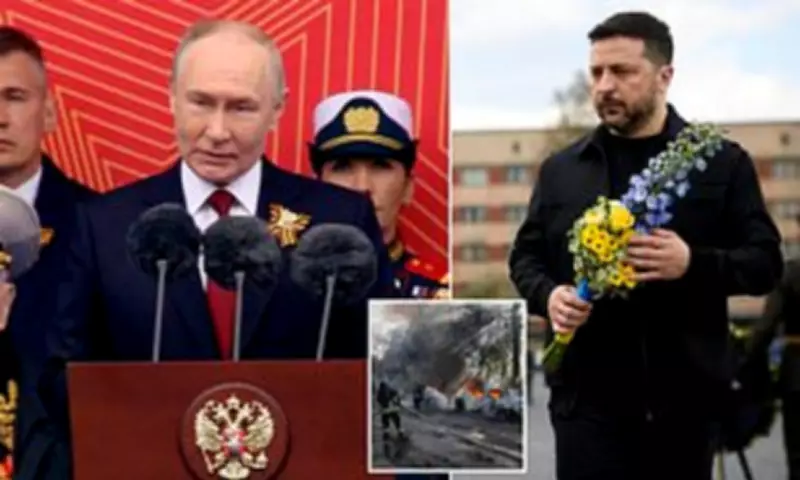
Vladimir Putin has claimed the war in Ukraine is 'coming to an end' after insisting Russia is fighting for a 'just cause' against the West. The comment came after Moscow hosted a considerably scaled-back military parade on Saturday, marking the Soviet victory in World War Two.
Putin's Victory Day Remarks
Speaking at the parade, in front of reporters and foreign leaders, the Russian President said: 'I think that the matter is coming to an end'. Just hours earlier, however, Putin had used his Victory Day speech to justify the conflict. In that speech, he said his country was fighting a 'just' war and called Ukraine an 'aggressive force' that was being 'armed and supported by the whole bloc of NATO'.
His remarks came days after it was revealed that more than 350,000 Russian troops had been killed while fighting in the four-year war. Later, when questioned at a news conference about the West helping Ukraine, Putin said: 'They (West) promised assistance and then began fuelling a confrontation with Russia that continues to this day'. Yet he went on to add: 'Victory has always been and will be ours. The key to success is our moral strength, courage and valour, our unity and ability to endure anything and overcome any challenge'.

Ceasefire and Meeting Conditions
The president also confirmed that he would only meet Ukraine's President Volodymyr Zelensky once a lasting peace deal was agreed to. 'A meeting in a third country is also possible, but only after a peace treaty aimed at a long-term historic perspective is finalised,' Putin told reporters. 'This should be a final deal, not the negotiations.' Putin said he had heard that Zelensky was ready to hold a personal meeting, but added, 'this is not the first time we have heard such statements'.
Scaled-Back Parade Amid Security Fears
The comments came as Russia celebrated its annual Victory Day in Moscow, in what is the country's largest military parade. However, this year, for the first time in almost two decades, the parade took place without tanks, missiles and other heavy weapons, aside from a traditional flyover of combat jets. This was due to fears that Ukraine might have targeted Russia's Red Square with drones. Russian officials added that the sudden and drastic change of format was due to the 'current operational situation', pointing the finger at the threat of a Ukrainian attack.
There were far fewer journalists at the event, with many international media organisations not being granted access. And authorities also ordered restrictions on all mobile internet access and text messaging services in the Russian capital on Saturday. For the first time, Saturday's parade also featured troops from North Korea, a tribute to Pyongyang that sent its soldiers to fight alongside Moscow forces to repel a Ukrainian incursion into Russia's Kursk region.
Foreign Leaders Attend Amid Controversy
Malaysia's King Sultan Ibrahim Iskandar, Laos President Thongloun Sisoulith, Kazakhstan's President Kassym-Jomart Tokayev, Uzbekistan's President Shavkat Mirziyoyev and Belarus' authoritarian leader Alexander Lukashenko attended the festivities in the Russian capital. Putin hailed the foreign guests who attended the parade for 'personal courage,' noting that they had decided to come to Moscow before the ceasefire brokered by Trump defused security concerns.
Putin told reporters after the parade that it didn't feature heavy weaponry because the military needs it on the battlefield in Ukraine. A last-minute ceasefire between Moscow and Kyiv, brokered by US President Donald Trump, however, reduced the danger of any attack, and the parade passed off without incident.
Trump-Brokered Ceasefire
Russia declared a unilateral ceasefire for Friday and Saturday, while Zelenskyy announced a truce that was supposed to begin on May 6, but neither held as the parties traded blame for continuing attacks. Fears about the festivities' security eased Friday, when Trump announced that Russia and Ukraine have bowed to his request for a ceasefire running Saturday through Monday and an exchange of prisoners, declaring that the break in fighting could be the 'beginning of the end' of the war.

Zelensky, who said earlier this week that the Russian authorities 'fear drones may buzz over Red Square' on May 9, followed up on Trump's statement by declaring Red Square temporarily off-limits for Ukrainian strikes and mockingly permitting Russia to hold its Victory Day celebrations on Saturday, a move that the Kremlin shrugged off as a 'silly joke.'
Putin told reporters after the parade that Trump offered to broker a ceasefire after Russia informed the US and others that it would launch a massive missile strike on the centre of Kyiv, fraught with collateral damage if Ukraine attempts to disrupt Saturday's festivities. 'We just described the situation to our friends, colleagues and partners: We don't have any intention to exacerbate or worsen relations with anyone, but it could happen because all control and decision-making centres in Kyiv are located close to diplomatic missions,' Putin said. 'When we started such a dialogue with the US administration, we warned them about this, pointed out the possible consequences and asked them to do everything necessary to ensure the security of their diplomatic mission.'
He noted that Russia immediately welcomed Trump's offer, which was driven by humanitarian motives and 'respect to our common victory over Nazism.' Trump also took to his Truth Social platform to confirm a ceasefire deal had been reached. 'I am pleased to announce that there will be a three day ceasefire (May 9th, 10th, and 11th) in the War between Russia and Ukraine,' Trump wrote. 'The Celebration in Russia is for Victory Day but, likewise, in Ukraine, because they were also a big part and factor of World War II.'
The President stated that the ceasefire will halt all military operations and include a 1,000-prisoner swap from each country. Russia reportedly holds upwards of 7,000 Ukrainian soldiers as prisoners of war, while Ukraine has captured 4,000 Russians. 'This request was made directly by me, and I very much appreciate its agreement by President Vladimir Putin and President Volodymyr Zelenskyy,' Trump added. Trump said he hopes the ceasefire will help bring an eventual end to a 'very long, deadly' war, adding, 'talks are continuing on ending this major conflict, the biggest since World War II, and we are getting closer and closer every day.'
Historical Context and International Reactions
Putin has used Victory Day celebrations to encourage national pride and underline Russia's position as a global power. The Soviet Union lost 27 million people from 1941 to 1945 in what it calls the Great Patriotic War. This enormous sacrifice left a deep scar in the national psyche and remains a rare point of consensus in the nation's divisive history under Communist rule.
Prime Minister Robert Fico of Slovakia, a European Union member, laid flowers at the Tomb of the Unknown Soldier memorial just outside the Kremlin walls but did not attend the Red Square parade. German Chancellor Friedrich Merz criticised Fico's trip, saying: 'I deeply regret this, and we will discuss his visit to Moscow with him.' Speaking at a meeting with Putin in the Kremlin, Fico bemoaned what he called a new 'Iron Curtain' in Europe that hampered trade, and emphasised the importance of Russia's energy supplies to Slovakia. Putin hailed the Slovak leader for conducting a 'sovereign' foreign policy and honouring the memory of fallen Red Army soldiers.