

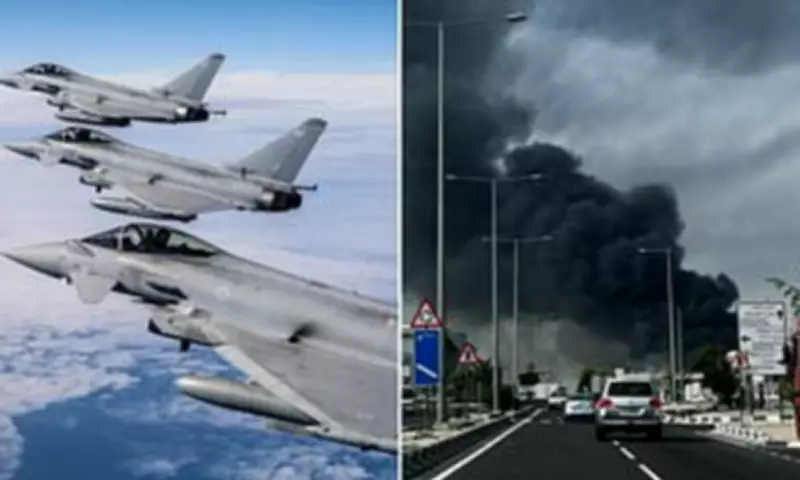
RAF Typhoon Engages and Destroys Iranian Drone Over Qatari Airspace
In a significant defensive operation, a Royal Air Force Typhoon fighter jet has successfully shot down an Iranian drone that was heading towards Qatari territory. This engagement, which occurred on 1 March 2026, represents the first confirmed takedown of an Iranian drone by a British fighter aircraft since the United States and Israel initiated military strikes against Iran over the weekend, sparking a wave of furious retaliation from Tehran.
Defensive Patrol Ensures Regional Security
The Ministry of Defence has confirmed that the RAF Typhoon was operating from Qatar as part of the joint UK-Qatar Typhoon Squadron. While conducting a defensive air patrol, the jet utilised an air-to-air missile to neutralise the incoming drone, thereby safeguarding Qatar's airspace and protecting British interests in the region. In an official statement, the MoD emphasised that "our Armed Forces are playing a vital role to protect our people, our interests and our Allies."
This action underscores the UK's commitment to regional stability, even as the nation has explicitly stated it did not participate in the initial US and Israeli strikes against Iran. British military assets, including F-35B fighter jets, have been actively involved in defensive operations from bases in Qatar and Cyprus.

Political Context and Evacuation Plans
The drone incident unfolds against a backdrop of escalating conflict. The US and Israeli strikes, described as pre-emptive actions aimed at halting Iran's nuclear ambitions, resulted in the death of Iran's Supreme Leader, Ayatollah Ali Khamenei. Iran has since launched retaliatory missile and drone attacks across the Middle East, targeting locations in Israel, Gulf states, and areas with significant Western expatriate populations.
In response to the deteriorating security situation, the UK government is preparing an unprecedented evacuation operation. Authorities are urging British nationals in the region to register their presence with the Foreign Office online. Already, a record 76,000 individuals have signed onto the service, predominantly from the United Arab Emirates. The government is advising against all but essential travel to Kuwait, Qatar, Bahrain, and the UAE, while warning against all travel to Iran.
Diplomatic Stance and Regional Fallout
Defence Secretary John Healey has faced scrutiny over the UK's position regarding the US-led strikes. In multiple interviews, he declined to explicitly state whether Britain supports the American and Israeli military action or considers it legal. Instead, he reiterated that the UK "played no part" in the offensive operations and stated it was incumbent upon the US to articulate the legal basis for its actions.
Meanwhile, the leaders of the UK, France, and Germany—collectively known as the 'E3'—issued a joint statement condemning Iran's retaliatory strikes. They notably pointed out that their nations "did not participate" in 'Operation Epic Fury' and called for the Iranian regime to pursue a negotiated solution to the crisis.
Widespread Disruption and Casualties
The conflict has caused severe disruption to global travel, with nearly 6,000 flights cancelled and approximately 30,000 delayed as airspaces across the Middle East remain closed. Iranian strikes have reportedly targeted critical infrastructure, including airports in Dubai and Abu Dhabi, as well as high-profile landmarks like the Burj Al Arab and Palm Jumeirah hotels.
Civilian casualties have been reported in several locations. At least ten people have been killed in Israel, three American troops have been confirmed dead, and there has been at least one fatality in Kuwait. The Iranian regime has vowed to continue its offensive, promising "devastating blows" and an intensity of force previously unseen by its adversaries.
As the situation remains volatile, the RAF's successful interception near Qatar highlights the ongoing defensive efforts to contain the conflict and protect allied interests amidst a rapidly evolving and dangerous regional crisis.






