

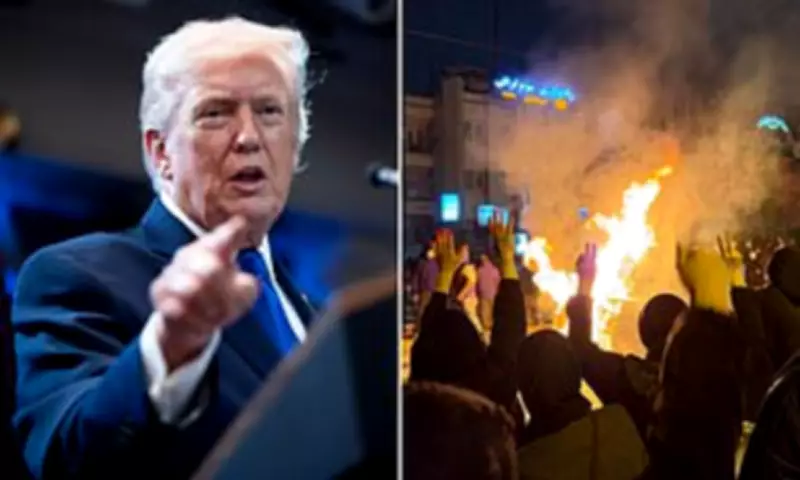
US Military Planning for Iran Reaches Advanced Stage Amid Trump Threats
Military planning by the United States for potential action against Iran has progressed to an advanced stage, with officials indicating that Donald Trump could target individual leaders and pursue regime change in the Islamic Republic. Two US officials have warned of the military's potential next steps in Tehran if Trump authorises military intervention, heightening fears of a wider conflict in the Middle East.
Trump's Ultimatum and Military Buildup
This warning follows Trump's recent ultimatum to Tehran, giving them a deadline of 10 to 15 days to negotiate a deal resolving their longstanding nuclear dispute or face what he described as 'really bad things.' The threat comes amid a significant US military buildup in the region, which has stoked concerns about escalating hostilities. When questioned on Friday about considering a limited strike to pressure Iran into an agreement, Trump told reporters at the White House, 'I guess I can say I am considering it.' He later emphasised, 'They better negotiate a fair deal.'
Diplomatic Efforts and Counterproposals
In response, Iran's foreign minister, Abbas Araqchi, stated on Friday that he expects to have a draft counterproposal ready within days after nuclear talks with the United States this week. Following indirect discussions in Geneva with Trump's Special Envoy Steve Witkoff and son-in-law Jared Kushner, Araqchi noted that the sides had reached an understanding on main 'guiding principles,' but cautioned that this does not mean a deal is imminent. In an interview on MS NOW, he mentioned that a draft counterproposal could be ready in two or three days for top Iranian officials to review, with further US-Iran talks possible in about a week.

Araqchi warned that military action would complicate efforts to reach a diplomatic agreement. He clarified that during the Geneva talks, the United States did not demand zero uranium enrichment, and Iran did not offer to suspend enrichment. Instead, discussions focused on ensuring Iran's nuclear program, including enrichment, remains peaceful indefinitely. He added that technical and political 'confidence-building measures' would be enacted in exchange for action on sanctions, though details were not provided.
Human Rights Concerns and Trump's Statements
Trump also addressed human rights issues, asserting a distinction between the people of Iran and its leadership. He claimed that '32,000 people were killed over a relatively short period of time,' figures that could not be immediately verified. Describing it as a 'very, very, very sad situation,' Trump stated that his threats to strike Iran had deterred the leadership from plans for mass hangings two weeks ago, saying, 'They were going to hang 837 people. And I gave them the word, if you hang one person, even one person, that you're going to be hit right then and there.'
In contrast, the US-based group HRANA, which monitors human rights in Iran, has recorded 7,114 verified deaths and is reviewing another 11,700 cases. Hours after Trump's statements, Araqchi responded that the Iranian government has published a 'comprehensive list' of all 3,117 killed in the unrest, challenging critics to provide evidence if they doubt the data.
International Reactions and Ongoing Tensions
The White House reiterated its stance, stating, 'The president has been clear that Iran cannot have nuclear weapons or the capacity to build them, and that they cannot enrich uranium.' Meanwhile, United Nations spokesperson Stephane Dujarric expressed concerns about heightened rhetoric and increased military activities in the region, urging both the United States and Iran to continue diplomatic engagement to settle differences.
This escalation follows previous military actions, including US and Israeli bombings of Iran's nuclear facilities and some military sites in June, after which Trump renewed threats of strikes in January as Tehran suppressed widespread protests with deadly force. The situation remains volatile, with ongoing protests in Iran and international demonstrations, such as a march from Whitehall to the Iranian Embassy in London, calling for regime change amid reports of hundreds killed and thousands detained in the uprising against Supreme Leader Ayatollah Ali Khamenei's rule.






