

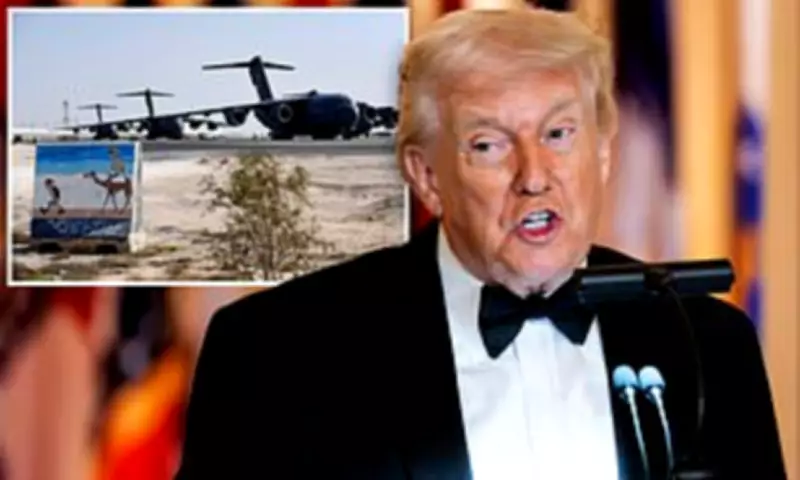
US Troops Relocated from Qatar Base Amid Escalating Iran Tensions
American military personnel have reportedly been relocated from a major military installation in Qatar as tensions between the United States and Iran continue to escalate. This development comes alongside increasing calls from prominent US politicians for military action against the Middle Eastern nation.
Military Movements and Strategic Positioning
Multiple reports indicate significant military movements across the Middle East as the possibility of conflict with Iran grows. US officials confirmed to ABC News that hundreds of personnel stationed at a base in Qatar were being relocated ahead of potential military action. While the exact base wasn't specified in initial reports, the primary US military facility in Qatar is the strategically important Al Udeid Air Base.
Satellite imagery and flight tracking data have revealed substantial military buildup across the region. At the Muwaffaq Salti Air Base in Jordan, surveillance identified approximately sixty aircraft, including at least sixty-eight cargo planes, multiple drones, helicopters, advanced F-35 stealth jets, and newly deployed air defense systems. These movements suggest extensive preparation for potential conflict scenarios.

Political Pressure for Military Action
South Carolina Senator Lindsey Graham, a longtime ally of former President Donald Trump, has publicly called for military strikes against Iran. In statements to Axios, Graham acknowledged concerns about military entanglements in the Middle East but argued against what he termed "letting evil go unchecked."
"I understand concerns about major military operations in the Middle East given past entanglements," Graham stated. "However, the voices who counsel against getting entangled seem to ignore the consequences of letting evil go unchecked."
The senator has been particularly vocal in his criticism of the Iranian regime, recently describing Supreme Leader Ayatollah Ali Khamenei as "a religious Nazi" who seeks to "purify Islam, destroy the Jewish people and come after the United States." Graham made these remarks during a speech in Munich, Germany, where he expressed solidarity with those demanding regime change in Iran.
Diplomatic Context and Nuclear Concerns
The escalating tensions occur against a backdrop of failed nuclear negotiations between the US and Iran. Indirect talks in Geneva last week reportedly concluded without meaningful progress, despite Iran's continued denial of motivations to develop nuclear weapons. The Islamic Republic maintains its right to enrich uranium, which serves as the primary fuel for nuclear power generation.
Former President Donald Trump has strongly hinted at military action to compel Iran to negotiate, telling reporters he was "considering" such measures. However, Trump has appeared somewhat ambivalent publicly, refusing to commit definitively to either diplomatic or military approaches.
Regional Diplomacy and Economic Implications
Senator Graham recently completed a diplomatic tour of the Middle East, meeting with officials in Israel, the United Arab Emirates, and Saudi Arabia to discuss the Iranian situation. Following these meetings, Graham praised Saudi Crown Prince Mohammed bin Salman and UAE President Mohamed bin Zayed Al Nahyan on social media, indicating strengthened alliances against Iranian influence.
During a press briefing in Tel Aviv, Graham suggested that decisions regarding action against Iran were imminent, stating that the timeline was "weeks, not months away."
The geopolitical uncertainty has already impacted global markets, with the Brent crude oil benchmark experiencing significant price spikes over recent days. While Iran accounts for less than three percent of global oil production, the country controls the strategically vital Strait of Hormuz, through which approximately twenty percent of the world's oil supply passes. Market analysts interpret the oil price surge as an indicator of anticipated military action.

Military Capabilities and Potential Responses
Reports indicate that approximately thirty-five thousand US troops have been stationed across the Middle East ahead of potential military action. This substantial force includes the advanced USS Gerald Ford aircraft carrier, one hundred cargo planes, numerous fighter jets, and the formidable USS Abraham Lincoln strike group.
Iranian officials have issued stern warnings in response to the escalating situation, promising "decisive" retaliation if their nation is attacked. The country has demonstrated military capabilities through recent joint naval exercises with Russia near the strategic Strait of Hormuz, simulating rescue operations for hijacked vessels.
As negotiations are expected to continue despite the heightened tensions, the international community watches closely, aware that any military action could have far-reaching consequences for regional stability and global energy markets.





