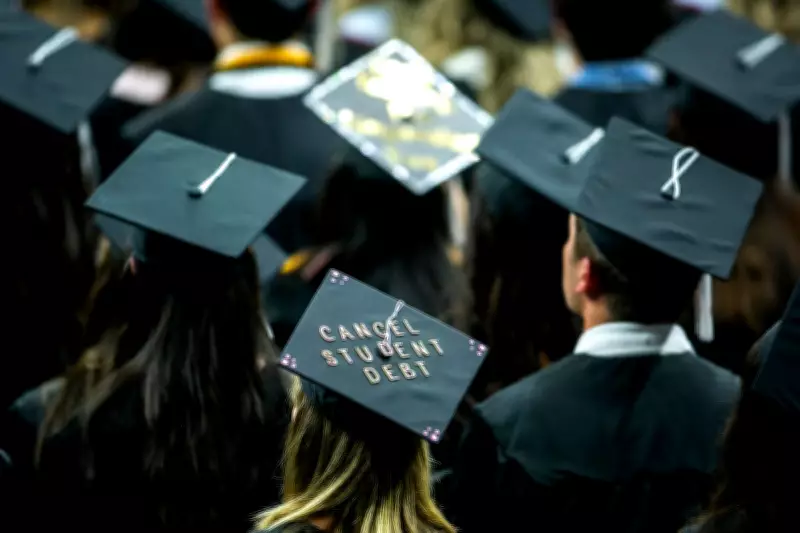
Graduate Discovers Student Debt Ballooning Despite Minimal Repayments
When Bryony Gooch finally mustered the courage to check her student finance account, she was confronted with a staggering reality. Her debt, which stood at £84,541.66 upon graduation in 2022, had inexplicably swollen to £87,264.76 despite her having repaid just £310. This eye-watering increase of £2,700, driven entirely by accumulating interest, has left her and millions of other graduates questioning the fairness of the current student loan system.
The Plan 2 Loan Trap
Gooch finds herself among the millions ensnared by the controversial Plan 2 student loan scheme, widely regarded as the most punitive of the five available plans. Introduced in 2012, Plan 2 loans carry an interest rate pegged to the Retail Prices Index plus up to three percent, with the rate escalating as graduates earn more. Repayments are set at nine percent of earnings above a specific threshold, which was recently frozen at £29,385 for three years instead of rising with inflation.
"I knew my debt was vast when I graduated," Gooch explains, "but seeing it grow despite my payments is demoralising." Her experience is far from unique, with the average graduate now leaving university burdened by approximately £53,600 in debt.

Experts Urge Calm Amid Systemic Concerns
Despite the alarming numbers, financial experts are advising graduates not to panic. Kate Ogden, an economist at the Institute for Fiscal Studies, emphasises that the student loan system was deliberately designed with non-repayment in mind for many borrowers. "These are not like normal loans," she states. "It was fully expected that a large proportion of people would not fully repay. The system is structured so that higher-earning graduates subsidise those on lower incomes."
Government forecasts suggest that around 56 percent of full-time undergraduates starting in 2024/25 will repay their loans in full, more than double the 32 percent predicted for the 2022/23 cohort, thanks to recent reforms. However, this offers little comfort to current graduates struggling under the weight of existing debt.
Impossible Repayment Scenarios
Analysis conducted with the Centre for Social Justice reveals the near-impossibility of clearing Plan 2 debt for most graduates. To pay off her £87,264.76 debt before the 30-year write-off point, Gooch would need a starting salary of £68,346—almost triple the average graduate starting salary and significantly above the UK average of £39,039. To clear the debt within five years would require an astronomical salary of £207,773, placing her in the top one percent of UK earners.
Modelling from the CSJ illustrates three typical graduate scenarios:
- A minimum wage earner would repay just £899.17 before their loan is written off at £139,056
- A graduate starting on the median salary of £24,800 would repay £3,077.38, with the loan written off at £168,545
- Even a graduate progressing through median salary bands would repay £45,404.41 before the remaining £177,512 is written off
"The repayment terms in the bloated student loans system are bonkers," declares Dan Lilley, head of youth at the Centre for Social Justice. "They are just one of many indications that our education system needs wholesale rewiring."
Calls for Systemic Reform and Better Education
The growing student debt crisis has sparked widespread calls for reform. Protesters have accused the government of acting like "loan sharks," while financial expert Martin Lewis has joined demands for improved financial education in schools and universities. "Even after all these years we still, tragically, educate many of our youth into what we call a debt, but never educate them about debt," Lewis lamented in a recent post.
John Webb, head of consumer affairs at Experian, echoes this concern: "Many young people commit to complex, long-term student loans at 18 without fully understanding how interest builds or how repayments work. We've made progress on financial education in schools, but it's nowhere near enough."

Lilley suggests that greater investment in apprenticeships could provide a viable alternative, noting that apprentices typically earn around £5,000 more than graduates five years after qualifying while avoiding substantial debt.
Government Response and Future Outlook
A government spokesperson defended the current system, stating: "We inherited the student loans system, including Plan 2, from the previous government. Threshold freezes have been introduced to protect taxpayers and students now, alongside future generations. The system protects lower-earning graduates, with repayments based on income and loans being cancelled at the end of repayment terms."
Despite these assurances, the education secretary has only committed to "look at" Plan 2 loans without promising substantive changes. As graduates like Gooch continue to watch their debts grow despite making payments, pressure mounts for a fundamental reassessment of how higher education is funded in the UK.
Ogden offers a sobering perspective: "Many people can still expect to repay a substantial amount towards these loans. Even if they don't fully repay them, they are likely to have paid back thousands of pounds over the next few decades. These repayments will affect people's living standards and take-home pay." For millions of graduates, student debt represents not just a financial burden, but a long-term constraint on their economic mobility and quality of life.