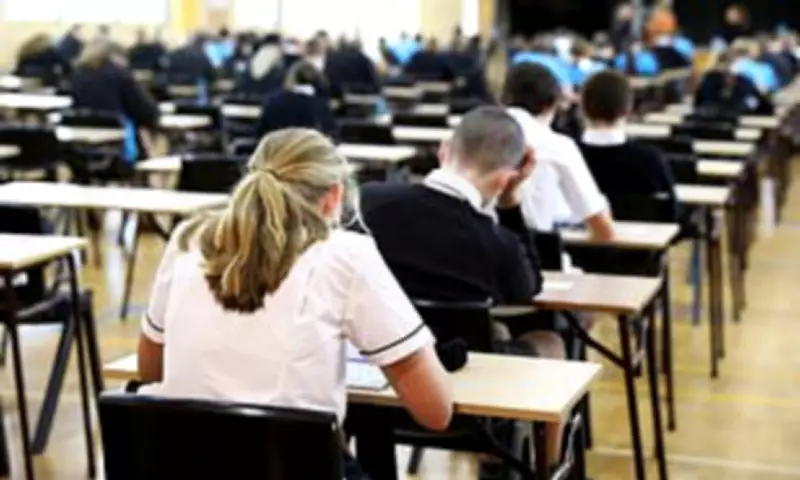
Labour Extends Covid Exam Aids Until 2030 Amid 'Dumbing Down' Accusations
The Labour government has ignited a fierce political row by announcing that Covid-era exam prompts for GCSE maths and science will be retained until at least 2030. This decision has drawn sharp criticism from opposition figures, who accuse the party of being 'hell-bent on dumbing down' school standards across the country.
Pandemic Measures Become Permanent Fixture
Originally introduced during the pandemic to assist pupils whose education was severely disrupted by lockdowns in 2020 and 2021, the memory aids provide students with formula and equation sheets during their exams. The initial intention was always to return to normal arrangements, but it has now been confirmed that this will not occur for at least another four years, extending potentially until 2030 or 2031.
This means that pupils are continuing to take less challenging tests that were originally designed as a temporary measure for those affected by cancelled lessons. Shadow Education Secretary Laura Trott launched a scathing attack, stating: 'Labour are hell-bent on dumbing down school standards in this country. They fail to understand we should believe all children can do better, not lowering the bar. It will be the most disadvantaged that will suffer and that will be the legacy of this Prime Minister.'

Policy Reversal Under Labour Government
Equation and formula sheets have been provided for GCSE maths, physics, and combined science exams since 2022. In 2023, the previous Conservative government declared that these sheets would be scrapped in the future as part of a broader return to rigorous assessment standards.
However, after Labour came to power the following year, Education Secretary Bridget Phillipson announced that the sheets should remain until 2027. Her justification at the time centered on the pandemic's 'continued impact' on students who had 'missed out on vital years of education.'
Now, schools minister Georgia Gould has requested that the education watchdog, Ofqual, extend this provision for the entire lifetime of the current GCSE specifications, subject to consultation. In response, Ofqual chief regulator Sir Ian Bauckham indicated that the change would apply 'up to and including 2030 or 2031.'
Broader Educational Reforms and Historical Context
From 2030 onwards, students will be taking exams under Labour's newly reformed curriculum, and ministers are still deliberating whether exam prompts will be included in these future assessments. Other proposed changes include reducing overall GCSE exam time by approximately two-and-a-half to three hours for the average student.
In her formal letter to Sir Ian, Mrs Gould wrote: 'For the lifetime of the current GCSE specifications in these subjects, students should not be required to memorise formulae and equations for assessment purposes. Students will continue to be expected to understand and use these formulae and equations, maintaining high standards for what students must study.'
It is noteworthy that pupils sitting their GCSE exams next year would have been only eight or nine years old in 2020 when schools first closed due to lockdowns. This decision comes after the Conservatives spent fourteen years implementing reforms to make the GCSE curriculum and exams more rigorous, spearheaded by former education secretary Michael Gove.
The Tories argued that under New Labour, a 'prizes for all' culture had developed, leading to significant grade inflation and a perceived dumbing down of educational standards. Their reforms included making the curriculum more challenging, renewing the focus on examinations, incentivising schools to encourage pupils to take harder subjects, and introducing a new system at Ofqual specifically designed to prevent grade inflation.
The current debate highlights deep ideological divides over educational philosophy and the long-term impact of pandemic-era policies on national standards.